




Bank of Japan (BoJ) Governor Kazuo Ueda is addressing the press conference, explaining the reason behind leaving the key interest rate unchanged at 0.75% in the January policy meeting.
BoJ press conference key highlights
Japan’s economy is recovering moderately.
Japan’s economy is likely to continue moderate growth.
Government economic package boosted economic outlook.
Underlying inflation will keep rising moderately.
Takata and Tamura proposed revisions to the outlook report.
Will keep raising rates if the economic outlook is realized.
Lending rates linked to BoJ rate are already rising.
Conditions remain accommodative after December hike.
FX is affected by various factors.
Will refrain from commenting on Yen level.
I will keep watching FX closely.
Bond yields are rising very rapidly.
BoJ to conduct bond operations nimbly in exceptional cases.
We may conduct operations to encourage stable yield formation.
Underlying inflation getting closer to 2%.
It’s possiblethe Yen is impacting prices more.
We need to give more attention to FX.
Long yields affected by end of fiscal year factor.
April price behavior is a factor to mull over rate hike.
Economic Indicator
BoJ Interest Rate Decision
The Bank of Japan (BoJ) announces its interest rate decision after each of the Bank’s eight scheduled annual meetings. Generally, if the BoJ is hawkish about the inflationary outlook of the economy and raises interest rates it is bullish for the Japanese Yen (JPY). Likewise, if the BoJ has a dovish view on the Japanese economy and keeps interest rates unchanged, or cuts them, it is usually bearish for JPY.
Read more.
Next release:
Thu Mar 19, 2026 03:00
Frequency:
Irregular
Consensus:
–
Previous:
0.75%
Source:
Bank of Japan
The section below was published on January 23 at 3:35 GMT to cover the Bank of Japan’s monetary policy announcements and the initial market reaction.
The Bank of Japan (BoJ) board members decided to maintain the short-term interest rate at 0.75%, following the conclusion of the two-day monetary policy review meeting on Friday. This decision was widely anticipated.
That leaves borrowing costs at the highest level in three decades.
Takeaways from the BoJ’s policy statement
Japan’s economy likely to continue recovering moderately.
Consumer inflation likely to gradually accelerate.
Mechanism in which wages, inflation rise in tandem to be sustained.
Output gap likely to improve as trend, expand moderately.
Medium-, long-term inflation expectations likely to continue rising moderately.
No big imbalance seen in japan’s financial activity.
Japan’s financial system stable as a whole.
Moves to reflect wages in selling prices could strengthen to a greater extent than expected.
Recent rise in food prices, such as rice prices, largely reflects temporary supply-side factors.
Uncertainties remain over the outlook for the global economy, such as the impact of trade policies, which could lead to a rise in import prices from the supply side.
Trade policies announced so far could push down the global economy.
With regard to the US Economy, attention is warranted on factors such as the impact of tariffs on employment and income formation through deterioration in corporate profit.
There remain high uncertainties over Chinese economy surrounding the future pace of growth.
If import prices were to rise significantly, households’ defensive attitude toward spending could strengthen further.
Trade policies announced so far could trigger a change in the trend of globalisation.
Board’s real GDP fiscal 2025 median forecast at +0.9% vs +0.7% in Oct.
Board’s real GDP fiscal 2026 median forecast at +1.0% vs +0.7% in Oct.
Board’s real GDP fiscal 2027 median forecast at +0.8% vs +1.0% in Oct.
BoJ’s quarterly Outlook Report
Board’s core consumer price index fiscal 2025 median forecast at plus 2.7 percent compared with plus 2.7 percent in October.
Board’s real GDP fiscal 2025 median forecast at plus 0.9 percent versus plus 0.7 percent in October.
Real interest rates are at significantly low levels.
Risks to economic outlook roughly balanced.
Impact of FX volatility on prices has increased compared to past as firms have become more active in raising prices and wages.
Core consumer inflation likely to slow to below 2% throughout first half of this year.
Actions to reflect wages in selling prices could strengthen more than expected.
Japan economy likely to continue recovering moderately.
Market reaction to the BoJ policy announcements
USD/JPY extends gains toward 158.60 in an immediate reaction to the Bank of Japan’s (BoJ) rates on hold decision, adding 0.11% on the day.
Japanese Yen Price Today
The table below shows the percentage change of Japanese Yen (JPY) against listed major currencies today. Japanese Yen was the weakest against the Australian Dollar.
| USD | EUR | GBP | JPY | CAD | AUD | NZD | CHF | |
|---|---|---|---|---|---|---|---|---|
| USD | 0.06% | 0.05% | 0.30% | -0.01% | -0.18% | -0.02% | 0.08% | |
| EUR | -0.06% | -0.01% | 0.22% | -0.07% | -0.24% | -0.08% | 0.02% | |
| GBP | -0.05% | 0.01% | 0.26% | -0.06% | -0.23% | -0.07% | 0.03% | |
| JPY | -0.30% | -0.22% | -0.26% | -0.29% | -0.47% | -0.31% | -0.20% | |
| CAD | 0.00% | 0.07% | 0.06% | 0.29% | -0.18% | -0.02% | 0.10% | |
| AUD | 0.18% | 0.24% | 0.23% | 0.47% | 0.18% | 0.17% | 0.28% | |
| NZD | 0.02% | 0.08% | 0.07% | 0.31% | 0.02% | -0.17% | 0.10% | |
| CHF | -0.08% | -0.02% | -0.03% | 0.20% | -0.10% | -0.28% | -0.10% |
The heat map shows percentage changes of major currencies against each other. The base currency is picked from the left column, while the quote currency is picked from the top row. For example, if you pick the Japanese Yen from the left column and move along the horizontal line to the US Dollar, the percentage change displayed in the box will represent JPY (base)/USD (quote).
This section below was published on January 22 at 23:00 GMT as a preview of the Bank of Japan Interest Rate Decision.
- The Bank of Japan is widely expected to keep interest rates unchanged at 0.75% on Friday
- The central bank will wait to assess the impact of December’s rate hike before further tightening.
- February’s general elections add a layer of uncertainty to the bank’s monetary policy.
The Bank of Japan (BoJ) is expected to leave its benchmark interest rate unchanged at 0.75% after concluding its two-day monetary policy meeting next Friday.
The Japanese central bank hiked rates to its highest level in three decades in December, and will likely stand pat on Friday to better assess the economic consequences of previous rate hikes.
BoJ Governor Kazuo Ueda is expected to reiterate the bank’s commitment to further monetary policy normalisation. In that sense, investors will analyze Ueda’s press conference with particular attention for further insight into the timing and the scope of the bank’s tightening cycle.
What to expect from the BoJ interest rate decision?
The BoJ is widely expected to keep interest rates unchanged in January and hint at further monetary policy tightening if the economy evolves in line with the bank’s projections.
In December, the bank’s monetary policy committee approved a 25 basis points rate hike to the current 0.75% level, and the minutes of the meeting revealed that some policymakers see the need for further monetary tightening, as real interest rates remain deeply negative, taking inflation into account.
A back-to-back rate hike, however, is completely discarded by the market. More so after Prime Minister Sanae Takaichi’s unexpected call for snap elections earlier this week and her plans to suspend taxes on food and beverages for two years, aiming to help households coping wth the rising inflationary trends.
It is still unclear what impact these actions will have on the central bank’s monetary policy, but the BoJ plans to gradually normalize its monetary policy and remove the monetary stimulus measures without damaging economic growth. Against this backdrop, the bank will opt to wait until the political scenario clarifies and the consequences of previous rate hikes manifest before tightening its monetary policy further.
The Yen, on the other hand, has been depreciating steadily since market speculation about a snap election arose. It will be interesting to see whether JPY weakness has prompted the central bank to adopt a less ambivalent stance towards monetary tightening.
How could the Bank of Japan’s monetary policy decision affect USD/JPY?
Investors are fully pricing a BoJ rate pause on Friday, but the bank will need to make a clear commitment towards a further monetary tightening cycle to stem the current Yen depreciation.
Yen bears have taken a breather over the last few days, favoured by broad-based US Dollar weakness, amid the European Union (EU)-US trade rift after President Donald Trump’s threats to annex Greenland. USD/JPY, however, remains about 0.7% up on the year and relatively close to the 18-month high near 159.50 hit last week.
Investors fear that Prime Minister Takaichi might gain a stronger parliamentary support after the elections to expand her policy of big spending and lower taxes, adding pressure on the country’s strained public finances. This has sent the Yen tumbling and long-term Japanese yields rallying to record highs, amid fears of an upcoming fiscal crisis.
Recent comments by BoJ Governor Ueda have reaffirmed the bank’s gradual monetary-tightening rhetoric, indicating that Japan is moving toward a more durable inflation regime, with a mechanism in place for wages and prices to rise in tandem. The Yen will need clear signs of rate hikes ahead to extend a hitherto fragile recovery.
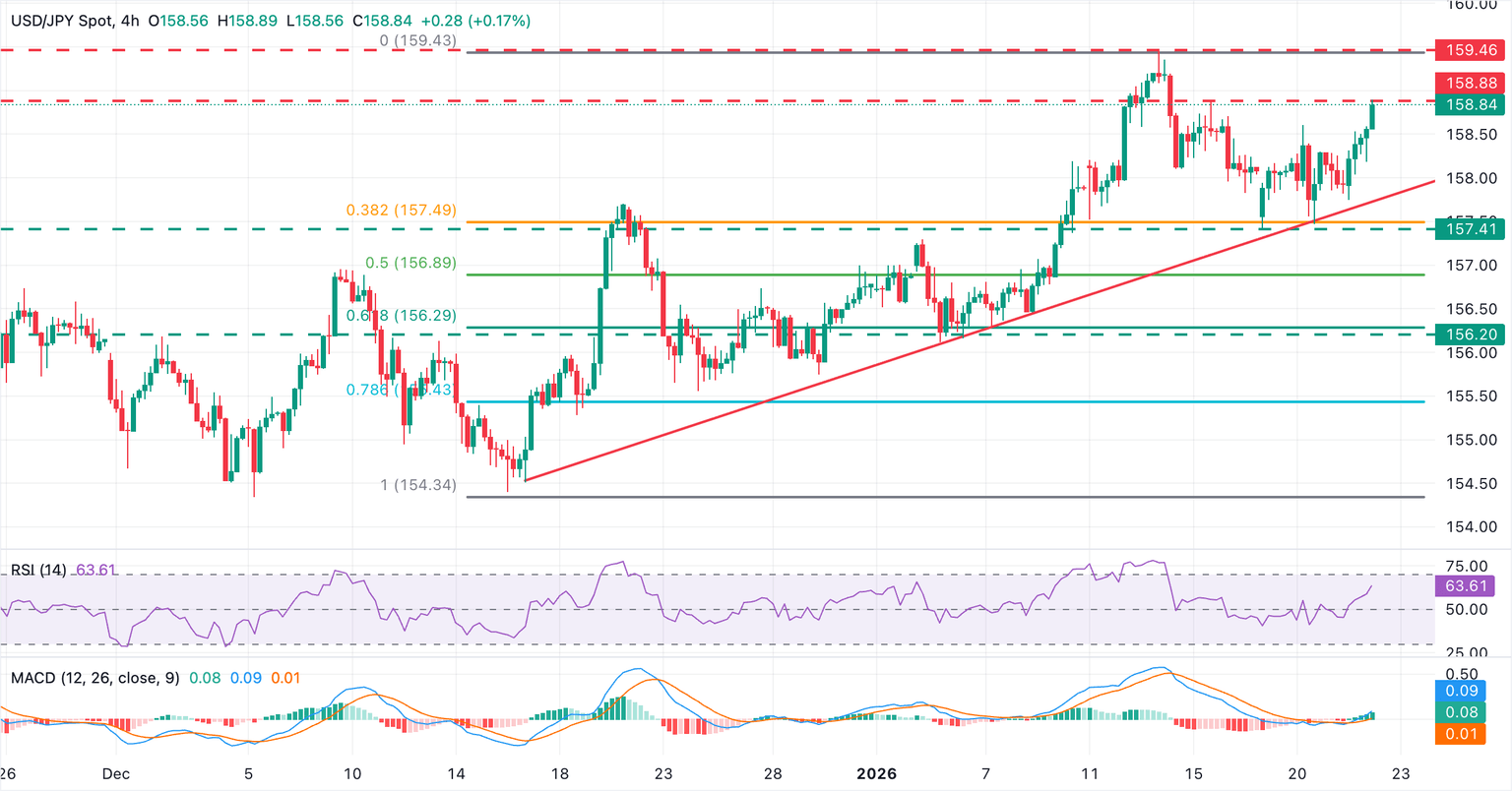

From a technical perspective, Guillermo Alcalá, analyst at FXStreet, sees the USD/JPY pair on a bearish correction, with key support above the 157.40 area: “The pair has retreated from highs, but Yen bulls would need to break the support area between 157.40 and 157,60, to cancel the near-term bullish structure and aim for the early January lows, around 156.20.”
A hesitant BoJ message would disappoint markets and undermine support for the Yen. In that case, Alcalá sees the pair reaching fresh long.-term highs: “Technical indicators are turning positive. The 4-Hour RGI has bounced up from the 50 line, highlighting a stronger bullish momentum. The pair is testing resistance at 158.70 (January 16 high) at the time of writing, which is the last barrier before the 18-month high near 159.50.”
Interest rates FAQs
Interest rates are charged by financial institutions on loans to borrowers and are paid as interest to savers and depositors. They are influenced by base lending rates, which are set by central banks in response to changes in the economy. Central banks normally have a mandate to ensure price stability, which in most cases means targeting a core inflation rate of around 2%.
If inflation falls below target the central bank may cut base lending rates, with a view to stimulating lending and boosting the economy. If inflation rises substantially above 2% it normally results in the central bank raising base lending rates in an attempt to lower inflation.
Higher interest rates generally help strengthen a country’s currency as they make it a more attractive place for global investors to park their money.
Higher interest rates overall weigh on the price of Gold because they increase the opportunity cost of holding Gold instead of investing in an interest-bearing asset or placing cash in the bank.
If interest rates are high that usually pushes up the price of the US Dollar (USD), and since Gold is priced in Dollars, this has the effect of lowering the price of Gold.
The Fed funds rate is the overnight rate at which US banks lend to each other. It is the oft-quoted headline rate set by the Federal Reserve at its FOMC meetings. It is set as a range, for example 4.75%-5.00%, though the upper limit (in that case 5.00%) is the quoted figure.
Market expectations for future Fed funds rate are tracked by the CME FedWatch tool, which shapes how many financial markets behave in anticipation of future Federal Reserve monetary policy decisions.