





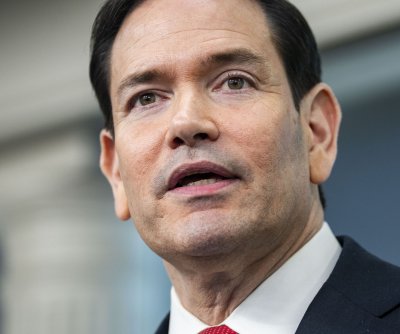
Secretary of State Marco Rubio on Monday announced additional sanctions against Cuba. File Photo by Bonnie Cash/UPI | License Photo
May 19 (UPI) — U.S. Secretary of State Marco Rubio said he has imposed additional sanctions against Cuba, with more to come in the days and weeks ahead, as the Trump administration ratchets up the pressure on the communist government of President Miguel Diaz-Canel.
The sanctions announced Monday by the U.S. State Department target 11 Cuba officials and three Cuban security and intelligence entities, freezing any assets under U.S. jurisdiction and prohibiting U.S. persons from doing business with them.
Agencies blacklisted were Cuba’s Ministry of Interior, the National Revolutionary Police Force and its Directorate of Intelligence, Havana’s primary foreign intelligence agency.
Officials hit included the heads of the Revolutionary Police Force as well as various ministers, the chief of staff of military counterintelligence, the chief of the Central Army of Cuba, the chief of the Eastern Army of Cuba, and the president of Cuba’s National Assembly for People’s Power, among others.
Rubio described them as “Cuban regime elites” and officials who have been involved in repressing the Cuban people.
“Regime-aligned actors such as those designated today bear responsibility for the suffering of the Cuban people, the failing Cuban economy and the exploitation of Cuba for foreign intelligence, military and terror operations,” he said in a statement, while warning that more sanctions “can be expected” in the following days and weeks.
“Today’s designations further restrict the Cuban regime’s ability to suppress the will of the Cuban people.”
Late Monday, Diaz-Canel lashed out at the United States over the sanctions, saying no one in Cuba’s government, political party or military institutions has any assets or property to protect under U.S. jurisdiction — and the Trump administration knows this.
“The anti-Cuban rhetoric of hate tries to make people believe such things exist in order to justify the escalation of its total economic war,” he said in a social media statement.
“That’s why we will continue to denounce, int he firmest and most energetic way possible, the genocidal siege that seeks to strangle our people.”
He described Trump’s Cuban policy as “collective punishment” and “an act of genocide,” calling on the international community to prosecute those responsible for it.
President Donald Trump has been targeting Havana with sanctions and economic restrictions since early this year, when he declared a national emergency concerning Cuba on the grounds that it has aligned with “numerous hostile countries, transnational terrorist groups and malign actors adverse to the United States.”
Trump has blocked Venezuelan oil shipments to Cuba, adding to the decades-old economic embargo and worsening the island nation’s energy crisis. The country’s fuel oil stocks have run dry, according to officials, and blackouts are common.
Trump has repeatedly raised the prospect of military action against Cuba and has stopped short of directly calling for regime change as he seeks to extend the United States’ influence across the Western Hemisphere.
Cuba blames the United States for its current economic and energy situation, and the sanctions came as its foreign minister, Bruno Rodriguez Parrilla, on Monday, defended Havana’s right to self-defense in response to reports that claimed the island nation had purchased drones from Russia and Iran.
While some Republicans, including Sen. Rick Scott and Rep. Carlos Gimenez, both of Florida, celebrated the sanctions, several Democrats have condemned the Trump administration’s broader campaign, accusing it of manufacturing a pretext for war.
Reps. Delia Ramirez of Illinois and Nydia Velazquez of New York lambasted the administration in a joint statement, accusing it of attempting to justify another “unauthorized and unlawful military invasion,” seemingly referring to the U.S. military abduction of Venezuelan President Nicolas Maduro in January and Trump’s late February strikes on Iran, which triggered a war later halted by a fragile cease-fire.
“For the Trump administration, the goal is another military incursion. They will justify their actions by claiming it serves the freedom of Cubans,” the Democratic pair said, calling on Congress to pass a war powers resolution to curb Trump’s ability to make war without congressional authorization.
“Today, we must act to stop the destructive ambitions of imperialists and warmongers.”


Vice President JD Vance speaks during a news conference on anti-fraud initiatives in the Indian Treaty Room of the Eisenhower Executive Office Building at the White House on Wednesday. Photo by Daniel Heuer/UPI | License Photo


