




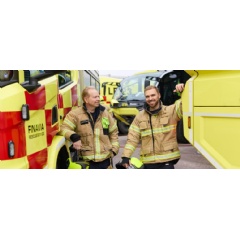
Rescue work requires a broad range of skills, good physical fitness and trust in ones colleagues. At Helsinki Airport Rescue Services, a shift lasts 24 hours. There are four stations in total. The satellite stations are staffed by two people, and their main focus is securing aircraft. At the main station, there are more rescuers, and in addition to aviation rescue readiness they handle firefighting and first-response duties across the entire airport area.
Jukka Kymlinen graduated from the Emergency Services Academy in 2000. He has worked as a rescuer at Finavia for 21 years. Before his career in rescue services, he trained as an electrician.
In the background there was still this thought that I wanted to do something else. I was a military police officer during my service, and the authority side of things interested me. What also appealed to me in rescue work was a certain kind of excitement, Jukka says.
For Aaro Koponen, the idea of working in firefighting and rescue services first emerged during upper secondary school.
I filled in a questionnaire, and based on that the suggested professions for me were firefighter and police officer. While serving in the army as a medic, the idea of working in the rescue services became stronger. After the army I attended the Helsinki Rescue School, graduating in 2013.
Aaro Koponen joined Finavia just under a year ago. Before that, he worked for 12 years at the Helsinki Rescue Department at Haaga Fire Station.
Learning the secrets of the field from a more experienced colleague
At the airport, rescue work focuses heavily on prevention and preparedness. The shift begins at 9 a.m. with a morning briefing, where the station assignment and duties for the shift are confirmed.
Our most important task is to protect the terminal, the aircraft and the passengers. That means a lot of training and preparation. The area is huge, so you really need to know the locations well. Everyone also has to be able to do everything, Aaro Koponen explains.
This is where a more experienced colleague becomes invaluable.
Jukka knows every corner of the airport. Ive learned a lot from him about how to get to different places quickly. Thats absolutely essential.
Trust grows from training and experience
Rescue work is strongly based on knowing, as a professional, what to do in different situations.
When you can trust that the other person will take care of their role, you can concentrate fully on doing yours, Jukka says.
This applies both at the station, when responding to an alarm, and on site during an incident.
Aaro sees trust as a form of professional security.
We all have the same kind of training. We all know how to act. You also quickly learn about each others personalities, which increases trust even further. I really value Jukkas calmness and analytical ability. You can tell that you can rely on his expertise, and that he has excellent command of the airport area.
Jukka, in turn, appreciates Aaros proactive approach.
If, during a shared shift, I ask Aaro whether he can take care of something, the answer comes immediately: Ill handle it, Jukka says appreciatively.
He also praises his colleagues physical fitness and technical skills.
Hes very capable and in great shape. During rope training, he knew the knots and attachments really well. Thats where Im quite humble myself.
A workplace where its easy to feel at home
Although the job involves preparing for serious incidents, everyday life at the station is often calm. When there are no alarms, time is spent training, practising and maintaining equipment and vehicles.
Theres also some free time, and you might read a book, for example. The atmosphere is pleasantly relaxed, and with colleagues you talk about work but also joke around. Its been easy to settle in here as a newcomer, Aaro says.
This news content was configured by WebWire editorial staff. Linking is permitted.
News Release Distribution and Press Release Distribution Services Provided by WebWire.