



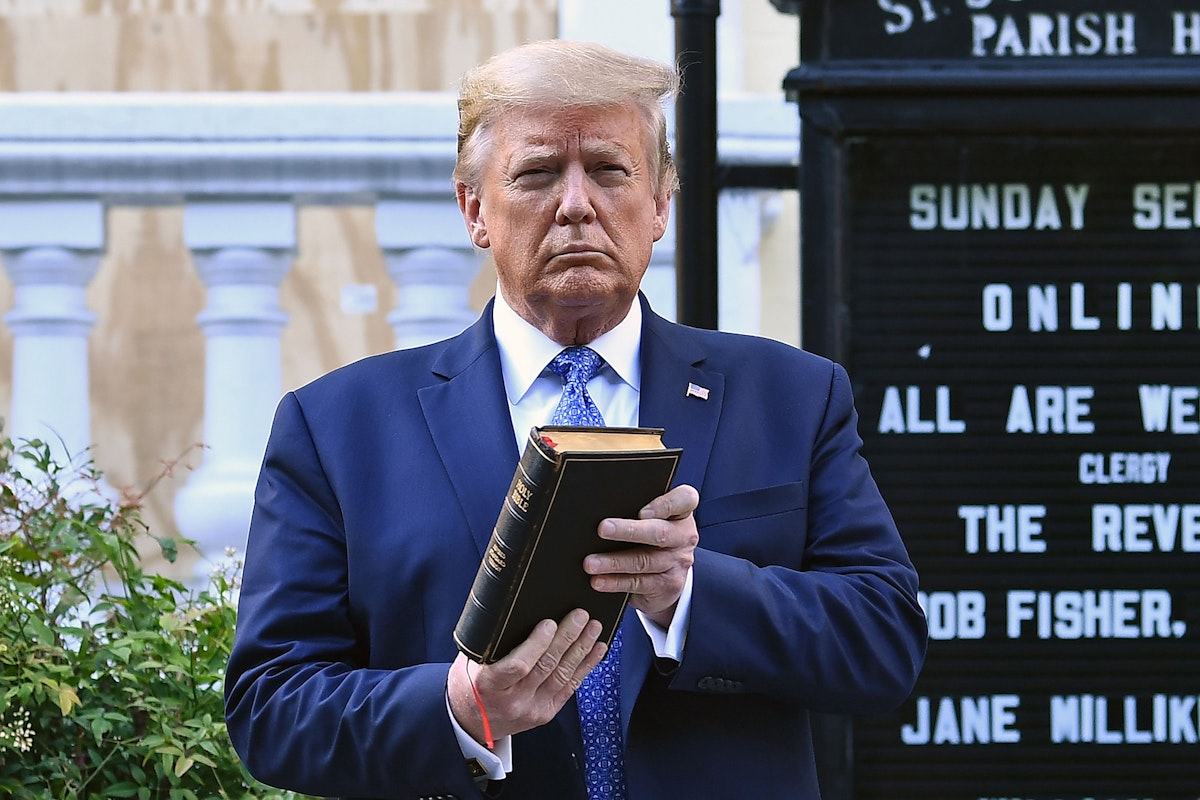
I have been reliably informed that the United States is currently governed by Christian nationalists. The term “Christian nationalism” is often used in academic and liberal circles to refer to the modern American right’s fusion of American conservatism with evangelical Christianity. In practical terms, it does little more than provide spurious biblical justifications to an authoritarian and illiberal worldview.
Manifestations abound. Secretary of “War” Pete Hegseth quoted Scripture earlier this year to justify the war on Iran, which the United States is now losing. Trump and his allies hosted an under-attended event on the National Mall last month where participants took turns reading Bible verses. Government officials now use their official platforms for overtly sectarian messaging, aimed either at the public or the federal civil service.
The problem is that Trumpism these days is neither all that Christian nor all that nationalistic. The MAGA movement’s leaders, including Trump and his top lieutenants, do not appear to be guided by any recognizable Christian values. They are merely looters and wreckers.
A person’s innermost thoughts and beliefs are unknowable. That said, there is no real evidence that Trump himself is a devout Christian. It’s true that the president has said that he believes in God and that he identifies as Presbyterian. Like a growing number of Americans, he does not regularly attend church. At a 2015 event, Trump claimed he had never asked God for forgiveness of his sins, thereby missing the central point of Christianity. The following year, he famously referred to one of the books of the New Testament as “Two Corinthians,” which is sort of like hearing a Yankees fan refer to Babe Ruth as “George.”
If anything, Trump himself appears to be the living negation of Christian moral teachings. He lies, cheats, and steals with casual ease. He had extramarital affairs in multiple marriages, including one with an adult-film star whom he later paid hush money to keep quiet during the 2016 election. Almost two dozen women have accused him of sexual misconduct in various forms, ranging from harassment to rape. A federal jury concluded in 2023 that he had sexually assaulted E. Jean Carroll, the New York writer, during an encounter in the mid-1990s.
Trump’s own statements on Christianity and Christian denominations have also verged towards the blasphemous. Last year, Trump mocked Catholics by suggesting that he should be elected as the next pope after Pope Francis’s death. (More recently, he attacked Pope Leo XIV by describing him as, among other things, “weak on crime.”) In April, he outraged even some of his ardent evangelical supporters by posting an AI-generated image of himself as Jesus. Trump later deleted the post amid the backlash and claimed that he thought the image, which depicted him in linen robes and with glowing hands, showed him as a doctor.
One can be a Christian and still sin, of course. But the sheer breadth of Trump’s sins, as well as their habitual nature, calls into question any commitment he might have to any personal Christian beliefs. For those close to him, however, it matters little. Evangelical pastor Mark Burns, who describes himself as one of Trump’s “spiritual advisors,” told The New Yorker’s Isaac Chotiner that Trump has been forgiven by God for his sins and that his misconduct “doesn’t matter in the eyes of the Lord, and apparently, it doesn’t really matter to the eyes of the American voters because they voted for him and made him president twice.”
There is also scant evidence of ethics or moral principles in the Trump administration these days, let alone Christian ones. This is an administration that has sought to ethnically cleanse the United States through mass deportations. Those who are arrested and do not agree to immediately leave the country are housed in a vast network of federal warehouses in inhuman and dangerous conditions to coerce their compliance.
A lawsuit filed last month against federal officials alleged that detainees at a warehouse in Fort Bliss, Texas, are facing “severe beatings or sexual harassment by guards, squalid living conditions, spoiled and inadequate food, spoiled and inadequate food; no meaningful programming or recreation; inadequate access to basic hygiene products such as soap, razors or nail clippers, outbreaks of disease; and limited or no access to sunlight.” The state of New Jersey is suing the private operators of a detention facility outside Newark for denying access to state health inspectors.
Those outside American borders are also suffering. When DOGE commissar Elon Musk destroyed the U.S. Agency for International Development last year, he severed billions of dollars in funding for Christian charities and other faith-based groups that provide life-saving aid to developing countries. By some estimates, hundreds of thousands of people likely died because of the agency’s sudden demise. The loss of USAID funding for these groups, as well as secular ones, has been met with aggressive indifference by the Trump administration. The New York Times’s David French, a conservative and Christian lawyer, tied the cuts to a growing shift among right-wing Christians to reject empathy as a concept.
He pointed to books by evangelical Christians that denounced “toxic empathy” and the “sin of empathy,” which appear self-contradictory. “These attacks are rooted in the idea that progressives emotionally manipulate evangelicals into supporting causes they would otherwise reject,” French explained. “For example, if people respond to the foreign aid shutdown and the stop-work orders by talking about how children might suffer or die, then they’re exhibiting toxic empathy.” Vice President JD Vance, an adult convert to Catholicism, expressed similar views on the supposed limits of Christian spiritual love—drawing a pointed rebuke from Pope Francis.
Other Trump policies are shaped by undisguised cruelty. Last month, Trump told an audience that in the past six months, his administration had “lifted nearly 5 million Americans off food stamps.” With a normal president, one might infer that nearly 5 million Americans had obtained better paying jobs that made federal assistance unnecessary. What Trump actually meant was that his administration had excluded more than 4 million people from SNAP since last year thanks to new requirements that make it harder to obtain. In other words, the president was celebrating the fact that millions more Americans are going hungry.
Describing Trumpism as “Christian nationalism” also obscures the role that Christians and their churches have played in opposing Trump. Many of those who voted against Trump in the last three elections are Christians; Catholic bishops and mainline Protestant leaders have been among Trump’s most frequent critics. One of the nation’s top civil-rights leaders today is Reverend William Barber, who has led “Moral Monday” civil-rights protests in North Carolina for the last two decades. In a New Republic interview in 2024, Barber denounced Christian nationalists for misappropriating Jesus’s teachings.
“They hijack symbols and attempt to hijack the faith,” he explained. “We have a name for it in Christianity. It’s called heresy.” Barber noted that the Bible speaks at far greater length about “the least of these, the left out, the oppressed, the poor” than the issues upon which Christian nationalists most often dwell.
Another flashpoint in this theological debate came last month when James Talarico, a Texas state lawmaker, won the state’s Democratic primary for November’s U.S. Senate race. Almost immediately after news outlets called the race for Talarico, Republicans at the state and national level launched a deluge of attacks against him. Most of these attacks centered around his support of transgender rights; right-wing pundits and officials described Talarico as effeminate, vegan, or even transgender himself. (He is a heterosexual man.)
In 2021, Talarico denounced a state bill that forbade transgender K-12 students from playing in certain sports based on their gender identity. Part of his argument was made in Biblical terms. “God is both masculine and feminine, and everything in between,” he argued. “God is nonbinary. In Genesis 1:26, God speaks of God’s Self in the plural, saying, Let us make human beings in our image, to be like us. That’s the infinite multitude of God: the masculine, the feminine, and everything in between.”
“Trans children are God’s children, made in God’s own image,” Talarico continued. “There’s nothing wrong with them, nothing at all. They are perfect, they are beautiful, and they are sacred. Bullying children is immoral. It’s a sin, a special kind of sin.” Much of the post-election blowback centered on the “God is nonbinary” part, with some social-media critics describing it as heretical or blasphemous.
Even Talarico’s more nuanced critics had to concede that he was essentially right on the theological aspects. “Some of this, stripped out of context, is Christian orthodoxy,” National Review’s Ramesh Ponnoru begrudgingly acknowledged. “As the Catholic catechism puts it, ‘God transcends the human distinction between the sexes. He is neither man nor woman: he is God.’” Since God is omnipotent, in other words, he cannot be bound by the gender binary.
Tech oligarchs like Peter Thiel and Elon Musk are also not really Christian nationalists in any meaningful sense. Thiel describes himself as an “orthodox Christian,” though not in the sense that he’s a member of the Eastern Orthodox Church. He has been giving a series of closed-door lectures on the anti-Christ that are intellectually and theologically incoherent at best. According to excerpts from The Guardian, Thiel identifies Greta Thunberg as a potential candidate for the anti-Christ, denounces the International Criminal Court as a vehicle for it, and describes Vladimir Putin’s Russia as a potential “new Rome.” Sure, whatever, man.
Musk, by comparison, described himself a few years ago as a “cultural Christian.” The Tesla and SpaceX CEO said that he was “not a particularly religious person” but that he believed that the “teachings of Jesus are good and wise.” In the same breath, he rejected some of Jesus’s basic teachings about turning the other cheek and encouraged people to hit back against their “bullies.” His “cultural Christianity” is a video-game Christianity, one that draws more upon Age of Empires II or Crusader Kings III than the New Testament. It gives him a permission structure for hating and fearing others in the name of defending the West without any of the actual moral or ethical constraints that Christianity prescribes.
The base motivation behind all of these policies is better understood as white supremacy. Christian groups often helped administer the nation’s refugee-resettlement programs in the pre-Trump era; it was the Trump administration that shuttered them for all but white Afrikaners from South Africa. Christian hospitals and health care providers helped administer vaccines in the U.S. and around the world; it is the Trump administration that has embraced eugenic thinking to spread anti-vaccine propaganda in a grave blow to centuries of American public-health policy.
I point all this out not to deny that there were numerous Christian leaders, churches, and organizations who aided in Trump’s rise to power and continue to support him, nor the millions of self-identified Christians who do the same. The chasm between their professed faith and the acts of this administration is for them to reconcile, not for me to justify or explain. If I saw a woman eating a hamburger, I would not presume that she was Hindu. If I saw a man drinking a beer, I would not presume he was Muslim. If I saw a government that brutalized and abused people in warehouses, cut off food to the hungry, took health care from the sick, and venerated the most corrupt and amoral president in American history, I would not presume that its supporters had Christ in their hearts.
Beyond its un-Christian nature, the second Trump administration is not particularly nationalistic either. Trump and his associates do a half-hearted job of feigning it, of course. They drape themselves in flags, salute the troops, and claim that they are doing everything they can to benefit Americans. In Trump’s second term, however, there is an almost perfunctory nature to it, like they are just going through the motions.
Nationalists typically claim that they are seeking to strengthen and revitalize a nation, which they see as the principal level for organizing society. But Trumpism is arguably not a nationalist movement at all these days. It is an increasingly personalistic one, where Trump himself is the central figure of reverence instead of any recognizable American ideal. There is also no real evidence that Trump and his associates are actually trying to strengthen the nation or materially improve Americans’ lives. If anything they appear to be stripping it for parts or smashing its crown jewels for ideological reasons.
Since returning to power last year, Trump and his underlings have slapped his face on every government product that they can. Massive banners that feature his leering visage hang from federal buildings in D.C., including the Department of Justice. The Treasury plans to put his face on a new coin and on a $250 bill, defying a statutory ban on placing living people on American currency. Trump’s portrait adorns National Park passes and some passports; he says the planned 250-foot triumphal arch that he wants to build outside Arlington National Cemetery is for himself. He has often suggested on social media that his face should be added to Mount Rushmore. (Not to worry: Everyone with any expertise on the matter says it can’t be done.)
Among his most high-profile renovation efforts, the administration has renamed the United States Institute of Peace building and the Kennedy Center for the Performing Arts after Trump. A federal judge ordered that his name be removed from the latter last week; Trump petulantly replied with a rambling social-media post that suggested he would “transfer control” of the center to Congress, which does not really make sense.
This summer marks the 250th anniversary of American independence. While this would normally be a year of national celebrations, similar to the bicentennial in 1976, Trump has spent most of his second term reorienting the ceremonies towards self-glorification. After a number of musicians dropped out from a July music festival meant to celebrate the semiquincentennial, Trump announced that it would be replaced with a speech given by him—his first open-air remarks in the capital since January 6, 2021.
Military prowess is often the last bastion of the avowed nationalist, but here too Trump has fallen short. The Iran War is shaping up to be the worst defeat in American military history—not because Iran defeated the U.S. through strength of arms, but because the Trump administration exposed the limits of U.S. military power to impose its will. Now Trump is poised to surrender freedom of the seas and control of the Strait of Hormuz to Iran in the vainglorious effort to achieve a vastly inferior deal with Iran compared to the one struck by Barack Obama a decade earlier—if a deal can even be reached, that is. More than 160 U.S. soldiers died in the war, as well as unknown numbers of Iranian civilians. Perhaps Trump thinks of them as “losers” and “suckers” as well for embarrassing him.
Even as the Trump administration dives further into supporting Trump’s self-delusions, it also tries to diminish and destroy what actually made the United States the world’s most powerful country. The United States once had the world’s pre-eminent public-health system, which helped eradicate diseases like smallpox and subdue perennial foes like measles. In revenge for the COVID-19 pandemic, Trump happily turned that system over to a failed Kennedy scion who is wrecking the nation’s health infrastructure so his influencer allies can sell quack-ish “wellness” products to desperate people.
American universities have been powerful engines of economic growth and social well-being for the last 250 years, and the hub of international science and research since the end of World War II. Knowledge, in American hands, has driven the engine of prosperity; Trump is ceding that wealth to other nations. Instead of cashing in, the Trump administration has sought to choke would-be innovators out of federal funding and assume direct ideological control over them, often for white-nationalist reasons. Russ Vought, the director of the White House Office of Management and Budget, put forward new rules for federal science grants last month that would irreversibly politicize the nation’s scientific infrastructure. Trump officials are wrecking climate-science research programs and institutions to satisfy their fossil-fuel patrons, many of whom will reward them with nonprofit jobs and funding later.
The Trump administration also simply hates many Americans on a personal level. Trump’s executive order purporting to nullify birthright citizenship was an anti-constitutional effort to refine who counts as an American, making it easier to ethnically cleanse the country by depriving many lifelong Americans of the legal protections to which they are entitled by the Fourteenth Amendment. The Supreme Court appeared unlikely to embrace this effort during oral arguments earlier this year, but no one can breathe freely until a ruling is handed down by the end of June.
Even those who are American by the Trump administration’s terms will be hammered by its policies. Trump’s tariffs have raised prices for Americans across the economic spectrum, particularly when it comes to groceries. His illegal war against Iran clipped the jugular vein of the global economy, with even greater economic pain likely ahead. Even if Americans manage to weather these headwinds, they face new threats from Trump officials’ slash-and-burn deregulation. The Trump administration has made it easier for industries to poison your water, pollute your skies, and sell you tainted meat and infected milk.
Along the way, Trump has essentially adopted a pro-white-collar crime agenda. Vought largely shut down the Consumer Financial Protection Bureau as quickly as he could last year, depriving Americans of a helpful hand against crooked actors in the financial sector. The Trump Justice Department has redirected almost all of its energies towards anti-immigrant policies. Trump appointees are doing almost nothing to stop the growth of corrupt prediction markets (and may even be profiting from their insider knowledge on them) and crypto scams. Trump-led financial regulators are refusing to stop Musk from siphoning off Americans’ retirement funds to become a trillionaire when he takes SpaceX public later this year. Trump himself has pardoned white-collar fraudsters and insider traders at a record clip. The goal appears to be to create a nation of marks who can be hustled and rugpulled at whim.
The end result will be a nation that is less prosperous, less influential, less dynamic, less educated, less healthy, and less trusting than the one Trump first took over in 2016. There is no nationalism (and no Christianity, for that matter) in Trumpism, just personalism, corruption, and white supremacy with a vaguely patriotic and religious gloss. Trump and his allies cynically hope that Americans will be too fixated on the flag and the cross to notice that they’ve pulled the copper wiring out of the nation’s walls.