







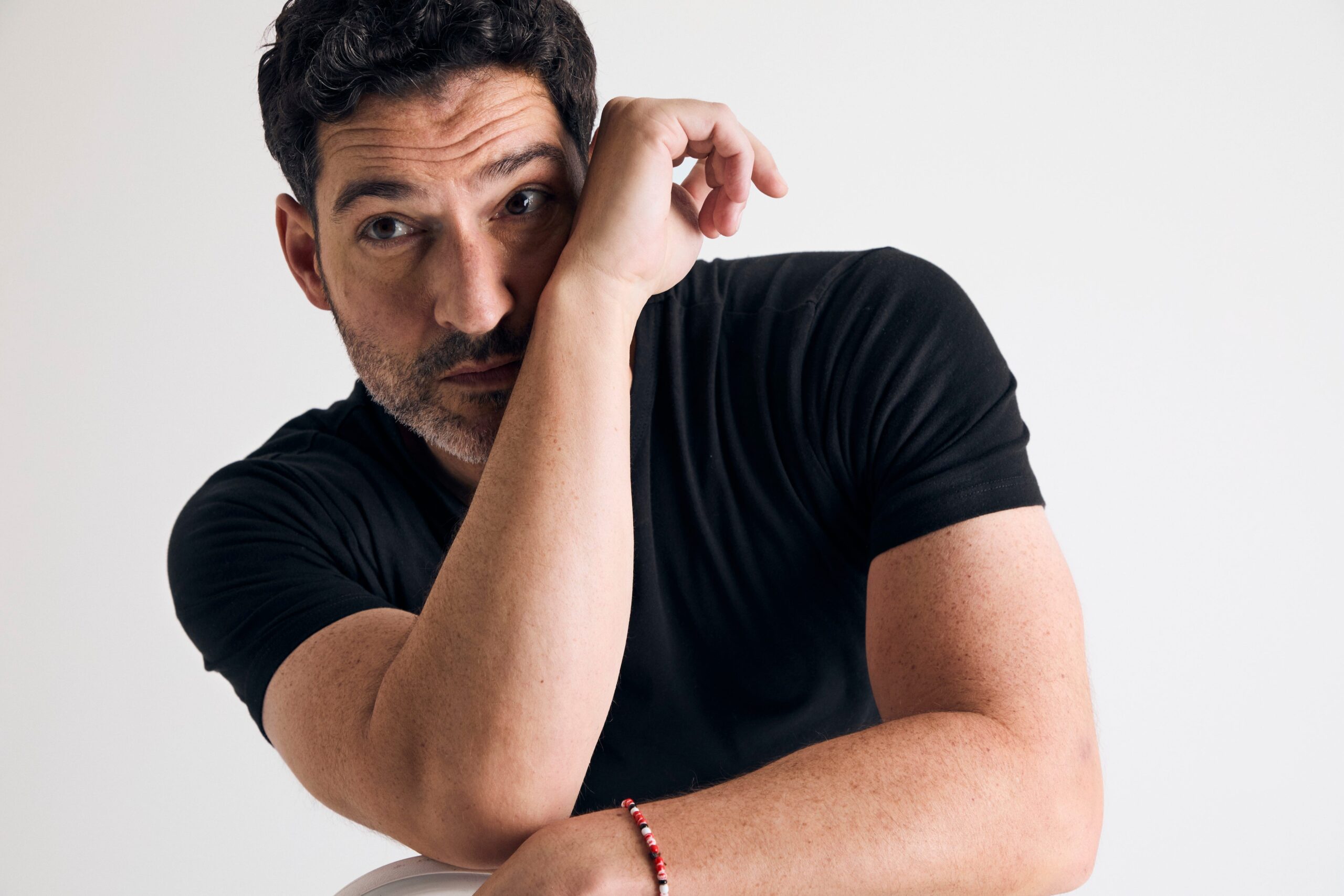


“LUCIFER IS HERE to see you,” the receptionist tells me over the phone when Tom Ellis first arrives for our chat at the Men’s Health offices. The Welsh actor played the Lord of Hellfor six seasons, first on Fox and then on Netflix, in the supernatural drama Lucifer. The show concluded in 2021, but the character has clearly stuck in the minds of the show’s appropriately cult-like fanbase, even as Ellis has spent the last several years appearing in a variety of projects, including the hit drama Tell Me Lies, the critically acclaimed miniseries Washington Black, and the movie adaptation of the popular mystery books The Thursday Murder Club. As Lucifer, Ellis played a charming devil who abandons his throne for Los Angeles and finds himself dabbling as a consultant for the LAPD. The result was an otherworldly procedural that consistently broke genre barriers and reflected its antihero’s tongue-in-cheek flair for the dramatic.
Now Ellis appears as another morally gray character, this time in a decidedly more earthbound procedural, as the star of CBS’s latest Dick Wolf joint, CIA. Ellis plays Colin Glass, a spook who’s forced to team up with a straight-laced FBI agent. The show, like Lucifer, explores the gray areas of morality, and also marks Ellis’s return to leading a series. And while it may feel familiar, the massive TV-making apparatus behind Wolf’s shows posed new challenges for Ellis, who had to keep up with the pace of a network series firing on all cylinders. On a day off from CIA production, Ellis took a break to talk about the joys and challenges of being number one on the call sheet, the sensitivities involved in depicting spycraft, and how acting keeps you young.


MEN’S HEALTH: How did you get recruited into CIA?
TOM ELLIS: I was approached by Dick Wolf and his team, and they had this idea to spin out from the FBI series, about a CIA operative in New York that would team up with an FBI agent. It was very early days, but the way they were talking about it and what they wanted to do, I was really interested. And the prospect of coming to New York was something that really ticked a lot of boxes for me. My wife and I had been talking about moving here for a while. She went to NYU, and she’s had a love affair with New York ever since. I was getting a bit uninspired living in L.A., and I couldn’t put my finger on why. I think there were a lot of things I missed about living in London, and I realized New York covered all the bases in terms of the things I was missing. It was a new adventure.
MH: Despite working for an American intelligence agency, your character has a British accent and it’s stated he was raised in the UK. What led to that character choice?
TE: When we first started talking about the show, I was going to be American in it. I’ve done that before, and it’s not an issue for me. In fact, it was sort of a challenge that I was ready to embrace. But when I met Dick Wolf in person, we got to chatting and he said, “You know, the more I think about this, the more I think we should just make your character British, because it feels like the perfect cover.” And yes, absolutely, I do feel like the last thing you’d expect is that this British guy would actually be a CIA operative. So, it opened up a lot of possibilities for us.
MH: What drew you to the role?
TE: Since Lucifer finished, I’ve done lots of different jobs here, there, and everywhere, and what I really missed was being on a set and leading it. If you’re going to play a character on TV, you want to make sure it’s something that’s going to interest you over time. Colin presents as one thing, but he’s actually lots of different things, a bit of a chameleon, and there was an opportunity there to play a multifaceted character. And the notion of working for Dick Wolf’s company was hugely tempting because they’ve got such an amazing track record of making successful TV shows.
MH: Lucifer was always a cult hit, but being a part of a massive Dick Wolf production must be something else. I assume they run like a big, well-oiled machine.
TE: They do. A lot of the crew on our show have worked for Dick Wolf before. What was new to me, which is the norm for all of them, is the amount they do in a day. It’s the busiest schedule I’ve ever worked—and that’s including Lucifer. On any other production, I’d say there’s absolutely no way we’re getting through everything they plan in a day. But they’re a well-oiled machine. They know exactly what they’re doing, and their way of keeping up with that workload is baked into them. And now that I’m up to speed, it feels like the norm.
MH: Are there any skills you had to build to keep up with the new pace?
TE: I generally had to build up my stamina. Since Lucifer, I hadn’t continually gone into work absolutely every day with a schedule that dictated the rest of my life. So the biggest challenge was building my stamina back up. And for the first time ever, I felt my age a little bit this year. But now I feel like I’m ready.


MH: Do you find the action on the show more or less physically grueling than on Lucifer?
TE: For a few reasons, I found it more physically grueling, but that’s partly because I’ve been suffering from a couple injuries and managing my way through that has been tough. Plus there’s the fact that I’m 10 years older than I was when I started Lucifer, and I’ve got a 2½-year-old daughter now. But when I think about how much we do in a day, how much I’m on my feet, I realize I’m staying fit just by trying to keep up. I’m like a hamster in a wheel.
MH: How did you become versed in the lingo, operations, and history of the CIA?
TE: We have a couple consultants in the writers’ room and on set. We have an FBI tech consultant who worked for the FBI and had also done a lot of surveillance, counter-surveillance, and deep cover work in his time. Some of the stories he tells me you’d think only happen on TV and in films. How these people operate is kind of unbelievable to me, but it’s just second nature to them.
MH: There’s that message that appears on screen at the end of every episode that reads: “The preceding story was fictional. No actual person, entity, or event was depicted.” It points to how much a show like this can dovetail with real-world events. Did you see a lot of parallels with reality between filming and airing an episode?
TE: Take our very first episode for example. It was written and produced way before what happened in Venezuela, yet it featured parallels to that operation. Even the nature of the [type of sonic] weapon we talk about in the episode was similar to what some people think was actually used by the States during that raid. So we’re flying very close to the sun here without intending to. We’re sometimes covering territory that feels very relevant right now, like Iranian sleeper cells, so it may appear that we’re reacting to what’s going on in the world and putting that into the show, but actually it’s been the other way around—we’ve made up these stories on the show and now what’s happening in the world seems to reflect them. I think that’s just the nature of doing a show about the CIA or FBI.


MH: This show, and others like it, depict American forces against foreign governments and third parties like terrorist groups and cartels. At a time when international relationships are so fraught, how does a show like CIA approach the responsibility to not paint a large swath of people with the same brush?
TE: We have to be careful that when we’re talking about characters from a certain country, we’re being very specific about who those people are. They don’t represent the country or culture in general. We can’t always suggest that one country is bad and another country is good. I think our writers do a really good job with that.
MH: There’s a line in the second episode where somebody says, there are “monsters on both sides.” That line seems to represent a key factor in any show or movie about the CIA.
TE: And I think that’s really important. For Bill Goodman, the FBI agent within the show, a big part of his story is slowly having to learn that not everything is black and white. He comes from a very linear approach to law and order, that what’s right is right and what’s wrong is wrong. And when he comes into this world, he realizes that we’re sometimes the bad guys, that we have to be the bad guys in service of what we think is the greater good. The CIA is such a secretive agency, and there are several reasons it’s secretive, one being that a lot of people would be against some of their tactics. It’s not a political show, but it is a show about an institution that has been here for a long, long time, and has had to use dubious tactics in order to achieve whatever the goals of their operations are. Something we talk about in the show a lot is that these agencies work in the gray, and that what the CIA does isn’t always right. It’s a difficult tightrope to walk.
MH: Speaking of institutions who’ve been here for a long time, you recently worked with some screen legends—Helen Mirren, Pierce Brosnan, Ben Kingsley, Celia Imrie, and Jonathan Pryce—in The Thursday Murder Club. What did you learn from them?
TE: That I want to be working at their level at that age. I think this job keeps you young. All of those people are in their 70s and 80s, and I think if you were to go and take a slice of all the people who are in their 70s and 80s, I imagine that most wouldn’t have the youthful energy those guys have. I think it’s because in their heads, they’re still kids. There’s something about the fact that they’ve just been doing it and doing it and doing it and doing it, and they still have this exuberance and this appetite and this energy. They’ve done all this work, they have Oscars and all sorts of accolades, and they still love the simple act of just coming to work. That’s what I want to be like.
This interview has been edited for length and clarity.


Nojan Aminosharei is the Entertainment Director of Men’s Health and the Special Projects Editor of Harper’s Bazaar. He was previously the Entertainment Director of Hearst Digital Media, and before that a Senior Editor at GQ. Raised in Vancouver, Canada, Nojan graduated from NYU with a master’s degree in magazine journalism. The late Elaine Stritch once told him, “What the fuck kind of name is Nojan? I’m 89 years old, I don’t have time for that shit.”


