







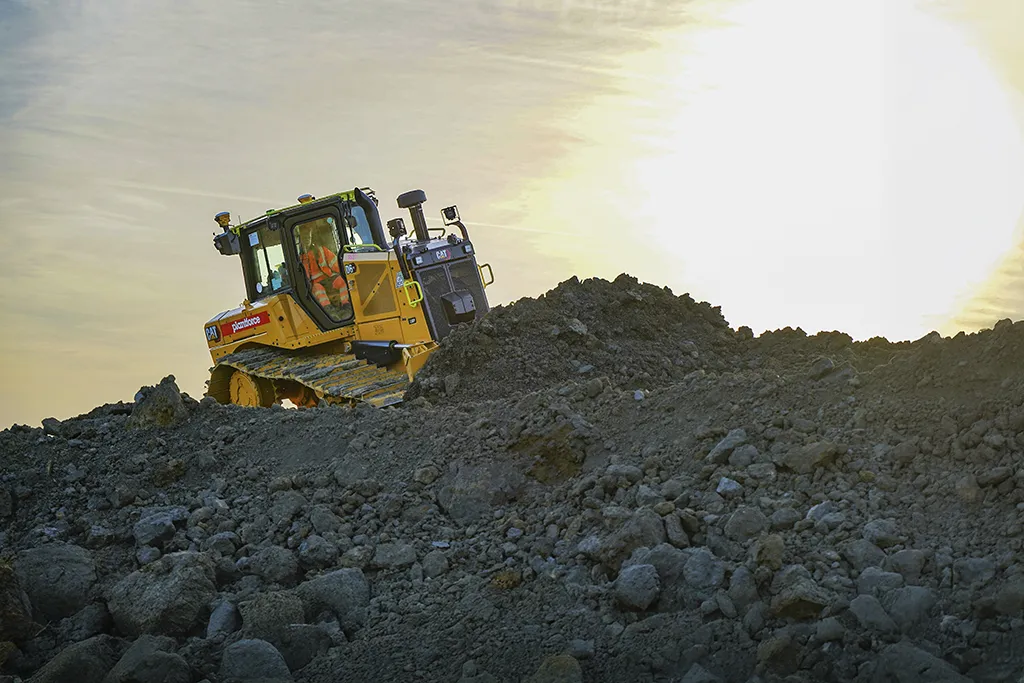
The construction sector may be committed to the principle of net zero, but there remain many challenges to ditching the industry’s favourite fuel
When the government axed the red diesel rebate for construction in 2022, it hoped to prompt the industry into using “cleaner alternatives”. Diesel had long been one of the most polluting ways to power machines and construction was its greatest user, according to a 2023 study for the Department for Energy Security and Net Zero. Hundreds of thousands of construction machines emit almost half of the CO2 emitted from non-road mobile machinery, most of it generated by burning diesel, it found. “The construction industry is the highest polluting industry,” the study concluded.
“Downtime for charging or refuelling is expensive and inefficient”
Chris Matthew, Plantforce
That same year, the industry responded through the Construction Leadership Council (CLC), with a bold pledge to “eliminate the sector’s use of diesel” with a “zero diesel sites route map”. This included a target to reduce the use of diesel by 78 per cent on construction sites by 2035. Five further pledges came in 2024 when the UK’s infrastructure companies signed up to client carbon commitments to tackle what the CLC called “the biggest contributors to CO2 emissions during construction”, namely steel, concrete and diesel. National Highways, one of the first signatories, is aiming for zero emissions on the £9bn Lower Thames Crossing by 2027, a year after it gets on site.
But just how realistic are these pledges to transform construction from an industry predominantly powered by diesel to one mostly wedded to greener sources of power? To find out, Construction News has spoken to leading industry figures about their plans and routes to reducing diesel use. We’ve found that, despite widespread commitment to the principle of net zero, there remain many challenges to switching away from the industry’s favourite fuel.
The alternatives
Despite the dominance of diesel, there are numerous other sources of power for construction plant that are already in use or potentially available soon. One of the most widely used is hydrotreated vegetable oil (HVO). Vehicles and machines can be easily converted for HVO, it behaves much like diesel, and it is marketed by its suppliers as reducing CO2 emissions by an impressive 90 per cent.
Electric-powered machines are also in use, and manufacturers say they are poised to produce hydrogen-powered plant in high numbers.
Occupying the middle ground are so-called ‘hybrids’, a broad category that includes machines that can capture, store and redeploy energy from common movements like braking and slewing, but also require other power sources.
“We’re moving towards a future with a diverse range of power options,” says Chris Matthew, commercial director at hire firm Plantforce. “Diesel has been dominant because it works across almost all scenarios. In the future, no single technology will do it all. Hybrid machines will excel in some areas, battery-electric in others, and hydrogen-powered equipment will also have its place. But diesel isn’t disappearing anytime soon.”
Each of these alternative fuels appear to have their own place on the road to the non-diesel site, as well as challenges. Many companies use vehicles powered by HVO and they are readily available from hire firms. But this biofuel has become embroiled in controversy in recent years because of ethical concerns over whether it is being sourced sustainably.
The Scottish Plant Owners Association (SPOA) points to claims that HVO is sometimes sourced from freshly harvested virgin palm oil instead of waste sources such as spent cooking oil. Balfour Beatty refuses to use it and has flagged the “strong likelihood” that a “sharp increase in demand” for the fuel would add to global deforestation. Jeremy Fish, chief executive of Ardent Hire Solutions, says his entire fleet can operate with HVO and that “quite a few customers have toyed with it”, but notes that it is seen as a “transitory fuel” – a stepping stone towards a greener alternative.
One option is electric but its use has proven challenging, especially in the UK, where most firms rent rather than own plant. Hirers say electric machines are costly to buy, more expensive to hire and unsuitable on remote sites. They also require substantial stoppages and unconventional ways of working because of the need to recharge. This is a particular challenge for large, heavy-use machines such as excavators, which are required to work round the clock.
“With large machinery like a 20-tonne excavator, you want it to work for at least 10 hours, ideally more,” says Matthew. “Downtime for charging or refuelling is expensive and inefficient. There’s also the challenge of where to recharge. On major projects like HS2, operators are often bussed to their machines, which may be several hundred yards from the nearest power source. On greenfield sites or remote areas, setting up charging points can be impractical.”
“You can’t get the machines because no one’s providing the fuel and no one’s providing the fuel because there are no machines”
Andrew Kidd, National Highways
Fish says electric is a “non-starter”. He adds: “Electricity will work with smaller tools and smaller machines, such as 1.5-tonne mini-dumpers, but it just isn’t robust enough for lots of use in construction. The costs are too prohibitive. You have got to pay almost three times the price of a diesel machine. It’s a non-starter unless regulation is brought in to force companies to use it.”
The SPOA says there is “still a way to go” before electric-powered plant becomes a “viable alternative”. The limitations of electric power have led many major manufacturers to develop heavy plant capable of running on hydrogen gas.
JCB says all its new diesel engines are HVO compatible and it has sold about 35,000 small electric machines since 2019. But the company now has its sights firmly on hydrogen. Its fleet of hydrogen-fuelled machines has been tested for four years and is now “very close to production”, JCB group director of special projects Tim Burnhope tells CN. Hydrogen engines can be dropped into any of its machines and manufactured on existing production lines, which churn out 500 engines a day, he says.
The challenge now, according to Burnhope, is to ensure hydrogen fuel is available in the right place, at the right time and at the right cost. “It’s not really a big challenge,” he says. “Producing hydrogen is relatively easy.” The UK would need 50 hydrogen production plants for the fuel to replace diesel, JCB estimates. “I’d be more worried about putting in 20 million charging points for cars,” Burnhope says.
The government has even pumped £4.9m into a one-off project, dubbed Element 1, to show how hydrogen gas can reduce emissions (see box, below). But despite the claimed success of this project, making hydrogen-fuelled machines mainstream has become known as the “chicken and egg” problem in construction, says Andrew Kidd, National Highways’ director of environmental sustainability for the Lower Thames Crossing. “You can’t get the machines because no one’s providing the fuel and no one’s providing the fuel because there are no machines,” he says.
Breaking new ground
The Lower Thames Crossing project is hoping to break that cycle, Kidd says. “We’ve deliberately set out to make the Lower Thames Crossing the greenest road ever,” he tells CN. “It is a pathfinder for our business, a deliberate strategy that says we’ll use this project to lead, and that will then make it easier to do things nationwide. But it is also partly a pathfinder for the industry to really help construction supply chains and big contractors to adopt new techniques across the board.”
Kidd admits there remain challenges to hitting the 2027 zero-emissions goal. “To get there we will need electric and hydrogen machines which are not currently in the market,” he says. “But we’ve done a lot of work with equipment manufacturers to understand what they can do already, what their research and development pipeline looks like, and when their products could come to market. We have line of sight for most of the machines.”
National Highways plans to use plug-in cranes and piling rigs, and install electricity substations and charging units to recharge mobile battery-powered vehicles, as part of its Net Zero Highways initiative. It expects its bigger excavators and haulers to be initially powered by hydrogen, and has had a tender out in the market for a supplier for the fuel since 2023.
Construction firms are also trying to break the chicken-and-egg cycle, making public their own “roadmaps” to zero carbon. Tier one contractor Bam asked its top 20 plant suppliers when they thought technologies for alternative fuels would be available at the price and scale it needed. “For each of the technologies we got a sense of when we should trial them, when we should be looking to scale them up, and when we think they will be there at the scale for a contractor to adopt them more broadly,” says Damien Canning, whole-life carbon lead for Bam UK and Ireland.
“Heavy-duty hybrid machines are quite available and the difference in hire cost is within 10 to 20 per cent so it makes commercial sense for us to move into that space,” Canning adds. “But you can see that for hydrogen combustion engines it is the early to mid 2030s, so it allows us to temper expectations.”
Bam hopes its roadmap will help inform the wider industry’s manufacturing and buying plans. “It is about trying to create a demand signal in our market so that our suppliers can order more, which sends a signal to the likes of JCB and Komatsu that they should be producing more for the market,” Canning says.
Whether major projects like the Lower Thames Crossing or construction firm roadmaps will prompt a major machine manufacturing boost or a proliferation in suppliers of cleaner fuels like hydrogen remains to be seen. For now, there is a mix of optimism and doubt that the CLC’s 2035 target will be hit. According to Kidd, the supply chain for plant is changing. “We know that some of the equipment manufacturers are looking to move to more of a lease-type arrangement to take the residual value risk,” he says. “This market will evolve and we will see different sorts of commercial arrangements that make some of these things a lot easier.”
But Fish is more sceptical. “It’s no good thinking the target to reduce diesel use on site by 78 per cent by 2035 is achievable,” he says. “It is only 10 years away. How many thousands of pieces of plant across the country are going to have to be replaced by new models?”
At this stage in the journey to diesel-free construction sites, it’s a difficult question to answer.
Element 1: making hydrogen work for construction
Element 1 is a government-funded project to push forward the use of hydrogen fuel on construction sites and move away from diesel. The £4.9m project was run by a consortium of companies led by Bam and included fellow contractor Skanska, plant-hire firms Flannery and Plantforce, hydrogen suppliers and the Building Research Establishment.
“Element 1 seeks to completely eliminate the use of diesel as a fuel on UK construction sites by 2040 and addresses this challenge via a scalable, commercially viable and globally applicable low-carbon alternative to red diesel based on the use of hydrogen,” the project claims. It ended in March after it achieved its goals, its website states.
As part of the project, diesel-fuelled excavators were fitted with hydrogen tanks on their counterweights. This created a system that allowed the machines to run on a blend of the two fuels. Hydrogen from the tanks was injected into the air intake, mixed with diesel, and together they created a more efficient combustion process. This resulted in reduction in the use of diesel of up to 40 per cent for the same workload and a significant reduction in carbon emissions, NOx and particulate matter.
Consortium member Plantforce said the project was a success but scaling it up would bring new challenges, such as where to source the hydrogen and how to transport, store, compress and ultimately use it on site. “These logistical challenges are significant and can’t be overlooked,” says Chris Matthew of Plantforce. “Despite the challenges, the machines are available to rent now. For clients looking to reduce carbon without transitioning fully to electric, hydrogen blends offer a practical, measurable reduction that’s ready for use.”


