







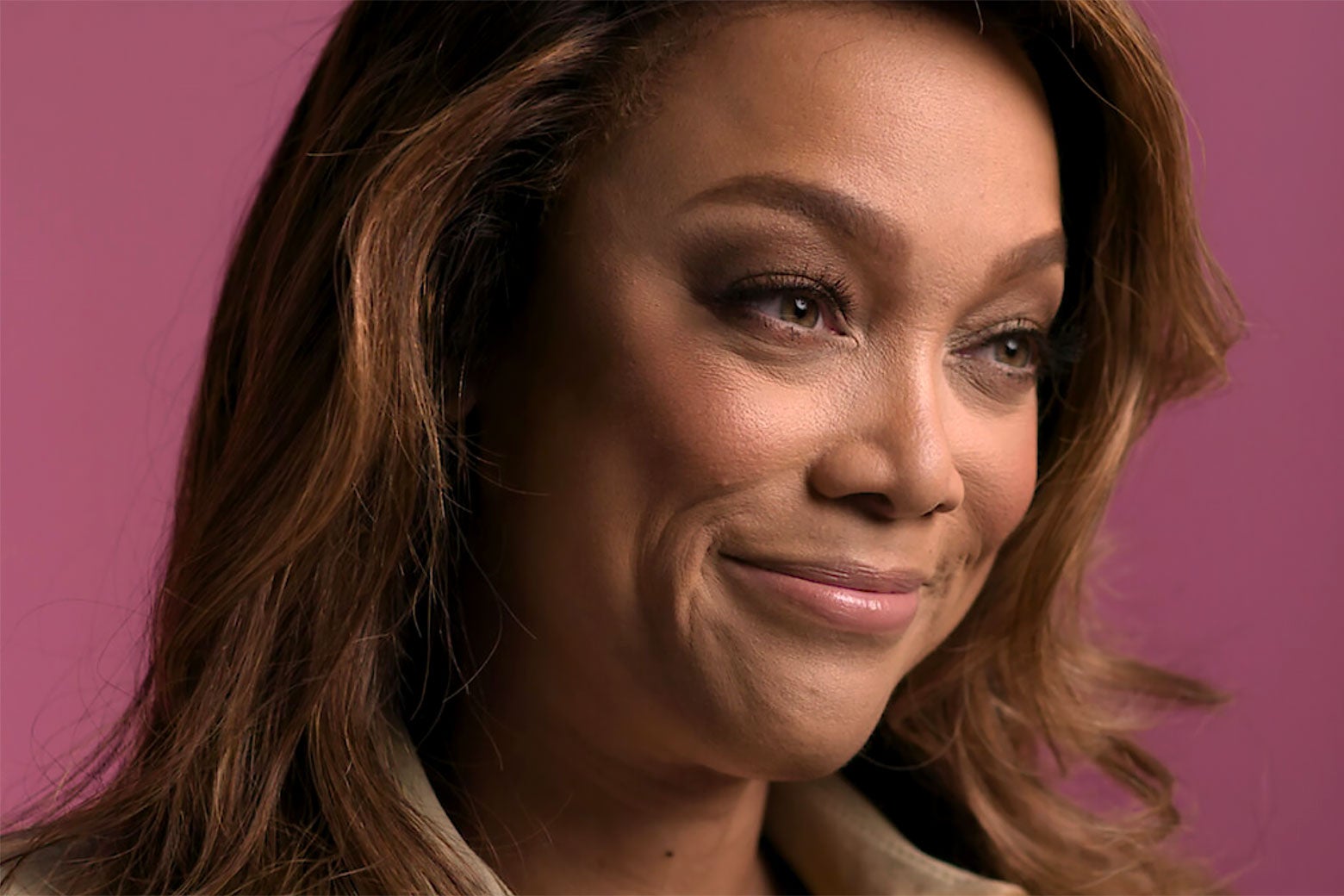
Netflix’s Reality Check: Inside America’s Next Top Model doesn’t go easy on Tyra Banks. It still manages to give her the spotlight.
By
Scaachi Koul
Enter your email to receive alerts for this author.
Sign in or create an account to better manage your email preferences.

In the cold light of hindsight, America’s Next Top Model feels like a fever dream of a reality show. The entire franchise feels like an improbable 30 Rock joke: A gaggle of models in their late teens and early 20s share a house and are run through weeks and weeks of challenges at the behest of ur-supermodel Tyra Banks, who spends most of her time teaching the girls how to “smize.” How much blackface is involved? Much more than you’d ever imagine possible.
For 24 seasons, ANTM was among the most influential and dominant reality shows of the aughts. Millions of us watched the show’s producers, Banks and fellow executive producer Ken Mok among them, nudge girls into intense dental work, make them reenact devastating traumas of their past via high-concept photoshoots, and dangle an improbable dream in front of hungry and often downright desperate reality-show contestants. If they won the show, they’d get a modeling contract and a head start—plus, a personal relationship with Banks herself.
Unsurprisingly, Gen Z and Gen Alpha have found the show since its finale in 2018, while plenty of millennials committed to a rewatch through the pandemic. For years now, ANTM has been a lightning rod for conversation and critique of the early-aughts-TV meat grinder. If you grew up with ANTM, it’s easy to forget how big of a deal the show was when it launched, and how it created its own arm of reality programming. It’s also easy to forget how bonkers it was for Banks to ask girls to walk down a narrow runway flanked by water while inside a giant plastic bubble.
The nostalgia cycle usually ends with a documentary, and so this week’s premiere of Reality Check: Inside America’s Next Top Model on Netflix is the inevitable next step after renewed TikTok virality. Featuring interviews with former cast members, judges, and television executives, as well as Banks and Mok, the documentary does what you want a good documentary to do: It reminds us what happened, and why it happened, and ultimately renames it as both a culture-buster and a reinforcement of the worst of predatory entertainment.
But it also names at least one person as the bad guy, over and over. Reality Check doesn’t balk: It’s Banks who’s left holding the bag. In the show’s hagiography, ANTM is her baby, born from her experiences as a model in the ’90s, a way for her to pay it forward. Banks reminds us, again and again, that she wasn’t some mere presenter of the show; she was an executive producer, key in the show’s development and production. That ownership of the program means it was also her fault when things went awry, which according to Reality Check, they did pretty often.
Banks is the documentary’s main villain, but her participation in her own reassessment solidifies what she’s always been: an evil genius. If she’s going to be held responsible for the show’s many deficiencies, she also sets herself up as a part of its ongoing conversation. She aspired to make something that forced people to think of models and modeling as a legitimate career, and to set women up in careers as public figures. The show was imperfect, but by participating in a documentary about it, she still gets to have the final word.
Reality Check ticks all the boxes of an ANTM retrospective. The show’s most indelible moments are inevitably dissected, some with interviews featuring the women involved. Banks’ famous rant at Cycle 4 contestant Tiffany is mined, as it has been in interviews in the past, but so are less infamous scenes like Cycle 4’s Keenyah being called fat over and over again (they made her dress up as an elephant, Jesus Christ), Cycle 8’s Dionne posing as a gun-violence victim after telling producers her mother was paralyzed by a gunshot, or Cycle 10 winner Whitney having no clothes to fit her “plus size” frame at a photoshoot that the show organized. (She was around a size 6.) At best, a few girls got a head start into the industry, like Cycle 1 winner Adrianne Curry (eventually a star on The Surreal Life) or Cycle 3’s Eva Marcille (later cast on Real Housewives of Atlanta). At worst, it devastated them. The network-provided dental work is oft-discussed, an encapsulation of the show’s double-edged sword: Yes, ANTM could help poor girls get dental work they would ordinarily only dream of. But the work was only half done, and only done for cameras, and they never felt like they had a choice to say no. What did it all really fix?
Some of the series’ most brutal disclosures focus on Cycle 2’s Shandi, the brutally shy Walgreens employee from Kansas who was steadily becoming the season’s most promising prospect. If you watched the show in real time, you might remember that Shandi’s story ends when she travels to Milan with the rest of the show and cheats on her boyfriend by having drunken sex with a male model in a hot tub. To hear Shandi tell it now—23 years later, reflecting on a snapshot of being barely legal and drunk and jubilant on a reality show—it wasn’t a fun hookup or merely a youthful indiscretion. She was too drunk to consent, too drunk to really remember what happened, and certainly too drunk to permit a crew to film her, which they did. Later, when the producers had to take her to a doctor, they filmed her calling the model to ask him if they had used a condom and if he had any STDs.
After the episode aired, she became synonymous with what her boyfriend called her on the phone when she told him what happened: a “slut,” and a “stupid bitch.”
Banks is present for the interviews but only intermittently willing to accept blame for what the show became. She knows the black- and brownface was nuts, and she has a few clear regrets on how she handled creative decisions on the show, and how the girls were treated too. But when the complaints become more granular and thus more devastating—as with Shandi’s story, or fellow judge Jay Manuel detailing how coldly Banks approached him after he wanted to leave the show—she’s harder to pin down. When Miss Jay tells the production about his recent stroke, and that Banks has yet to visit him, Banks isn’t pressed about her perceived indifference.
But it almost doesn’t matter how much or how little responsibility Banks takes in the documentary; she’s already tied herself to the attention cycle of even the disapproval of her baby. By staying ensconced in the conversation around her own show—even if the conversation is about its myriad failures!—she’s also afforded another opportunity to participate in its hagiography. A documentary means another chance to talk about ANTM’s noble beginnings, so Banks gets to remind us of where she came from. Don’t forget: She was making this show when being the hottest Black girl in the world still meant she was having a tough time in the modeling industry. Her advice, absurdist though it was, often was rooted in her real experience. She wasn’t just telling the girls to lose weight to be cruel—she was offering the only information she had, at a time when we thought it was the information we needed. ANTM was the first of its kind, and Banks was maybe the only of her kind. Criticize the work, sure, but to do so, you have to give Banks her flowers first.
Reality Check traffics effectively in the nostalgia-cum-accountability programming that’s become a cottage industry unto itself, like Quiet on Set: The Dark Side of Kids TV, Fit For TV: The Reality of The Biggest Loser, and Girls Gone Wild: The Untold Story. (I should know—I’m one of the producers of that last one.) Cultural discourse is inevitable; release something into the ether with no expected reproach and you’ll be disappointed. But Banks has always understood that it’s better to stand firmly in the center of the outrage cycle than to let it engulf you. A celebrity like Banks is more preoccupied with legacy than with reality. In documentary, she gets a bit of both.
Get the best of culture
Get the best of movies, TV, books, music, and more.


