






South Korea’s extensive railway network could provide new space for solar generation in densely populated areas where land availability is limited. Researchers have investigated the potential of installing PV systems between railway tracks, finding that suitable sections of five surface railway corridors could host more than 8.5 MW of solar capacity.
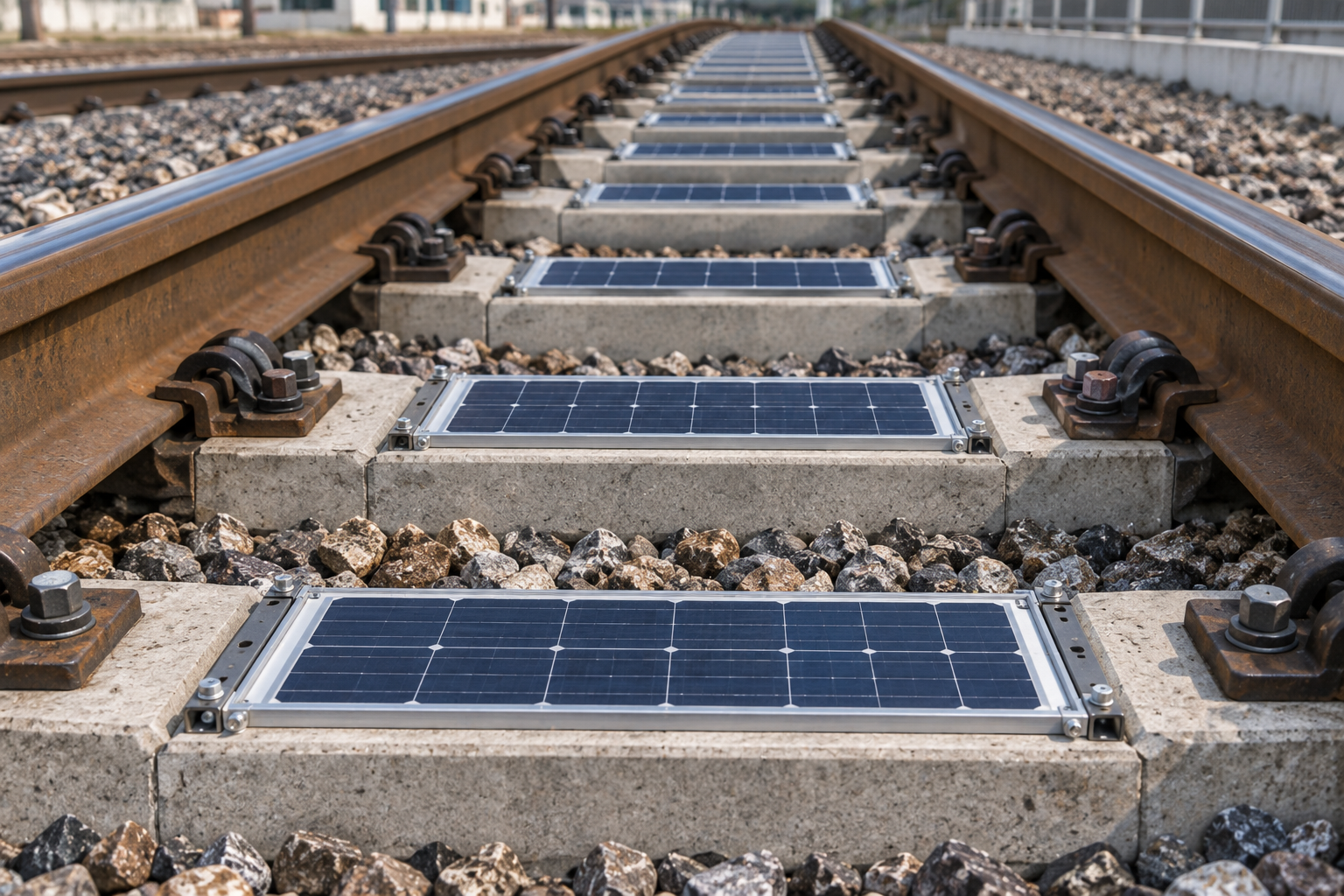
An international research team has investigated the potential of installing PV systems between railway tracks in South Korea as a way to expand solar generation without competing for scarce land. The researchers found that suitable sections of five surface railway corridors could host more than 8.5 MW of PV capacity, highlighting the potential of existing transport infrastructure to support solar deployment in densely populated areas.
“Dense metropolitan regions need renewable energy strategies that do not compete for land. Railway corridors offer one such option because they already occupy linear public space and connect closely to traction and distribution infrastructure,” the researchers said.
“Our study examines whether the transport system can use PV electricity generated within railway corridors, how much electricity must be exported or curtailed, what storage capacity is needed, and how financial uncertainty affects the probability of payback,” they added.
The researchers assessed five surface railway corridors: the Gaya and Donghae lines in Busan, above-ground sections of Seoul Subway Line 1 and Daegu Metro Line 1, and selected open sections of the Gyeongbu Line, which connects Seoul and Busan.
Using OpenStreetMap railway geometry and a Korean digital surface model in QGIS, the researchers excluded tunnels, viaducts and track sections with annual shading losses exceeding 15%.
They simulated the installation of 1.05-meter-wide flexible monocrystalline silicon laminates, with a minimum clearance of 150 mm from the railhead on each side. The laminates had a nominal efficiency of 21.4% and a power density of 214 W/m².
The simulations assumed soiling losses of 3.5%, including an additional percentage point to account for railway dust, as well as combined mismatch and DC wiring losses of 2%. The researchers also assumed inverter efficiency of 97.5% and an albedo of 0.18 for ballast and concrete sleepers. They validated the generation model against 17 months of measured rooftop PV production in Busan.
The group then simulated railway PV output and matched it against hourly traction-demand profiles to calculate self-consumption, grid exports and curtailment. It also compared centralized and distributed electrical connection configurations and assessed lithium iron phosphate (LFP) battery capacities of up to 2 kWh per kilowatt of installed PV capacity.
The researchers evaluated the system’s financial performance over 20 years, assuming annual PV module degradation of 0.45%. They conducted sensitivity analysis and a 10,000-run Monte Carlo simulation to account for financial uncertainty.
“The screening identified 28.4 km of suitable surface railway corridor and 39,760 m² of installable area. This corresponds to 8.51 MW of photovoltaic capacity, based on the corrected module density of 4.67 m²/kW for a 1,435 mm standard-gauge corridor,” the researchers said.
They estimated annual generation at 9.95 GWh, with a capacity-weighted capacity factor of 13.4%. Without storage, 62.3% of PV generation coincided with traction demand. Of the remaining 37.7%, 19.8% could be exported to the grid and 17.8% would be curtailed.
The researchers found that a 0.5 kWh/kW battery could reduce the unabsorbed surplus from about 38% to 8.5% of generation. Adding the battery would increase the levelized cost of electricity by about 10% when round-trip storage losses are charged against delivered energy. Before accounting for those losses, the increase would be 9.0%.
“The probabilistic analysis yields a median levelised cost of energy (LCOE) of 170 USD/MWh on a delivered-energy basis and a 68% probability of payback within 12 years with a 40% capital subsidy, compared with roughly one-third without a subsidy,” the researchers concluded.
The findings are presented in the study “Climate-resilient urban energy infrastructure through rail-integrated photovoltaics in land-constrained South Korea,” published in Engineering Science and Technology, an International Journal.
The research team included scientists from Dong-A University and Kyungsung University in South Korea, the Sumatra Institute of Technology in Indonesia, and the Higher Colleges of Technology in the United Arab Emirates.
This content is protected by copyright and may not be reused. If you want to cooperate with us and would like to reuse some of our content, please contact: [email protected].


