







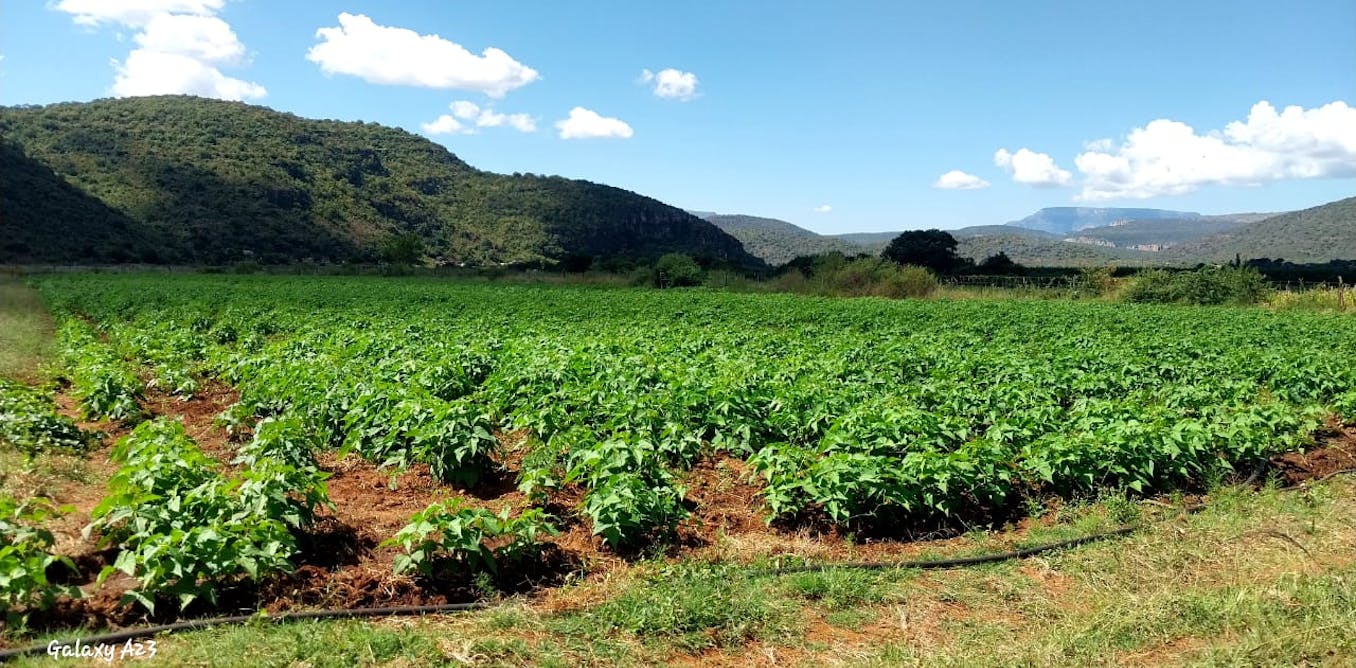
The growing use of toxic agricultural chemicals including fertilisers is also driving a scaling up of sustainable agrochemical alternatives.
In South Africa, I’ve been exploring why small-scale farmers resist switching to these more cost-effective and environmentally friendly solutions, such as “biological fertilisers”. Rural small-scale farmers are hesitant about these non-toxic bacterial alternatives because they aren’t readily available or widely understood.
One such biological fertiliser is made from rhizobia. This bacteria converts atmospheric nitrogen into a nutritional form that can be absorbed easily by the roots of plants known as legumes. This process is called “nitrogen fixing”.
Biological fertilisers harness the power of these nitrogen-fixing bacteria to enhance the growth of legume crops such as bambara nuts, common bean and soybean, by making soil nutrients more available. Legumes are cost-effective and protein-rich crops.
My PhD research showed how rhizobia improves the growth of cancer bush, a multipurpose plant native to South Africa. Rhizobia also enhances the therapeutic effect of medicinal plants such as cancer bush, which is traditionally used as an anti-inflammatory treatment or to boost the immune system.
Some rhizobia tolerate extreme environmental conditions and can enhance plant growth even during drought. Rhizobia also improve soil health, increase microbial diversity and nutrients.
Unlike chemical fertilisers which easily wash away when it rains, rhizobia-based biological fertilisers persist in the soil for a long time. This means repeat applications aren’t often required.
Growing up in rural South Africa, I saw how small-scale farmers were hugely dependent on chemical fertilisers. Today, many of these farmers today are aware of the negative effects of synthetic chemical fertilisers. Yet they continue to use them.
Chemical fertilisers reduce soil fertility and pollute the environment. Synthetic agricultural chemicals like these can cause eutrophication – when nutrients such as phosphorus and nitrogen overload streams and rivers, causing excessive algal growth. This depletes oxygen in the water and poisons aquatic life.
In contrast, Rhizobia-based fertiliser technology is cost-effective, non-toxic and sustainable. But even with hundreds of these fertilisers now on the market, their adoption among small-scale farmers remains very low.
Reasons for reluctance
To understand why farmers resist adopting sustainable alternatives, I spent a day in Phiring, a village in Limpopo Province, South Africa. This farming community still relies heavily on financial support from the government to pay for agricultural supplies such as fertilisers.
I spoke to 15 farmers about their cultivation practices and perceptions of both rhizobia-based and chemical fertilisers. Restricted access to biological fertilisers and limited knowledge about their correct application discouraged them from switching. Most farmers wanted to know where to buy biological fertilisers and how best to use them.

Mokgadi Hlongwane, Author provided (no reuse)
One farmer noticed that his farm had a low crop yield compared to more recently established farms. The soil on his land had probably deteriorated due to extendsive use of chemical fertilisers over a decade.
Some farmers wrongly assumed that crops treated with biological fertilisers would grow slowly, rot quickly and have a low crop yield. As a result, they had not tried these alternatives to chemical fertilisers.
Convenience and access
This challenge is compounded by the abundant supply of chemical fertilisers. The Comprehensive Agricultural Support Programme is an initiative from the Department of Agriculture, Forestry and Fisheries that supports small-scale farmers across South Africa. It provides vast amounts of chemical fertilisers for free.
Research on the low uptake of climate‑smart agriculture technologies identifies limited funding, low awareness and poor access to agricultural inputs as key barriers. Providing biological fertilisers through the same government programme would significantly increase adoption.
The farmers told me that their choice of cultivation practices is influenced both by convenience and access. Most farmers learn from their peers and seldom follow the instructions from the fertiliser manufacturers, so are likely to over- or underdose.
They rarely conduct soil analysis. This makes it difficult to select fertilisers that are suitable for their land, soil conditions or crop. In these cases, soil health further deteriorates and crop productivity declines.
The farmers I spoke to acknowledged their lack of knowledge about fertiliser applications, cultivation systems and available alternatives.
When legume crops are treated with rhizobia fertilisers, the increased nutrients and microbial diversity in the soil can also benefit non-legumes such as maize and wheat. this can happen through intercropping (simultaneously planting non-legume with legumes) or rotational cropping (planting legumes in one season and another crop in the same field the next).
There is huge potential for farmers to gain by switching from conventional agrochemicals to rhizobia-based fertilisers – but first, the financial constraints and misconceptions must be addressed.


