






Women preparing meals for more than 1,000 students at Tiyani Secondary School in South Africa’s Limpopo province no longer rely only on firewood. Instead, much of the cooking is powered by biogas generated from cattle dung collected from Tiyani village. This community-led project could reduce pressure on forests while cutting greenhouse gas emissions, experts say.
The pilot project was established in 2022 with support from the University of Venda.
Every weekday, four community volunteers from Tiyani use an ox-drawn cart to collect cattle dung from nearby households. The manure is then mixed with water and fed into a biogas converter digester, an airtight, oxygen-free container where microbes convert it into methane-rich biogas. The gas is then piped directly to the school kitchen, where it powers the cooking of breakfast and lunch for the school’s 1,054 learners. When there isn’t enough cow dung, the school still supplements with firewood.
“We never imagined that something we regarded as waste could become a source of energy,” Fosta Chavalala, the community project manager of the biogas project, told Mongabay in an interview. “In future, we hope to expand the project” to rely more on gas than firewood.
In a March 2025 article published in the industry magazine ReSource, David Tinarwo, head of the Biogas Research team at the University of Venda, said the project was designed to reduce dependence on firewood while making productive use of livestock waste.
“The demand for firewood was placing pressure on local trees, and the way trees were being cut was not sustainable,” he told Mongabay in an interview. “We wanted to develop a solution that would reduce dependence on firewood while making use of livestock waste that was readily available in the community.”
Bornface Siliya Kenan Zulu, a Zambia-based engineer specializing in renewable and low-carbon energy systems, told Mongabay by email that community-scale biogas projects can significantly reduce methane emissions by capturing gas that would otherwise escape from decomposing manure while providing cleaner cooking fuel.
However, Zulu said their long-term success depends on a reliable supply of livestock manure, regular maintenance of digesters and strong community ownership. “Without a consistent supply of feedstock and local capacity to maintain the system, gas production can decline and communities may lose confidence in the technology,” he said.
While it’s had a promising start, the Tiyani project faces challenges. Volunteers spend hours collecting manure because some cattle owners live too far away or are unwilling to participate, Chavalala said. The school also has only one three-plate gas stove, limiting how much of the available biogas can be used, and additional cooking equipment and better transport would increase the system’s impact, he added.
The digester occupies a 4-by-12-meter (13-by-39-foot) site and is maintained jointly by community volunteers and the school, with funding from the University of Venda.
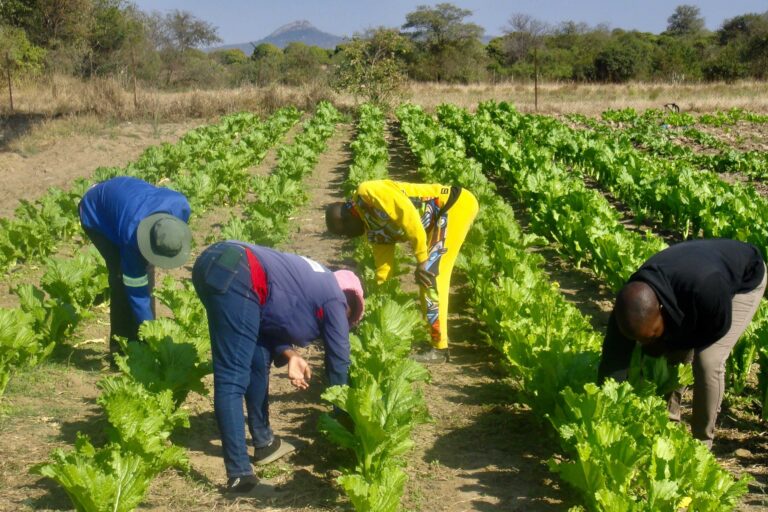
Banner image: Volunteers work in a vegetable field belonging to Tiyani Secondary School where the manure is thrown after gas is extracted. Image by Bernard Chiguvare.


