







There’s a prevalent trend in contemporary documentary filmmaking where directors are looking inwards towards their own lives and experiences. British Romanian filmmaker Rachel Taparjan’s “Something Familiar” is the latest entry within this mode. Even the title belies that. However Taparjan valiantly deconstructs her personality by examining her past and unearthing her demons and traumas. “Something Familiar” might be too self-reflective, even navel-gazing, but it’s strong nonetheless.
Taparjan was adopted as a baby by a British couple from a Romanian orphanage. The couple’s daughter died when she was only 6 years old and they adopted Taparjan as a replacement. In archival TV footage we see the adaptation, and it seems odd that they are openly talking about their new daughter in that way. The film cuts to Taparjan in the present going back to Romania to trace her origin and find her birth mother. The adoption documentation shows she has an older brother and a sister. She reunites with some of them, tries to make familial connections and slowly reveals what happened to her in young adulthood. The film’s narrative becomes a play of expectations versus reality and nature versus nurture. Was Taparjan destined to relieve her ancestors’ trauma even if she grew up in a completely different environment?
Popular on Variety
However “Something Familiar” strangely starts with another adoptee’s story, Mihaela. She was adopted from the same orphanage as Taparjan by an American family. The filmmaker escorts her back to Romania to try to find her birth mother. This part of the film seems unnecessary as it attempts to say something universal about how all adoptees feel. Then it unceremoniously drops the subject when Taparjan gets to tell her own story. When Mihaela appears in the end credit sequence to tell the audience about her current life, it takes a minute for us to remember who she is, because what came after her has been much stronger.
Taparjan reconnects first with her brother, Alexandu. Together they search for their sister Ana Maria and the filmmaker learns that her birth mother has passed. The brother and sister relationship is immediately warm with both finding an instant camaraderie. Taparjan says in voiceover how much she appreciates seeing her face on someone else’s and the comfort that brings. When they finally find the sister, Ana Maria, the family’s secret history and its trauma is fully revealed. Then the filmmaker looks at herself and unpacks her own past and what drove her to behave the way she has. Both sisters are heartbreakingly vulnerable in front of the camera and these scenes are the strongest in the film.
However, an earnestness mars most of the proceedings. There’s a lot of couch psychoanalysis and announcements by the protagonists of being “survivors.” That may be true but the camera is fixed at them and they are acutely aware of its presence. Sometimes they look straight into the lens, which starts to feel more staged than natural. Taparjan’s voiceover fills the soundtrack with the same earnestness. Only in conversations, and even rather awkward silences, does the film reveal more emotion than the script ever can. If any catharsis was felt by the protagonists, it certainly did not come from the forced talks and the solemn narration.
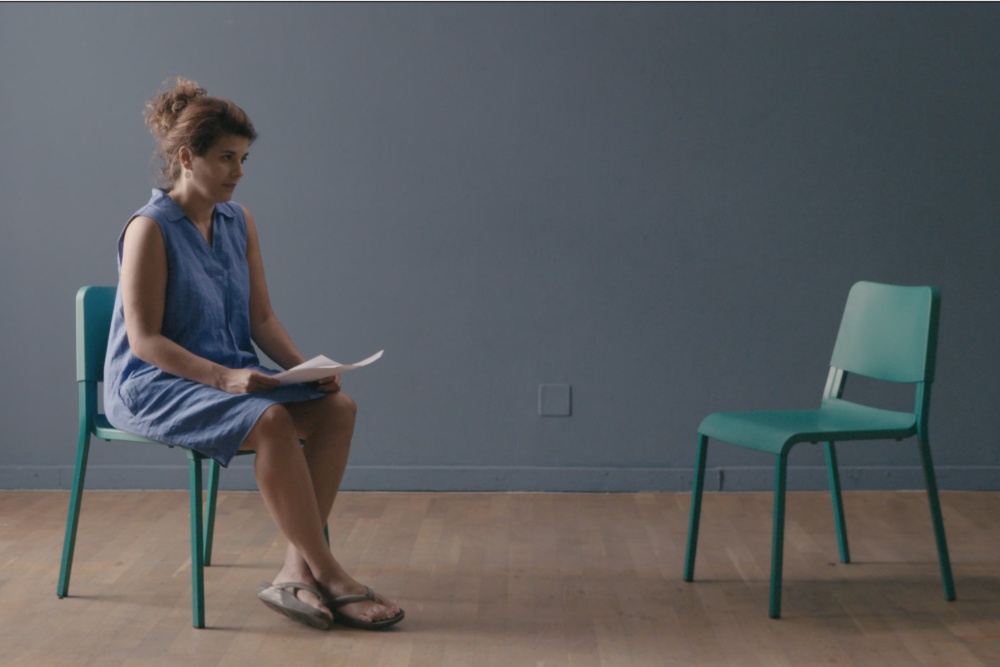
In lieu of confronting her mother about the reason for her abandonment, Taparjan works with actors. Several play her mother and she gets to ask pointed questions of them, they improvise the answers. The audience is never privy to how the filmmaker actually feels during these scenes. The actors, though, show genuine emotion and react in many different ways. By the end of the film it’s clear that these performed scenes get the filmmaker to arrive at an understanding about her mother that has eluded before.
“Something Familiar” is most compelling when it lets go of the need to explain itself. Taparjan’s search for identity, belonging and inherited trauma is undeniably affecting. Within its rough edges and moments of artifice, something raw and unresolved is uncovered. Somehow Taparjan finds a way to reckon with her own messiness with vulnerability and lets go of the blame and shame game that many parents, children and siblings fall into.


