Simone Rocha delivered a galloping dose of fashion magic this afternoon. She put together a characteristically considered potion of inspiration, marinating it deeply through her design process. Then she conjured a spellbinding atmosphere in which to serve the results. “I’m hoping it will feel like a big visceral feast,” she said backstage pre-show. Rocha’s ingredients were all connected, sometimes loosely and sometimes less so, to Irish equine culture: once the crowd had found its way into the beautiful venue, we were off.
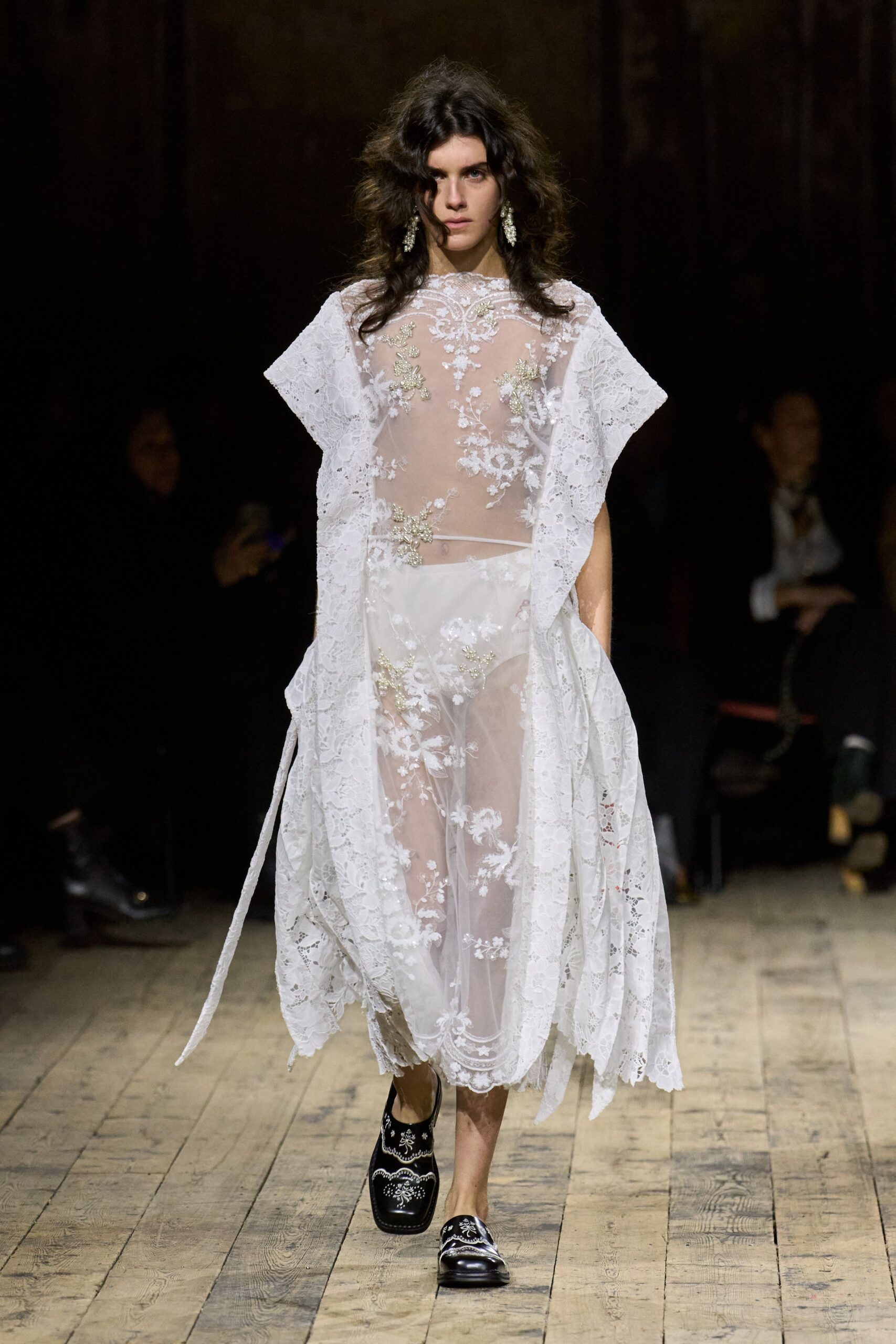
Her starting point was Enbarr, the all-white horse which in Irish mythology is the only form of transport to Tir na nÓg the land of eternal youth. This much pursued symbol was epitomized through the opening and closing looks of the show, framed by the evocatively rundown grandeur of Alexandra Palace. The color palette was shaped by the paintings of Irish artist Jack B. Yeats (brother of William B.), who depicted Tir na nÓg. Yeats’s female siblings Lily and Elizabeth, dismissed by James Joyce in Ulysses as “the weird sisters,” delivered a context for some of the early 20th century-feeling womenswear and tailoring: the tea dresses, the glittering cloches, and the boxy shoulders and wide pants in sturdy woollens.
Two more key ingredients were Mike Newell’s 1992 film Into the West (which is also Tir na nÓg and opens with a vision of Enbarr) and Perry Ogden’s 1999 book Pony Kids. Both of these portray the relationship between Irish traveller communities and their ponies, plus, crucially, an adjacency between that generations-old relationship and the contemporary worn vernacular of sportswear. It was this adjacency that lent Rocha the creative rationale for a large new collaborative collection with Adidas Originals, enabling its intertwining within the body and context of her mainline. She said: “I wanted this mythicism cut through with reality. It’s something I’ve thought about for a really long time, and seen for a long time in my head. I think it’s giving an interesting feeling.”
And it did. Look 37’s picot-edged, angularly paneled, ruffle bibbed dress in ivory paper nylon with Rocha-redesigned Adidas trefoil seemed the greatest sinew-stretch between the two brand identities on show: contextualized by set up, however, no strain was evident. Her side-split, three-stripe track jackets waisted with lace layers and ruffle-fronted track pants were similarly settled by placement in Rocha’s broader storytelling. One big point of overlap was the furry white or black split snorkel hoods that featured on Rocha-shaped variations of the MA1 jacket in olive nylon. Often the hood itself was detached and used as a collar above outfits shaped from different corners of the season’s spectrum; split fronted chalk stripe suiting, or a crinolined gown assembled by hook, eye, and scarlet ribbon.
These ribbons were part of a wide-roaming rosette story that saw them awarded across the collection. One supreme show-pony dress was composed apparently entirely of long ribboned rosettes, while two olive taffeta dresses were each presented as a single, imagined girl/rosette. Pockets shaped to resemble ribbon knots were built at the hip into some looks.
Shiny grommeting and harness-evoking hardware contrasted with the shaggy animal roughness of a dark shearling gown, collars, and gloves. More conventional shearling garments, long coats and jackets, were placed to add a stabilizing third point of contrast to the prettified sportswear beneath. This ribbon-strewn fashion enmeshing of the weird sisters, the pony boys, and Celtic fable sometimes appeared untamed in its eclecticism: however despite the wildness of the ride, Rocha’s hand stayed firmly on the reins.