







By
Melissa Fleur Afshar is a Newsweek reporter based in London, United Kingdom.
Her current focus is on trending life stories and human-interest features on a variety of topics ranging from relationships, pets, and personal finances to health, work, travel, and family dynamics. She has covered current affairs, social issues, and lifestyle stories extensively.
Melissa joined Newsweek in 2023 from Global’s LBC and had previously worked at financial news publication WatersTechnology, tmrw Magazine, The Times and The Sunday Times, Greater London-based radio broadcaster Insanity Radio, and alongside other journalists or producers for research purposes. Since joining Newsweek, Melissa has been especially focused on covering under-reported women’s health and social issues, and has spent a large part of her time researching the physical and mental impact of both the contraceptive pill and abusive relationships.
Prior to that, Melissa had been specialized in reporting on financial technology and data news, political news, and current affairs. She has covered data management news from industry giants like Bloomberg and Symphony, alongside the death of Queen Elizabeth II, the U.K economy’s 2022-pound sterling crash, multiple National Health Service (NHS) strikes, and the Mahsa Amini protests in Iran.
A show that she produced and presented at the Greater London-based community radio station, Insanity Radio, was awarded ‘Best Topical News Show’ and the runner up award for ‘Best New Radio Show’ on the network.
She is a graduate in MA History from Royal Holloway, University of London.
Languages: English, Persian.
You can get in touch with Melissa by emailing m.afshar@newsweek.com.
You can follow her on X or Instagram at @melissafleura.
Life and Trends Reporter
🎙️ Voice is AI-generated. Inconsistencies may occur.
NASA satellite imagery has revealed the dramatic scale of the wildfires scorching parts of southwestern New Mexico, as two major fires—the Buck and Trout—continue to threaten homes, infrastructure and air quality.
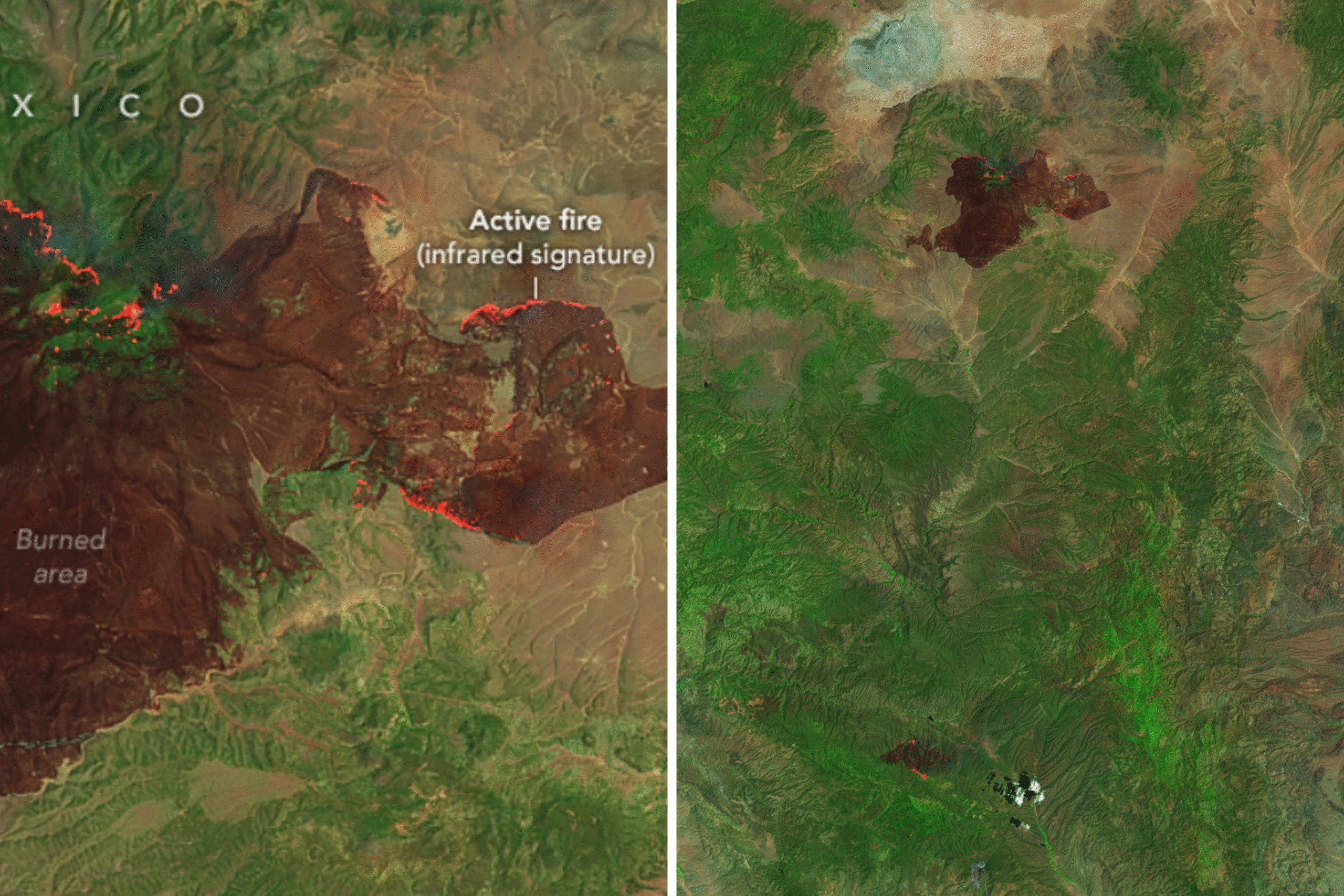
Captured on June 14 by the Operational Land Imager (OLI) aboard Landsat 8, the satellite images offer a stark visual contrast between scorched earth and still-green terrain, showing the devastation caused by the fast-moving blazes.
False-color imagery, which combines shortwave infrared, near infrared, and visible light, draws the viewers attention to the impacted areas. Actively burning areas appear bright orange in the images, while blackened ground from earlier fire activity darkens the landscape south of Lake Roberts in Grant County.
Together, the Buck and Trout fires had charred more than 80,000 acres by June 18, less than a week after they started on June 11 and 12, respectively.


NASA Earth Observatory / Michala Garrison
Windy, dry and tinder-laden conditions fueled their swift expansion in the area.
By that date, the Trout Fire had advanced nearly to the edge of Lake Roberts and was threatening communities along Sapillo Creek. Residents from approximately 2,000 homes had been placed under evacuation orders, according to local news reports.
In contrast, the Buck Fire showed slower movement and was 25 percent contained.
New Mexico’s Governor Responds
A federal emergency declaration was issued by New Mexico’s governor on June 17 in response to the Trout Fire’s rapid advance. The designation enables state agencies to request assistance from federal and other resources.


NASA Earth Observatory / Michala Garrison
More than 875 firefighting personnel—including hotshot and hand crews, bulldozers, helicopters and fixed-wing aircraft—were engaged in suppression efforts by June 18, according to InciWeb, the national incident information system.
Despite the growing perimeter, no infrastructure damage had yet been reported.
NASA’s monitoring did not stop with images. Its air pollution tracking satellite, TEMPO (Tropospheric Emissions: Monitoring of Pollution), detected plumes of nitrogen dioxide and formaldehyde in the smoke on June 17.
These pollutants, which can aggravate asthma and other respiratory conditions, were measured with TEMPO’s sensors. The satellite, launched to provide hourly air quality readings over North America, measures pollution down to a resolution of just a few square miles.
NASA continues to monitor the fires and air quality, providing data to support firefighters, emergency responders, and public health officials.
Do you have a tip on a science story that Newsweek should be covering? Do you have a question about the wildfires? Let us know via science@newsweek.com.
Is This Article Trustworthy?


Newsweek is committed to journalism that is factual and fair
We value your input and encourage you to rate this article.
Newsweek is committed to journalism that is factual and fair
We value your input and encourage you to rate this article.
Top stories
About the writer
Melissa Fleur Afshar is a Newsweek reporter based in London, United Kingdom.
Her current focus is on trending life stories and human-interest features on a variety of topics ranging from relationships, pets, and personal finances to health, work, travel, and family dynamics. She has covered current affairs, social issues, and lifestyle stories extensively.
Melissa joined Newsweek in 2023 from Global’s LBC and had previously worked at financial news publication WatersTechnology, tmrw Magazine, The Times and The Sunday Times, Greater London-based radio broadcaster Insanity Radio, and alongside other journalists or producers for research purposes. Since joining Newsweek, Melissa has been especially focused on covering under-reported women’s health and social issues, and has spent a large part of her time researching the physical and mental impact of both the contraceptive pill and abusive relationships.
Prior to that, Melissa had been specialized in reporting on financial technology and data news, political news, and current affairs. She has covered data management news from industry giants like Bloomberg and Symphony, alongside the death of Queen Elizabeth II, the U.K economy’s 2022-pound sterling crash, multiple National Health Service (NHS) strikes, and the Mahsa Amini protests in Iran.
A show that she produced and presented at the Greater London-based community radio station, Insanity Radio, was awarded ‘Best Topical News Show’ and the runner up award for ‘Best New Radio Show’ on the network.
She is a graduate in MA History from Royal Holloway, University of London.
Languages: English, Persian.
You can get in touch with Melissa by emailing m.afshar@newsweek.com.
You can follow her on X or Instagram at @melissafleura.
Melissa Fleur Afshar is a Newsweek reporter based in London, United Kingdom.
Her current focus is on trending life stories and …
Read more


