






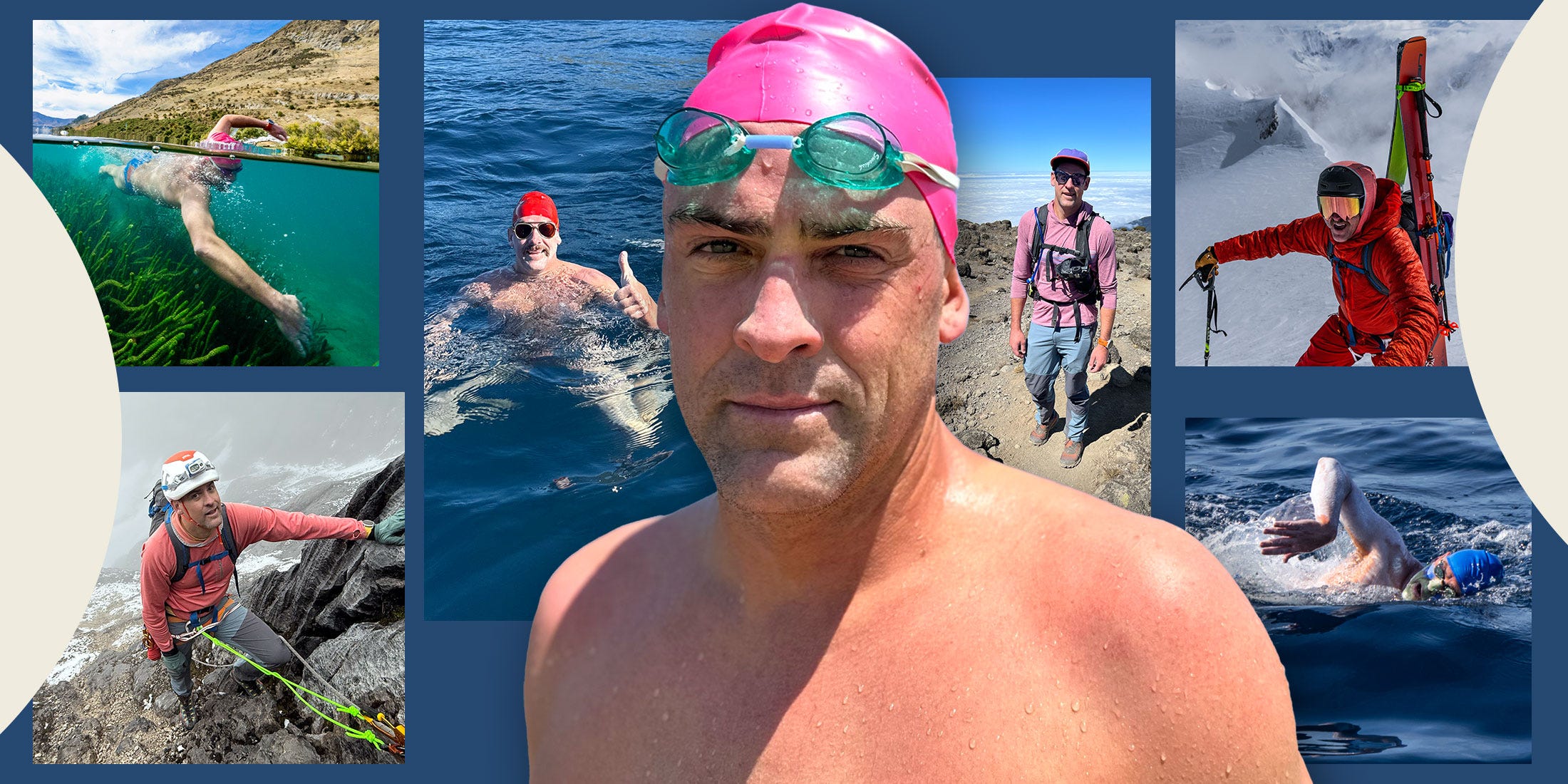
When a lifetime of sports adventures and injuries left Rob Lea facing an ankle reconstruction in 2017, he knew he needed something to do other than just physical therapy afterward. He wanted something to train for. And as a 70.3 triathlon World Champion (2012) and a former All-American swimmer at UC Davis, just another race wasn’t gonna cut it.
“Sitting on the doctor’s table, I decided I was going to swim the English Channel, even though I knew almost nothing about the English Channel,” the Utah-based realtor says.
So when he got home and started reading, he “stumbled on all these blogs talking about what’s harder, Mount Everest or the English Channel?” So of course, he decided to find out.
He wasn’t a stranger to mountaineering; he’d already climbed Aconcagua (2009) and Denali (2010). To compare the difficulty of the ascent and the swim, he figured he’d need to do them pretty close together. So in 2019, he climbed Everest and swam the English Channel within 6 months of each other and hey, if your background is triathlon, you throw in a
cross-country bike ride that year as well. (And got married to a professional ski mountaineer. “It was a busy six months there,” he says.)
Those became part of the epic Double Seven challenge—completing the Seven Summits (climbing every continent’s highest peak) and the Oceans 7 (the most iconic channel swims: Catalina, North Channel, Strait of Gibraltar, Cook Strait, Molokai Channel, and Tsugaru Strait). He’s the first to do this 7×7, and what started 17 years ago finished on June 30 with his crossing of the Tsugaru Strait.
So you’ve got to figure he has a detailed training plan, the latest trackers, and a precise nutrition strategy—the kind of stuff endurance athletes love to obsess over. How much does he swim in a build week and does he go on a 3- or 4-week training cycle? “I would love to tell you that my training is that precise, but I work a lot more off feel. When I was doing triathlon, watches were getting more popular, but I don’t ever think I wore one. I just kind of work off feel and get in that zone where I can keep going for a long time,” he says. He can’t really pinpoint how training changed at age 44 compared to what he did when he started at age 27 other than more life obligations often meant less time to train.
The one thing he did really take pains to dial in on: Cold tolerance. Before the English Channel swim, “I knew I could swim a long way, but you and only do so much if you get hypothermia.” Cold baths, putting on weight, spending time swimming in cold water—he did all of it.
But it wasn’t like he completely winged the rest. While he says he “relied on his overall fitness and endurance” to complete the challenges, he and his wife did a lot of technical training to be more comfortable being in the big mountains.
Same with nutrition. The job got done without optimizing the life out of it. Land was about keeping weight on to survive the cold channel swims, but not analyzing every nutrient. At sea, he explains with the matter-of-factness that he seems to have brought to this whole adventure, he knew what he needed, sticking to a feeding schedule, a calculated number of calories, and liquid feeds so he wouldn’t give up progress to currents while taking in what he needed.


Lea on Everest (left) and swimming the Tsugaru Strait (right).
There’s that joke about “how do you know if someone’s done an Ironman” and the punch line is, “don’t worry, they’ll tell you.” But Lea’s not tripping over himself to talk about his successes. He wasn’t preoccupied about potential failure. “I think I always thought that failing was a possibility, but I was never really worried about failing, and that’s maybe what helped me get through these, because I was never stuck on that in my head.”
If anything, he talks about the lessons learned the hard way, like getting SIPE (swimming-induced-pulmonary-edema) while swimming the Molokai Channel in 2025—a potentially lethal condition he didn’t realize he had until many hours after he finished (he went to an ER). It’s not clear why SIPE happens, often happens to highly trained swimmers, and can happen again.
Even so, he got in the water this year to swim the very last leg of the challenge, Tsugaru Strait. “I got in with enough confidence and enthusiasm that I could get this swim done, but also knowing that anything could go wrong, whether it’s out of my control, like currents and weather or things happening in my own body or mind that might stop the swim,” he says. In any of these adventures, “half the time I didn’t think I was going to succeed. I think that’s probably the biggest lesson of the whole challenge. You just have to get in.”
What happens after 17 years of chasing the all-consuming Double 7 challenge? “I think giving myself some leeway and gratitude to rest and recover is probably the first thing,” he says. “And we are going to run the New York City Marathon for charity in November.”

Marty Munson, currently the health director of Men’s Health, has been a health editor at properties including Marie Claire, Prevention, Shape and RealAge. She’s also certified as a swim and triathlon coach.


