

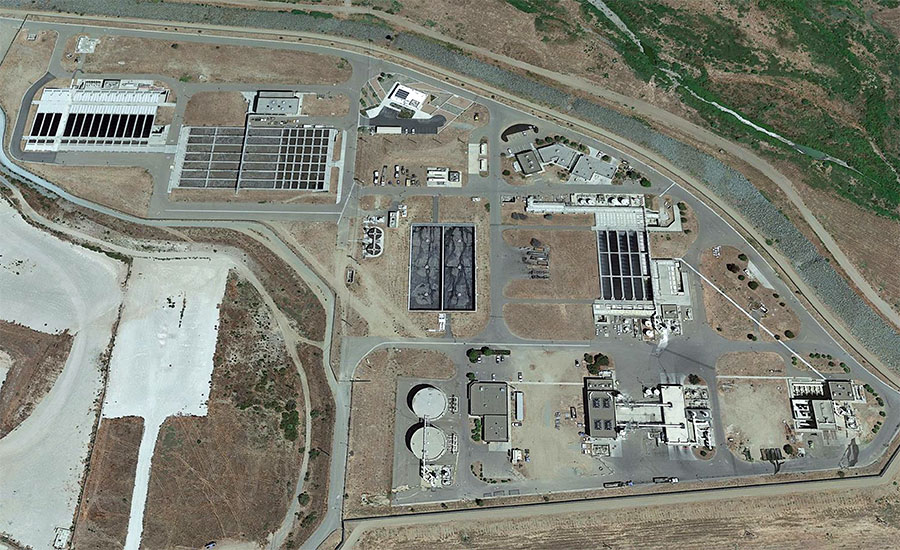

PCL Construction has a $42.4M progressive design-build contract to expand the South Bay International Wastewater Treatment Plant in San Diego after three years of cross-border sewage flows from Mexico.
Photo courtesy of U.S. Section of the International Boundary and Water Commission
The design-build team of Stantec and PCL Construction detailed the planned $250-million expansion of the South Bay International Wastewater Treatment Plant in San Diego, Calif., a project that has recently been fast-tracked due to the ongoing transboundary raw sewage flows from Tijuana, Mexico.
Michael Watson, senior vice president and major projects lead for water at Stantec and Jeff Newman, operations manager at PCL, said at a public meeting held by the U.S. section of the International Boundary and Water Commission June 12 that they had validated that 50 million gallons per day can be treated by the plant after the expansion and will soon put out early work packages. The expansion’s previous goal had been 35 million gpd.
Watson and Newman said the project will include a new integrated headworks, a new chemical system, two additional primary sedimentation tanks, 10 new secondary sedimentation tanks, seven new activated sludge tanks, a new sludge thickening and storage system and a new 12-kV electrical building with new switch gear and new transformers from San Diego Gas & Electric.
“In partnership with PCL, we will work hard to provide the most seamless plant expansion possible. We believe the repairs and changes we are undertaking will make a measurable difference both now and in the future,” Watson said.
U.S. Commissioner Takes Hard Line
New IBWC U.S. Commissioner Chad McIntosh told local officials and attendees at the forum that even after the expansion they would continue to press Mexico to halt the cross-boundary sewage and chemical flows into the Tijuana River which eventually flow into the Pacific Ocean near the South Bay community of Imperial Beach.
“What you have been going through over the last few decades has been and is unacceptable,” McIntosh said. “The impacts you’ve all experienced from the Mexican sewage that came over, that’s been coming over the border, is unacceptable. The odors, the beach closures, aerosols, it’s all unacceptable. You’ve been going through a lot.”
McIntosh said he became aware of the problem when he was deputy acting Environmental Protection Agency commissioner during the first Trump administration. He said he was shocked at the lack of progress on the cross-boundary problem and promised attendees the South Bay plant expansion would start soon.
Officials at the meeting said that some of the pipes that are part of the International Collector Project sending sewage to both the South Bay Plant and the Punta Bandera Plant on the Mexican side, which had ruptured during construction, have been repaired, and sewage flows into the Tijuana River from it have been mitigated.
“If you look on the river gauge for the last week or 10 days, the river flow is way down. It’s between six and eight and 10 million gpd now, instead of 24 or 30,” McIntosh said. Then, on June 15, there was transboundary flow at Del Sol Canyon Collector due to a drinking water line leak in Mexico that lasted just over an hour until it was repaired.
Due to a partially clogged conveyance line between the Del Sol Canyon Collector and the junction box two collector box that leads to the South Bay Plant, the flow draining out of the collector box was drastically reduced and the extra flow from the drinking water line leak resulted in a spill of 5,000 gallons. McIntosh said the U.S. side of the commission, a treaty-created federal agency under the U.S. State Dept., wants assurances from Mexico that the systems will be properly maintained in the future.
McIntosh said the Mexican military has completed the expansion of the Punta Bandera Wastewater Treatment Plant on their side of the border, and while its a modern treatment plant concerns remain about the systems of pipes on the Mexican side of the border and future maintenance. Tijuana’s population has grown considerably in the last 20 years.
“I’m always concerned about operations and maintenance on the Mexican side,” McIntosh said regarding the recent work. “We want to make sure they don’t have capacity issues 10 years from now like what happened before.”

ENR Associate Technology, Equipment and Products Editor Jeff Yoders has been writing about design and construction innovations for 20 years. He is a five-time Jesse H. Neal award winner and multiple ASBPE winner for his tech coverage. Jeff previously wrote about construction technology for Structural Engineer, CE News and Building Design + Construction. He also wrote about materials prices, construction procurement and estimation for MetalMiner.com. He lives in Chicago, the birthplace of the skyscraper, where the pace of innovation never leaves him without a story to chase.
