






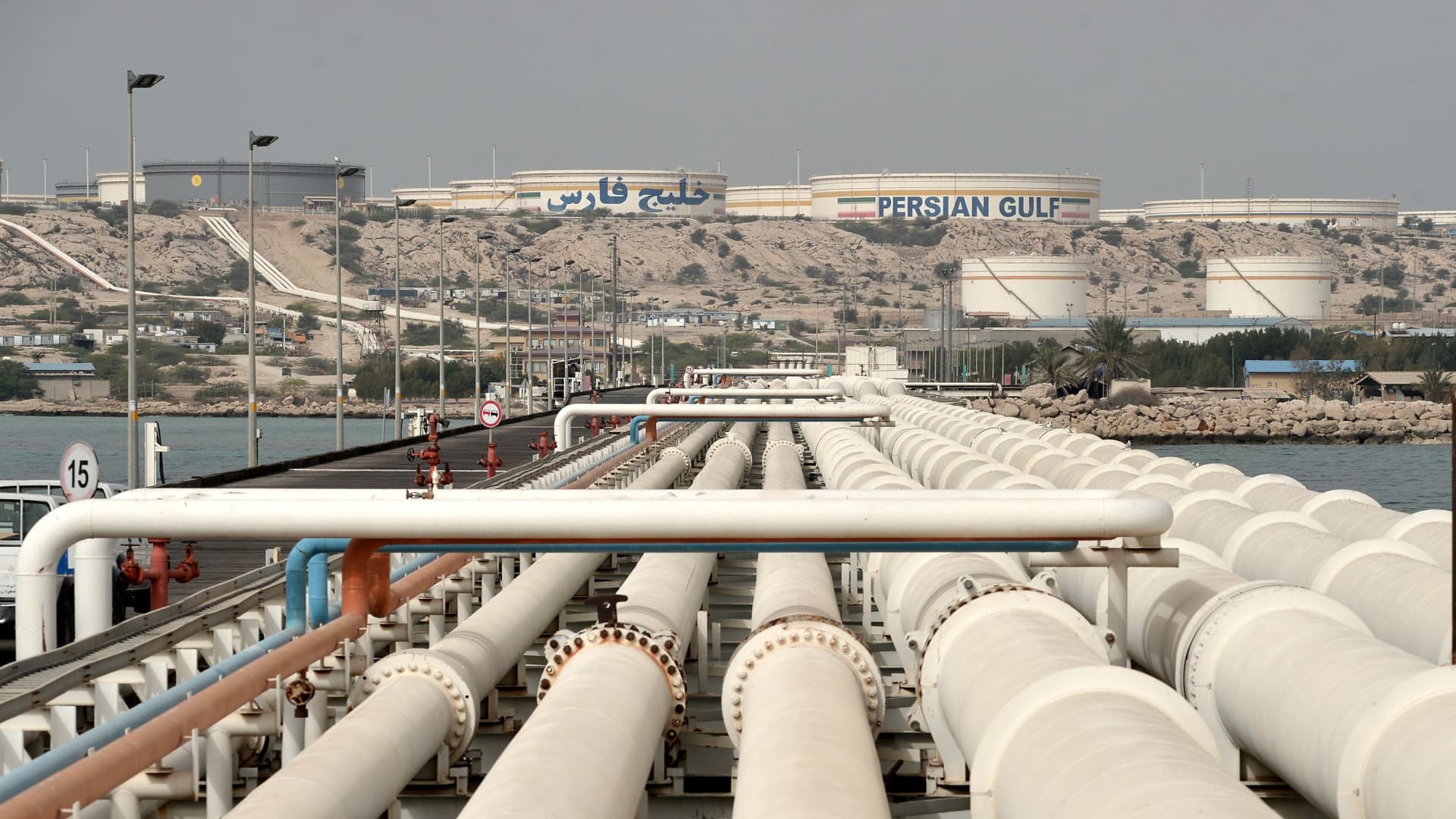
A general view of the Port of Kharg Island Oil Terminal, 25 km from the Iranian coast in the Persian Gulf and 483 km northwest of the Strait of Hormuz, in Iran on March 12, 2017.
Anadolu | Anadolu | Getty Images
Oil prices reversed course to drop in early Asia trading as traders assess President Donald Trump‘s statements on ending the war in Iran.
Trump told his aides that he was willing to end U.S. operations against Iran even if the Strait of Hormuz remained shut, as forcing Tehran to reopen the oil chokepoint could extend the conflict, The Wall Street Journal reported late Monday stateside.
The West Texas Intermediate futures for May delivery reversed gains, dropping 0.72% to $102.14 a barrel as of 10:31 p.m. ET. May futures for Brent crude also pulled back, declining 1% to $111.55 a barrel.
“President’s appetite for a large-scale and extensive sort of saturation bombing of Iran is pretty low,” Matt Gertken, chief geopolitical strategist at BCA Research, told CNBC’s “Squawk Box Asia” on Tuesday, describing Trump’s recent threats as an attempt to “retract and conclude a deal.”
“[Trump] needs, at a minimum, the highly enriched uranium. That’s [something] the Iranians actually could deliver and get regime survival in return,” Gertken said, adding that there’s zero chance the US is going to do a full-scale ground invasion.
“But if we don’t get that within two weeks, [Trump] will have to escalate … target the core [Iranian] regime elements, and that will lead to higher collateral damage.”


Brent
Trump had earlier threatened to expand attacks to Iran’s civilian energy infrastructure, including water desalination plants, if Tehran failed to reopen the Strait of Hormuz.
Trump said Monday that if Tehran didn’t re-open the Strait of Hormuz and agree to a peace deal for ending the war, “we will conclude our lovely ‘stay’ in Iran by blowing up and completely obliterating” electricity plants, oil facilities, and “possibly” desalination infrastructure, according to a Truth Social post.
Iran war has entered its fifth week with hostilities escalating across the region. Tehran hit a fully laden Kuwaiti oil tanker in the anchorage area of Dubai’s port earlier Tuesday.
“The competent authorities in Dubai have confirmed the success of the teams in extinguishing the fire that struck a Kuwaiti oil tanker,” according to a social media post from the Dubai government.
That incident indicates a further tightening of the Islamic Republic’s grip on the Strait of Hormuz, targeting tankers just outside the waterway, said Ben Emons, CIO at Fed Watch Advisors, highlighting renewed risks of further disruption to energy flows.
“The result is a more asymmetric game, with the U.S. leaning toward exit and Iran still incentivized to impose cost,” Emons said.
Trump has regularly vacillated between hailing talks with Iran as productive and warning that he’s prepared to order more military forces to the region.
He told reporters on Monday that Tehran agreed to “most of” the 15-point ceasefire proposal put forth by the U.S. while Tehran has publicly rejected the terms and responded with conditions of its own, including maintaining control over the Strait of Hormuz.
Trump has also reportedly weighed the option of sending in ground forces to seize Kharg Island, a major fuel hub that facilitates 90% of Iran’s crude exports.
Shipping traffic through the Hormuz waterway, which typically carried a fifth of global seaborne oil shipments before the conflict, has virtually ground to a halt since the war began on Feb. 28.
Experts warn that a potential ground operation to seize the Kharg Island could risk raising U.S. casualties and extending the war’s cost and duration.


