



This weekend, during the Fourth of July, the frontline to protect California’s vital waterways is on land. Inspectors across the state are keeping a vigilant watch on boats towed to dozens of lakes and reservoirs, including Lake Tahoe, looking for any indication they are carrying an unwanted and damaging visitor, the golden mussel.
Already this year, three counties in California — Kern, Sacramento and San Joaquin — declared a state of emergency over the arrival of the mussels.
But at the state’s largest reservoir, Lake Oroville, state officials won’t be checking boats at all.
Article continues below this ad
The rollback of boat inspections at Lake Oroville happened in April, in the wake of the mounting threat posed by golden mussels, and it is a surprising decision by the California Department of Water Resources. DWR and the California Department of Fish and Wildlife have launched a statewide campaign to stop the harmful invaders, in part by mandating boat inspections at key waterways.
Native to Asia, the golden mussel first appeared in California in the San Joaquin Delta in October 2024 and measures less than 2 inches in size. In under two years, the mussels have spread over 500 miles, as far north as the West Sacramento Port and down to San Diego. It’s a prolific species that can produce thousands of offspring every time they spawn, leading to damage in both water infrastructure and local ecosystems. In response to the threat they pose, local governments and state agencies have been on a mission to stop them.
So why is the state stopping inspections in Lake Oroville? It’s a decision that seems puzzling for a department charged with safeguarding the water for 27 million Californians across a 700-mile span. But state officials say that reservoir in particular is unlikely to be widely infested due to climate and the nature of the reservoir.
Article continues below this ad
FILE: Golden mussels were first spotted in the state in 2024 and have spread rapidly.
California Department of Fish and WildlifeAdvocates and experts say it’s unknown whether Lake Oroville will be able to escape mussel infestation forever and argue the decision shows California is in dire need of a comprehensive plan to stop the exponentially growing population of golden mussels.
Laura Patten, natural resource director of Keep Tahoe Blue, said the Lake Oroville decision underscores a big problem, that the state “lacks consistent statewide protections against golden mussels.”
Lake Tahoe is cracking down on boaters, in a massive effort to protect the lake from golden mussels. Last month, six boaters in Lake Tahoe were caught attempting to illegally launch in the lake without proper inspections. Officials found tampered inspection seals. Patten said the state’s “patchwork” approach to lakes and reservoirs undermines Tahoe’s efforts and is “creating vulnerabilities across the whole system.”
Article continues below this ad
“Golden mussels don’t care which agency actually manages a reservoir. These things are spreading like wildfire right now,” Patten told SFGATE. “And our concern is that once they get in, invasive mussels do have the potential to really destroy an ecosystem in a place like Lake Tahoe and we can’t fully protect ourselves, as the protections elsewhere are inconsistent.”
A new analysis
State water officials say they aren’t giving up on Lake Oroville. Instead, they are betting on the climate and fluctuating reservoir levels to keep the mussels from gaining a foothold.
A new assessment has shown “a lower risk of golden mussel establishment than was originally anticipated,” an April news release stated. Wildlife officials determined the climate and temperature of the lake mean it’s unlikely for mussels to cause major damage.
Article continues below this ad
FILE: Brazilian researcher Marcela Uliano da Silva tweezes a golden mussel out of its shell at the Carlos Chagas Filho Biophysics Institute, in Rio de Janeiro. Their proliferation can alter phosphorous and nitrogen levels in the water, producing blooms of toxic algae that can be deadly to aquatic creatures and humans.
Leo Correa / Associated PressThe colder climate means the mussels will likely only survive in the top 60 feet of the lake, which currently measures at 876 feet deep. As an acting reservoir, the water level will naturally fluctuate. Officials believe the varying water levels will dry out and kill the mussels before the animal can gain a permanent foothold.
Golden mussels tend to like warm, brackish waters and have reproduced widely in the waters of the San Joaquin Delta where they were first discovered in the state.
Andrea Schreier, director of the Genomic Variation Laboratory at UC Davis, is studying golden mussels in the San Joaquin Delta and said the state water officials’ decision to pull back on monitoring is understandable considering how large the state is and how many resources they have compared with how big of an area they have to manage.
Article continues below this ad
“They do have ecological, physiological underpinning to that decision,” Schreier said. “They have limited resources, and they have to sort of triage what the greatest concerns are. … If there was unlimited money, I’m sure they would be checking those [watercraft] everywhere.”
David Hammond, a senior scientist formerly of Earth Science Labs and currently at the environmental services company SePRO, said, looking at the state’s analysis, Lake Oroville appears unlikely to become widely infested.
“I do understand their logic,” he said, explaining the cooler temperature means a “permanent population” of mussels is unlikely to develop at Lake Oroville.
“Therefore it won’t become a vector for spread, which is normally what you’d be most concerned about with a large lake like that,” Hammond told SFGATE.
Article continues below this ad
FILE: Golden mussels, an invasive species, were discovered in the Delta and in a California reservoir.
California Department of Fish and WildlifeHammond said when the mussels are in larval form, or veligers, they float through the water at about the size of 200 microns: “Smaller than a period on a page,” he said.
“You wouldn’t see them if you just looked at a surface,” Hammond said of veligers attached to a hard surface like a pipe. “You could run your fingers over a smooth surface, and it would start to feel like sandpaper.”
The mussels can appear to grow “exponentially,” Hammond said, and crowd out native species by essentially “smothering” them.
Article continues below this ad
The California Department of Water Resources has not detected golden mussels in Lake Oroville, so far, and officials are continuing to monitor the region for signs of the species’ arrival, said Brianne Sakata, senior environmental scientist with the department, in a statement to SFGATE.
An ‘immediate threat’
There’s no guarantee Lake Oroville will be spared from mussel invasion, especially amid a warming climate, which could put the state’s second largest reservoir at risk of infestation. Lake Oroville is a key component of California’s water system with a storage of 3.5 million acre-feet that helps provide water to 27 million Californians and to over 750,000 acres of farmland.
Experts are just now learning how the golden mussel will react in California waters, especially amid a warming climate, and evidence is growing that they will spread in waters ranging between 41 and 95 degrees Fahrenheit, according to the California Department of Fish and Wildlife.
Article continues below this ad
San Joaquin County, where the mussels were first detected, was the first county to declare an emergency this year in April. And their struggles containing the harmful creatures are a potential warning sign for the rest of the state including Lake Oroville.
Paul Canepa, a San Joaquin County supervisor, told SFGATE they’re looking at multiple options to help stop or slow the mussels including a device that uses vibration to keep them from attaching, and coating pipes in different types of paint.
“We’re trying to just get our arms around it and figure out best practices,” he said.
FILE: Houseboats sit anchored at Bidwell Canyon Marina on Lake Oroville on June 15, 2023, in Oroville, Calif.
Justin Sullivan/Getty ImagesBut so far, county officials are still looking for an effective solution. Already a $100 million floodgate required expensive cleaning after the mussels coated the gate. And in June, Stockton declared a local emergency after an official at Stockton’s Municipal Utilities Department said there was an “immediate threat”
Article continues below this ad
Travis Small, deputy director of water resources in the municipal department, told the city council that common ways to kill the mussels, including copper and UV treatments, were not feasible for the water intake infrastructure. Instead, they were left mainly with “mechanical” solutions, or basically divers using “elbow grease” to manually remove the mussels.
“We have to look at some alternative chemicals that are safe to provide to the public,” he said. “There’s not very many of them.”
If the golden mussels are found in Lake Oroville, the state said it has plans to protect infrastructure by adding a special UV disinfection system to protect the Oroville-Thermalito power plants and the Feather River Fish Hatchery. That would cost about $1 million. Officials also would inspect watercraft after they exit the lake as part of normal protocol to prevent the mussels from spreading to another body of water.
‘Prevention is our only cure’
Patten, with Keep Tahoe Blue, is advocating for consistent state policies that require a uniform response to golden mussels.
Article continues below this ad
The state has over 3,000 named reservoirs, lakes and dry lakes, and boat inspections are conducted by multiple agencies, including California State Parks and Fish and Wildlife.
Keep Tahoe Blue, along with other groups including the California Outdoor Recreation Partnership and the National Marine Manufacturers Association, are pushing for the passage of Assembly Bill 1772, authored by state Assemblymember Diane Papan, which could create a uniform state response to combat the spread of the invasive mollusks. The bill would require the California Department of Fish and Wildlife to develop and implement a statewide program for inspection and decontamination of boats and other watercraft that could transfer the mollusks. California would also enter a watercraft inspection and decontamination program database with other Western states to track the movement of the mussels. It would also expand the Aquatic Invasive Species sticker program to include nonmotorized vessels, which would increase revenue to help cover these costs.
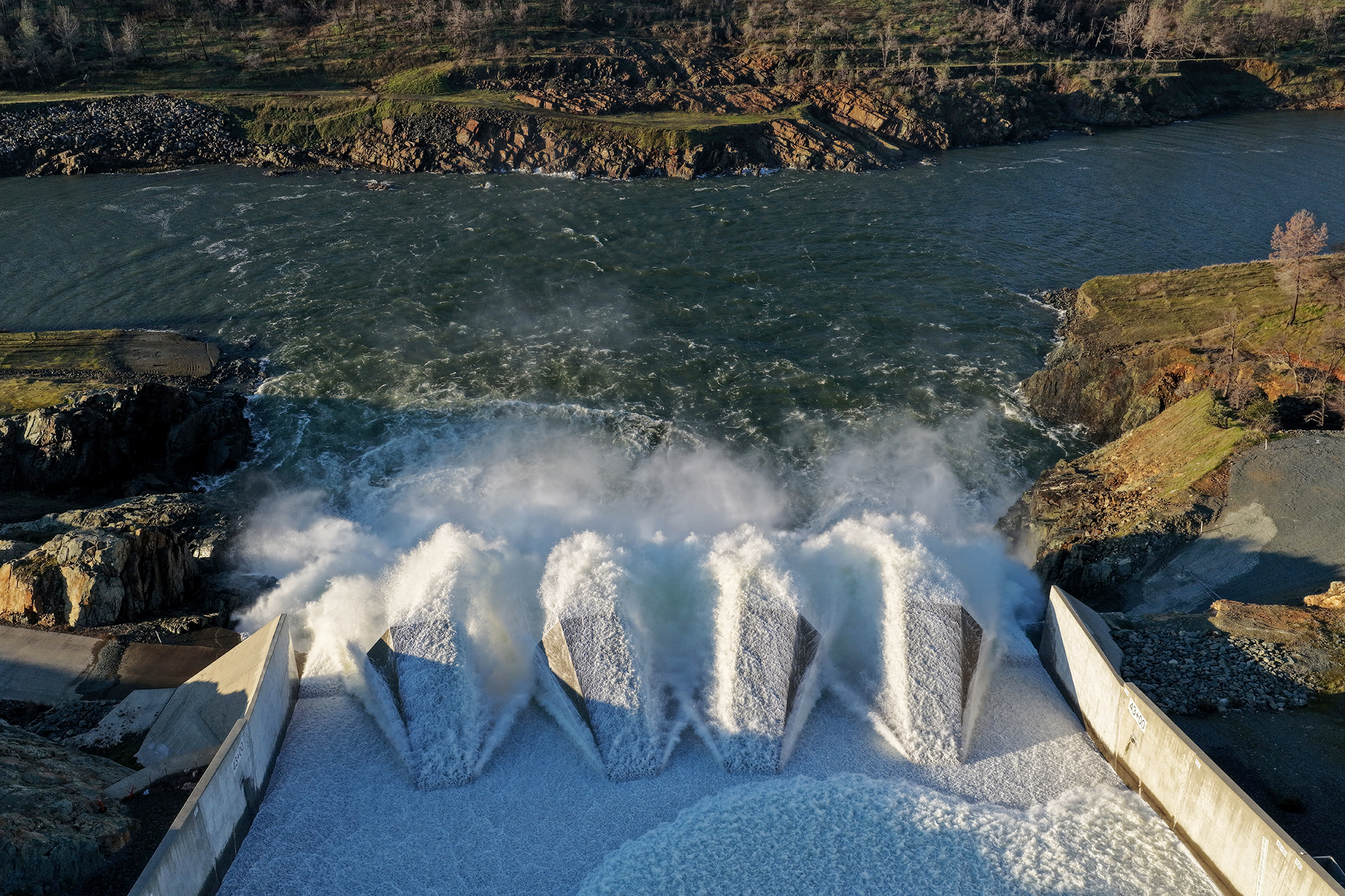
Water is released on the main spillway at Lake Oroville on Jan. 12, 2026, in Oroville, Calif.
Justin Sullivan/Getty ImagesLake Oroville “highlights the need for a statewide strategy,” Papan wrote in an email to SFGATE.
Article continues below this ad


Stay informed, and entertained.
By signing up, you agree to our Terms Of Use and acknowledge that your information will be used as described in our Privacy Policy.


“An ounce of prevention is worth a pound of cure,” Papan wrote. “… While some areas may not currently have the conditions that support the spread of invasive mussels, that may not be true tomorrow. That is why I believe AB 1772 is so important. By establishing a uniform management strategy, we can prevent the spread before it occurs rather than relying on a piecemeal approach, which may carry more risk and cost.” The bill does not specify exactly what a strategy would look like. It only provides the framework for agencies to come up with solutions.
But once the mussels get into a large waterway and start producing, there’s little that can be done to get them out. On a small scale, UV and chemical treatments called molluscicides may be able to prevent widespread damage, scientist Hammond said. But a large and protected body of water such as Lake Tahoe would be unable to rely on such measures to eradicate the invading species.
“If one of these golden mussels get in, they can multiply at a really extreme rate,” Patten said. “There’s really no point of return, because we don’t have the tools to be able to get rid of these. There’s no eradication tool that we can deploy in Lake Tahoe, so prevention is our only cure.”
Article continues below this ad
Gillian Mohney is a breaking news editor at SFGATE. Previously, she worked at Healthline and ABC News, where she covered health, science and national news. She is a graduate of the Columbia University Graduate School of Journalism and has lived in the Bay Area for nearly a decade.


