

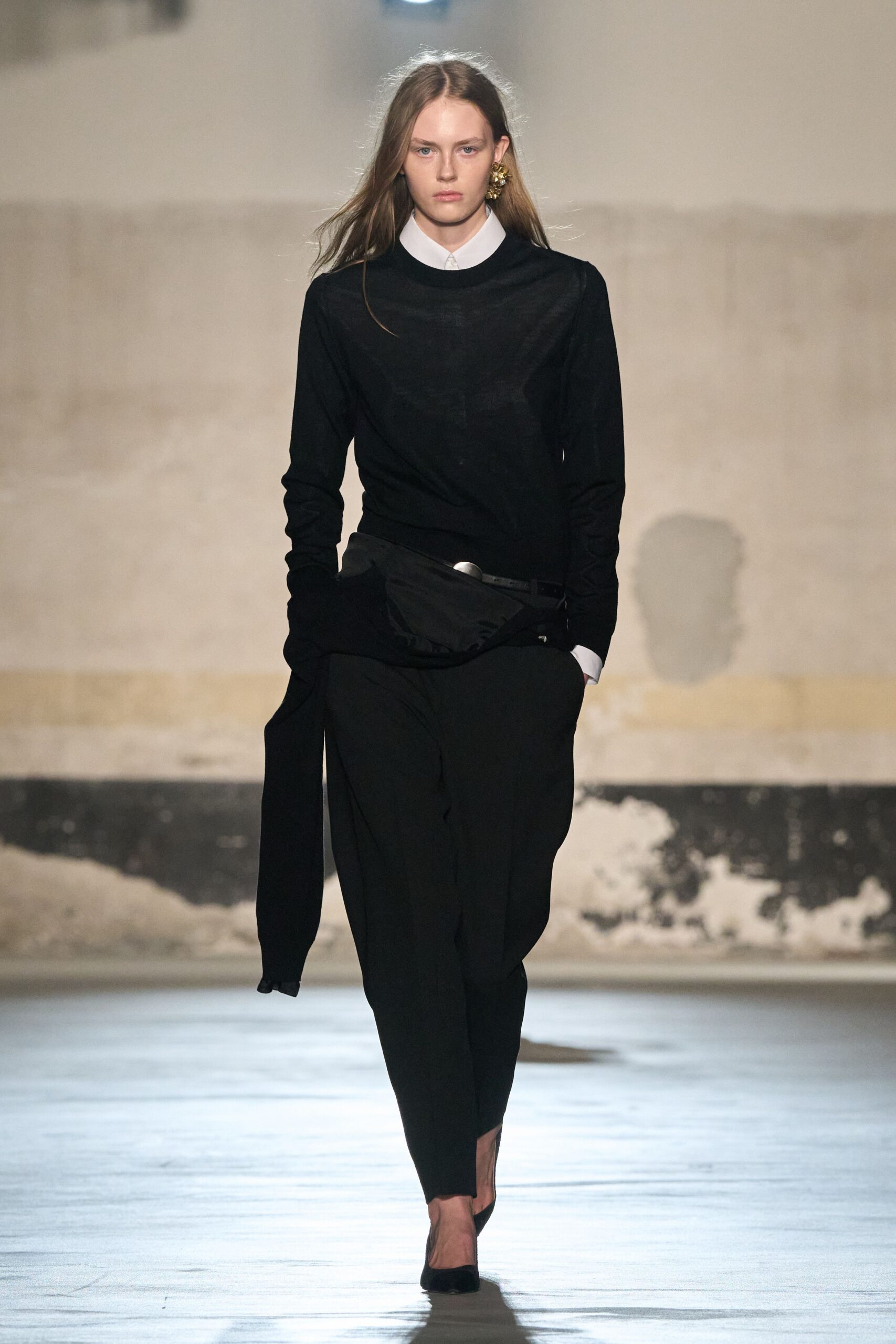
Alessandro Dell’Acqua kicked off his show flipping the usual runway logic; the models walked out in the finale lineup at the very beginning rather than at the end. The trick, he explained, was borrowed from 8½ by Federico Fellini, where the parade in the closing scene isn’t meant as a conclusion but as a carnival of vanities. “And so, the film ends? No, that’s how it begins,” goes the exchange between Guido Anselmi (Marcello Mastroianni) and Claudia (Claudia Cardinale).
A further layer of reference came from the conceptual artist with a taste for the intimate, Sophie Calle, and her book The Hotel, Room 47. In 1981, she took a job as a chambermaid in a Venetian hotel: 12 rooms, 12 stories, an entire gallery of lives to explore. But Calle did more than tidy up; she inhabited her guests in the most literal sense. She spritzed their perfumes, sampled the contents of their makeup bags, tried on their clothes, rummaged through suitcases, even read their diaries. It was voyeurism elevated to art. Dell’Acqua was fascinated, and the collection echoed what might have been found in drawers and closets: everyday clothes alongside evening dresses, jumpers quotidian and familiar, “an idea of natural femininity, without artifice, and as varied as women’s nature itself.”
The collection read like a cast of characters, opening with a sequence of black looks, the first a discreet homage to the late stylist Melanie Ward and the pared-back minimalism she honed during her years working with Helmut Lang. A little black dress with a white collar nodded to a maid’s uniform; a gray jumper was tossed over a hastily wrapped pink taffeta skirt, as if the wearer had dressed in a hurry after a clandestine hotel-room encounter (this is an idea that Glenn Martens tapped into at Diesel, as well). Furry stoles were slung over opera coats in herringbone tweeds or layered atop ’40s-inflected floral dresses that could easily have caught the eye of Pina Bausch for one of her Tanztheater productions.
As is typical with Dell’Acqua, there was plenty to covet: a sharply cut hourglass coat in deep red; an evening bustier in black taffeta that slyly revealed the nude corsetry beneath; a slip dress veiled by a layer of flowing chiffon, suggesting a subtle strain of voyeurism. Severity met eccentricity; moments of elegant louche were tempered by flashes of ladylike propriety.
Black is Dell’Acqua’s long standing couleur fétiche, and, as in many collections this season, it prevailed deliberately. Perhaps it is fashion’s way of registering the world’s dark mood, a chromatic pause for uncertain times. “Black is a non-color that represents subtraction, but also a neutral space on which to write new beginnings,” he said. Black as a sign of hope, then? In Dell’Acqua’s view, absence feels not only intentional, but charged with possibility.
