







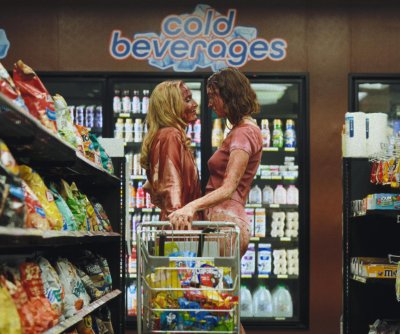
1 of 5 | Gillian Anderson (L) and Hannah Einbinder star in “Teenage Sex and Death at Camp Miasma,” in theaters Friday. Photo courtesy of Mubi
LOS ANGELES, Aug 3 (UPI) — Meta movies often reward viewers by acknowledging the tropes of the genre on which they are commenting. Teenage Sex and Death at Camp Miasma, in theaters Friday, uses meta commentary to address what movies really mean to us.
Camp Miasma was a summer camp slasher movie with more sequels than Friday the 13th. Kris Williams (Hannah Einbinder) is hired to write and direct a Camp Miasma reboot and she wants to lure original star Billy Presley (Gillian Anderson) back.
Spending the week at Billy’s isolated cabin, the movies start to bleed into reality.
Writer/director Jane Schoenbrun isn’t just saying, “Ha ha, weren’t slasher movies silly in the ’80s?” although a healthy dose of that is warranted and fun. Schoenbrun takes the Camp Miasma franchise seriously, because it impacted Kris more deeply than a mere career opportunity would.
Kris, a queer filmmaker who uses she/them pronouns, acknowledges that some transphobic elements in the Camp Miasma mythology will have to be updated. Sleepaway Camp was a real 1983 slasher movie with a gender twist, but Camp Miasma‘s killer, Little Death (Jack Haven), is an exponential riff on the kind of representation LGBTQ viewers had to tolerate in the ’80s.
It is Billy who challenges Kris’s intellectualizing on the importance of slasher movies. Kris can analyze gender politics and Hollywood capitalizing on nostalgic franchises, but Billy reminds Kris what is primal about the movies.
Billy screens the original Camp Miasma for Kris and Schoenbrun devotes significant run time to the film within the film. Scenes from Camp Miasma VI are more akin to the clips one expects from fictional films, but both take the movies as seriously as Kris does.
Schoenbrun’s horror references include much deeper cuts than the recent Scream sequels, but they still pay homage to classics from the local shopkeeper warning campers “you’re doomed!” to recent horror reboots.
The kills are far more graphic than the ratings board of the ’80s would have allowed, as well as utilize modern visual effects the Fangoria-worthy makeup masters could not have yet achieved. It’s sort of wish fulfillment for what might have been unhindered by politics or technology.
And yet those kills are set to a Counting Crows song from 1996, so even the ’80s horror movie is a bit impressionistic.
Schoenbrun creates the reality of the entire franchise via an opening montage of VHS boxes and promotional tie-in products. Those are all tangible objects that tell the viewer everything they need to know just by flashing on screen for a few seconds each.
They never do explain why Little Death wears an air vent on his head. Perhaps it’s what the bullies used to make him sink into the lake when they drowned him, a la Jason Voorhees.
The unusual pacing, back and forth between the modern story and the fictional film, works. The Miasma scenes put Schoenbrun’s money where their mouth is after talking about them for so long, and pay off when the focus returns to Kris and Billy.
It is a very intimate movie essentially between two women, but their intimacy hinges on movies about mutilating generic teenagers. Ultimately, their relationship is about something much more important than whether Billy returns to the franchise.
What Billy unlocks in Kris is really about what movies mean to us more abstractly than just the rules and references. Genre deconstructions like Last Action Hero and Scream touch on this too, but Camp Miasma includes what movies mean to us sexually, because that is important too.
Movies relate to all parts of us. It would be unhealthy to deny or avoid sexual awakenings, confusions, expectations and even romantic notions that form through what we watch.
Until recently, mainstream movies were mostly heteronormative and even rom-coms idealized unhealthy scenarios. An LGBTQ person had to dig deeper to address their needs via hidden messages and alternate readings of movies, but they were all important.
Through this specificity, Schoenbrun has articulated how movies work on people. That requires several more steps than a fanboy character referencing other movies, and the rewards are even deeper because of it.
Fred Topel, who attended film school at Ithaca College, is a UPI entertainment writer based in Los Angeles. He has been a professional film critic since 1999, a Rotten Tomatoes critic since 2001, and a member of the Television Critics Association since 2012 and the Critics Choice Association since 2023. Read more of his work in Entertainment.


Vin Diesel (C) is kissed by Jordana Brewster (R) and Michelle Rodriguez as they attend a photo call for “The Fast and the Furious” during the Cannes Film Festival in France on May 13, 2026. Photo by Rune Hellestad/UPI | License Photo


