




Buying AI capabilities to drive marketing is easy. Enabling marketing teams to actually use it independently, decisively, and at scale is far harder.
The main culprit? Humans.
Marketing teams have always had the same elusive goal: to move at the pace of the consumer. Responding to each customer’s needs in real time, delivering the relevant message at the right moment, and optimizing customer lifetime value to drive loyalty and ROI. The goal is not new.
What is perpetually new are the AI technologies available to analyze consumer data and generate instant, personalized messaging at scale. But while technology evolves rapidly, the ability of marketing teams to harness it independently and decisively has not kept pace. The main obstacle is organizational: most marketing teams have not structured themselves to extract full value from the technology they already have.
This is not to say that there is no progress. There is. Marketing teams that have crossed that chasm are seeing extraordinary results.
One case in point is Caesars Entertainment that reduced campaign execution time from five days to five minutes. Asadul Shah, vice president of player revenue Strategy, called it “a massive game changer.”
Before that transformation, Caesars marketers manually built targeting lists across disconnected systems, coordinated across multiple tools and waited on engineers, analysts and creative teams before anything could go out. The result was an operation too slow to target players with the precision and timing the market demanded.
Caesars worked with Optimove to consolidate data, orchestration and execution in one platform. Shah noted the transformation made marketing “not just more efficient; it is more responsive to what our players actually need in the moment.”
What made it work was not technology alone. Caesars implemented Positionless Marketing, a framework that frees marketing teams from fixed roles, giving every marketer the power to execute any task instantly and independently. Optimove provided the platform. Caesars built the team structure to make it real. Technology and human ingenuity working together making Positionless Marketing possible.
Any organization achieving this kind of transformation is doing what McKinsey calls “organizing to value,” a fundamental rethink of structure, decision-making and accountability that turns a marketing team into an operation built to drive value continuously. For marketing, that means becoming a Positionless team that optimizes customer lifetime value, drives loyalty and delivers measurable ROI.Below, we use McKinsey’s Organize to Value framework to outline the pitfalls that block Positionless Marketing and the blueprint to build teams that can execute any marketing task, instantly and independently.
The six pitfalls inhibiting the transition to Positionless Marketing
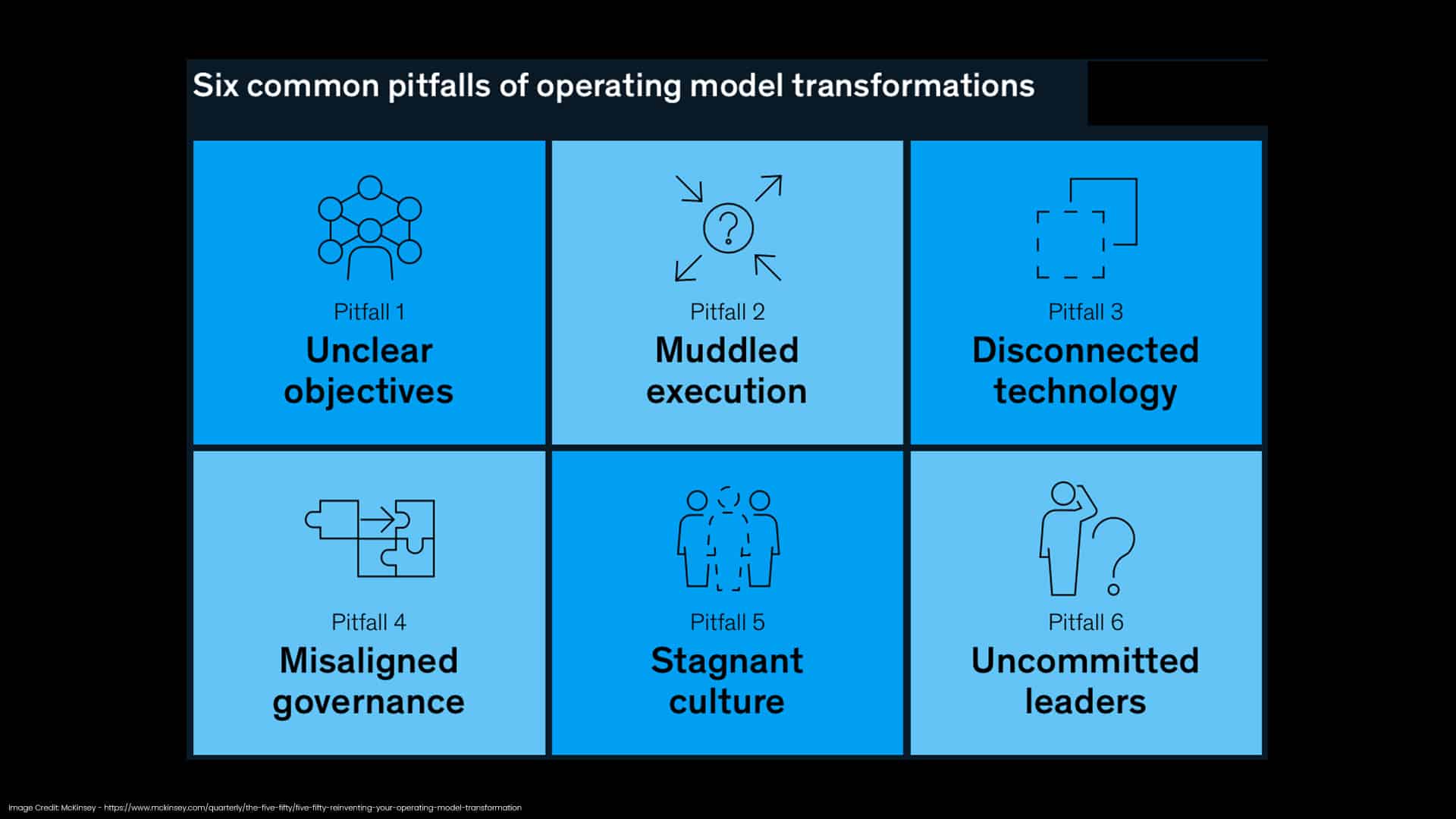
McKinsey has identified six core problems preventing marketing teams from successfully evolving into the Positionless model. Of these, only one is about technology. All the others are about how leaders and teams are getting in their own way.
- Unclear objectives push teams toward activity metrics instead of outcomes. When marketing goals are vague, execution defaults to roles and handoffs rather than impact.
- Misaligned governance creates approval layers that add days to decisions that should be faster. In marketing, excessive controls directly conflict with the speed required to deliver customer value.
- Uncommitted leaders manage through silos rather than enabling autonomy, preventing marketing teams from evolving past role-based dependency.
- Stagnant marketing culture resists experimentation even when the right tools are in place, slowing execution regardless of technology investment.
- Muddled marketing execution, with unclear process ownership, leaves no single person accountable for results, and performance erodes accordingly.
- Disconnected technology reinforces data compartmentalization and separation of tasks among sub-teams, making strategic alignment and agile responses virtually impossible.
These are the realities of assembly-line marketing operations — not Positionless ones. Insights live with analysts. Creativity lives with designers. Activation lives with engineers. Value disappears in the spaces between them.The assembly line was built for control. It was never built to deliver value.
Assembly-line marketing is counter to what Peter Drucker, the father of modern management, said: “The purpose of business is to create and keep a customer.”
How McKinsey’s Blueprint helps build positionless marketing teams (and why the effort pays off)
McKinsey’s “Organize to Value” blueprint proposes a fundamental shift: design organizations around value creation, clear outcomes, impact over job titles and minimal friction execution. It provides the foundation to become Positionless and build the conditions for marketing teams to keep customers for life.
To make Positionless Marketing a reality, marketing leaders should focus on pragmatic application and the aspects that most influence marketing execution.
- Start with purpose and behavior. Make explicit why actions are taken, alongside what is delivered. A shared sense of purpose allows teams to make fast decisions without waiting for approval on each one.
- Restructure work around outcomes and accountability. Map current processes and identify where approvals slow execution without adding value. Build cross-functional flexibility over time rather than reorganizing overnight.
- Leadership and processes. Establish a clear decision-to-execution flow and set explicit expectations for how fast each part of the marketing process should move. Processes should enable flow, not control.
- Governance, technology and talent. Effective governance ensures consistency without slowing execution. Technology and AI should unlock new value, not just automate existing processes. And talent should be deployed based on what the work requires, not what a title suggests.
- Empower marketers to act beyond their role. Once purpose, accountability, process and technology are aligned, marketers should be free to step across traditional job functions and execute independently as Positionless Marketers. The measure of success is not role compliance; it is value delivery.
These changes require sustained commitment. But the alternative (an assembly-line structure that was never built to deliver customer value) is far costlier than the transformation itself.
The results speak for themselves. In addition to Caesars:
- FDJ United implemented Positionless Marketing to eliminate overlapping platforms, remove reliance on other teams wherever possible and enable continuous improvement through real-time measurement. Campaign time was slashed from six weeks to hours, with end-to-end campaigns now executed by one marketer from ideation to analysis.
- A major retailer achieved a 16.1x increase in purchase rates while saving 300 working hours per year with the same team size. The shift to Positionless Marketing allowed the team to scale personalization and impact without adding headcount… demonstrating that the framework’s value is not just speed of execution, but the ability to do fundamentally more with what you already have.
The window to act is narrowing
The technology and AI tools are here and ever evolving. Today, AI generates infinite creative variants. Data platforms surface real-time behavioral signals. Decisioning engines coordinate across channels instantly.
But technology layered on top of an assembly-line structure creates the illusion of progress. The same handoffs happen. The same approvals add the same delays. Speed arrives at the edge; the bottleneck stays in the middle.
External pressures are accelerating. Customers expect personalization and the best experience across all channels. Competition is rising and growing more complex.
Marketing leaders who wait for transformation will find their competitors have already made it. The ones moving first are pulling ahead.
McKinsey confirms what the best marketing teams already know: the right structure and technology unleash human potential — and vice versa. Smart people trapped in the wrong system will still underperform. The best AI tools in the world won’t deliver results when constrained by the wrong organization.
McKinsey’s blueprint is pointing out the way. Positionless Marketing is the destination.
Opinions expressed in this article are those of the sponsor. MarTech neither confirms nor disputes any of the conclusions presented above.
Related Articles


Data was the new oil, but context is the new refinery. Because without a refinery, oil is just a smelly, toxic mess that often brings more harm than good.

Automation levels directly correlate with AI returns. Without structural change, marketing’s AI spend may amplify old inefficiencies.

Attribution informs optimization, but it can’t absorb risk or set priorities. Here’s why marketers must define ownership to protect credibility.

Dashboards don’t fix flawed premises. Learn practical ways to validate buyer intent using forms, nurture sequences and post-webinar conversations.