



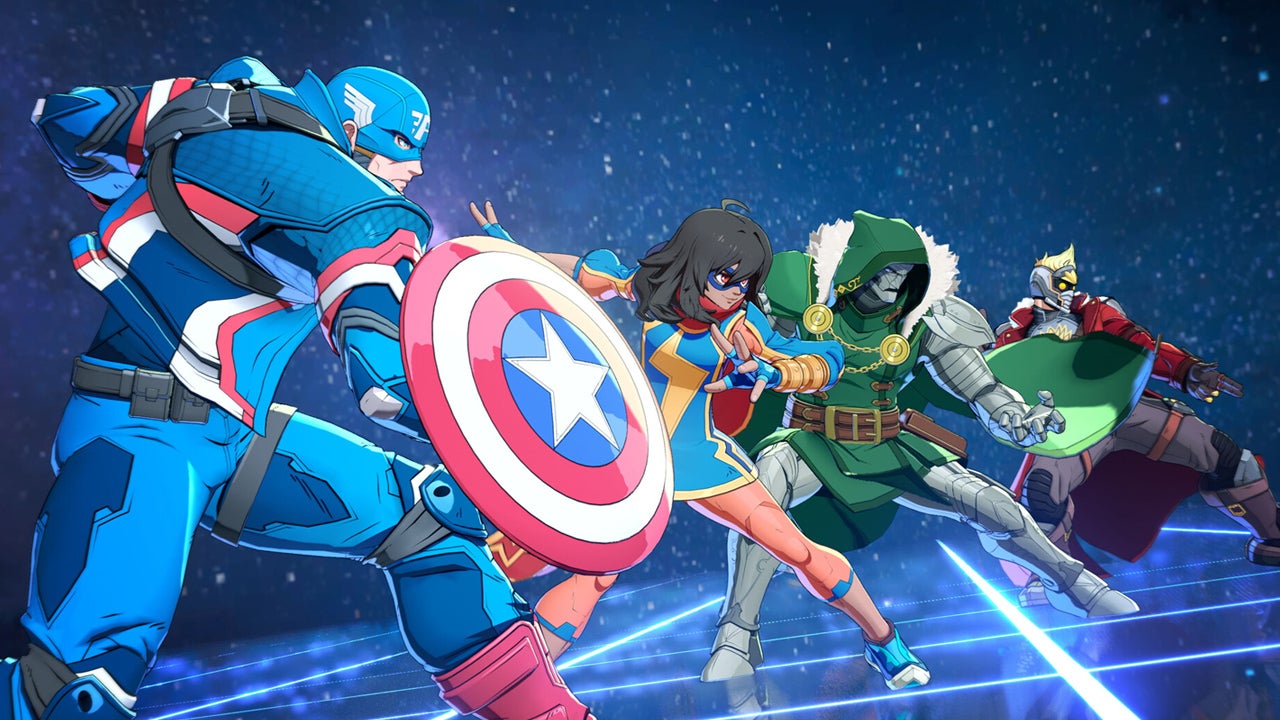
It’s a very rare feat when a fighting game manages to tick virtually every box across the board: Excellent fighting mechanics, fantastic teaching tools, great netcode, and both hardcore extras like Replay Takeover alongside more casual treats like a worthwhile story and ancillary modes. Marvel Tokon: Fighting Souls is about as close as a game has gotten to checking all of those boxes since Street Fighter 6. This is a gorgeous and innovative fighting game that can appeal to players of all skill levels, with characters that are easy and satisfying to just mash some buttons with, but equally fun to dive deep into and tinker with in the lab. The albatross that used to hang around its neck was the poor performance of the PC version at launch, but thanks to a recent patch that seems to have fixed most of those issues, Tokon is now a recommendation I can make wholeheartedly without any caveats.
Let’s start with the fundamentals: Tokon is a 4v4 tag fighter with a bunch of unique rules that attempt to control the inherent chaos of having eight swappable characters in a single match. For example, all characters on a team share the same lifebar, removing one of the core elements of traditional tag fighting games, which typically let you swap in a fresh fighter so the damaged one can restore health while they sit on the sidelines. It’s a smart adjustment that allows for a much cleaner UI, avoids the pitfall of 4v4 matches that would otherwise run too long, and removes one of the big barriers of entry to any traditional tag fighter: the need to learn multiple characters in order to have a competitive team.
But what’s especially cool is that while you can be very strong by knowing how to play just one character, there’s still a ton of value in crafting a well-synergized team. For instance, if you know that your main struggles in a particular match up, like maybe your opponent plays Magneto and you would have trouble against his strong zoning, you could have a better option waiting in the wings. Or maybe you have a character that you really like but have trouble opening opponents up with, like in my case, Blade – you could lead with a more mix-up-heavy character, and once you land the hit, swap to continue the combo and deal more damage than the mix-up character might have been able to get on their own.
What I really love about this system is that you can add new elements to your gameplan piece-by-piece rather than feeling like you need to have everything on lock right from the start. When I first started playing, all I needed to do was get competent with Spider-Man. I learned some high/low mix-up options, some bread and butter combos, got a basic understanding of how to use his web-zip to maneuver around the screen, and I felt ready to start playing against other people online. When I started to feel like I hit the ceiling of what I could do with just Spider-Man, I went back into training mode to learn more about Blade, and was able to add new layers to my gameplan. After that, I added in Magneto as an assist to help me convert more damage off of the low part of my high/low mix-up. Now I’m experimenting with the fourth position to try to find someone else with an assist that adds extra value to my team. This process of being able to start with a small foundation and build upon it is the ideal way to learn a fighting game, and Tokon feels designed specifically for it.
I love that you can add new elements to your gameplan piece-by-piece.“
Those assists are where things start to get a little strange. You see, Tokon doesn’t begin as a 4v4 fighter. Instead, every match starts with just two of the characters on each team available, with the remaining fighters needing to be unlocked by either landing a light auto-combo, hitting the opponent with a move near the corner that causes a stage transition or wallsplat, or losing a round. Unlocking these characters is important, because each one increases your overall health and adds another bar to your Assemble meter, which governs the ability to call assists during specific moments.
Tokon has a lot of hyper specific rules surrounding its assists, which leads to a system that can be fairly overwhelming for newcomers – it was certainly a lot to take in for me, even as someone who’s played many tag fighters like Marvel vs Capcom, Dragon Ball FighterZ, 2XKO, and more. Before a match begins, you place your four characters into various positions: Leader, Shooter, Vertical, and Assault. These placements determine what kind of assist is used when you call them out in neutral (meaning when you’re just standing still or walking without pressing a button or blocking). Leader is whoever the current point character is, Shooters will use a projectile, Verticals predictably cover a vertical hit box, and the Assault spot is generally reserved for each character’s most powerful assist.
Mitchell’s Favorite Fighting Games
These neutral assists don’t cost any meter, but if you try to call an assist after landing an attack to pick up a combo or to cover your recovery after a blocked move, you’ll instead get a universal dash-attack assist that costs one bar of the Assemble meter. What’s finicky about this system is that you have to be very precise with your assist call, because if it happens too early (or too late) the assist won’t come out. This extends to the active tag system, which allows you to switch control to your assist character for a brief period while they’re on the screen. It’s very similar to 2XKO, but here it feels much more restrained. In 2XKO, you can basically swap to your assist character at any point, enabling some really tricky mix-up opportunities. Tokon, on the other hand, seems to be much more hesitant to allow these kinds of unrestrained mix-ups. That isn’t to say that you can’t do gnarly things with the active tag system once you lock your opponent down in blockstun, just that the rules that govern the system are a little more rigid than what I’m used to.
And you know what, that’s probably for a good reason – given how cluttered the screen can get with four characters throwing nonsense out all at once, I think the amount of chaos that Tokon allows is already more than enough. Especially when you’ve got characters like Peni Parker, who takes up a huge portion of the screen and can send out a bunch of random drones; Magneto, who can fill the screen with literal garbage that can enhance his attacks; Magik, who can summon fire pillars that cover a fourth of the field. It can be very easy to lose track of what’s going on.
ArcSys has gone above and beyond in making each character feel authentic.“
There are some cool nuances to the tag system as well: The raw tag outs have a bit of delay to them, so you can do cool stuff like tag, perform a move during the delay, and when you take control of the incoming character, the previous character’s move will cover your approach without needing to spend a bar of the assemble meter. It’s touches like these that really add that extra layer of depth that makes learning Tokon on a deeper level so much fun.
The characters themselves are Tokon’s greatest strength. We’re no stranger to seeing a lot of these faces in fighting games before, but ArcSystem Works has gone above and beyond in terms of making them feel authentic to their comic book counterparts, while also ensuring they are each a blast to play in their own particular way. Spidey is able to zip all across the stage, baiting anti-airs by hanging and then jumping off his webs; Storm can manipulate the weather to push and pull objects and enemies (or even snatch her opponent in a command grab from half-a-screen away with a gust of wind that pushes her forward); Deadpool is a walking love letter to the FGC with a kit that is almost entirely comprised of memes and special moves from Street Fighter, Mortal Kombat, King of Fighters, Tekken, Guilty Gear, and much, much more.
It’s an impressive roster of 21, and while there are certainly some notable omissions (especially on the X-Men front) and curious inclusions (*coughDangercough*), the characters who did make the cut do a good job of justifying their spot with very unique playstyles that add something special to the roster. I can’t imagine Green Goblin being at the top of anyone’s list of characters to include in a Marvel fighting game, but he has ended up being one of the most interesting thanks to his unique ability to fight both on and off his glider.
The most delightful surprise about Tokon is that its story mode is actually pretty dang good! It’s broken up into five episodes, with each episode essentially being its own graphic novel centered around one of the five canonical teams of four: The Fighting Avengers, The Unbreakable X-Men, The Amazing Guardians, Samurai Outriders, and Knights of Doom.
The set up for all of this in-fighting between Marvel heroes and anti-heroes (and a few straight up villains) is the same throughout each of the episodes: an otherworldly being known as The Champion has challenged five of the Earth’s mightiest warriors to compete in a tournament, with the winners getting the opportunity to do battle with him – and, should they win, he will grant them any wish they desire. So it’s basically a Marvel version of Mortal Kombat meets Twisted Metal, and while that concept doesn’t win any points for creativity, it does for execution.
The episodes themselves are presented like motion comics, each illustrated by a different famous manga or comic book artist. This gives each story its own distinct art style, and I loved seeing all the different takes on these iconic characters. It’s especially cool as a big anime fan to see famous mangaka like Hiro Mashima of Fairy Tail fame and Betten Court, the creator of My Hero Academia: Vigilantes, each apply their very distinctive art styles to classic Marvel characters like Captain America and Spider-Man.
The most delightful surprise is that the story mode is pretty dang good!“
It’s not just the art though, the writing is strong as well. Kieron Gillen, the writer of all five mini-stories, does a great job of tailoring each one to the strengths of the characters involved. The Amazing Guardians focuses on Peter Parker struggling with the need to be a leader and reluctant mentor to Ms. Marvel, while also trying to rein in the added chaos of having a wildcard like Peter Quill on his team. Meanwhile, the Unbreakable X-Men episode deals with the familiar conflict of Storm, Magik, and Wolverine being heroes to a population that reviles them purely because they’re mutants. There’s not a lot of time to explore these themes beyond anything but a surface level, but the fact that there’s at least something to chew on at all is a step in the right direction for fighting game stories.
These episodes aren’t the end of Tokon’s ancillary modes either. There’s a survival mode that challenges you to take on 100 fights against steadily more difficult foes, giving you a variety of stat boosts to choose from as you increase your power level every five rounds. Your progress is saved at those five-round milestones as well, so it isn’t a true survival mode, since you get to restart without losing much progress, but it’s still a nice diversion for people who want another challenge to conquer before taking the fight online.
And then there’s Arcadia Rumble, which is entirely its own beast. It’s almost structured like a fighting game version of the City Trial mode from Kirby Air Riders, in that it’s split up into two phases that alternate for a total of five rounds, with the first phase being all about powering up your characters, and the second phase being about taking your powered up characters and competing against other juiced up fighters. Up to eight players and their customizable avatars roam around Tokon’s gigantic lobby with the goal of collecting stars. Stars can be obtained by beating up other players and knocking them out, participating in limited time events that pop up around the map, or defeating other players in the second phase, which are the traditional 4v4 battles. It’s actually pretty fun, and while I don’t see myself personally spending a ton of time with it beyond what I’ve played for this review, I can definitely see its value as a mode where players of all skill levels can play together and still have a chance to win.
This whole package is rounded out with some of the best teaching tools I’ve seen in a fighting game: General mechanics breakdown with playable lessons, character guides that explain the basics of each kit, practical combo explainers that cover things like how to convert a combo off of a unique skill, and my favorite feature, free-form combo challenges that simply give you a move you need to include in the combo and a damage threshold you need to hit.
I love this so much, because it really encourages people to actually experiment and learn the characters rather than just memorize a string of buttons. The prompts you’re given are often very practical as well, teaching me how I should combo off of Spider-Man’s overhead, or what I should do when I land a hit but don’t have any assemble meter, or what my big cashout combo is when I land a hit and have full resources. Not to mention the excellent training mode, replay searching, replay takeovers, training presets, and so on. It’s everything I could ask for when it comes to learning tools, and Tokon has it all right out of the gate.
PC Performance and Online Play
I’d be remiss not to mention the PC performance woes that many people have had since launch, and even in the beta before it. Personally, I didn’t actually have any notable issues on my rig, but I say that as someone running a GeForce RTX 5090 and AMD Ryzen 9 16-Core processor with 32 GBs of RAM, so I would certainly hope that’s the case.
That said, on several occasions while I was playing online this past weekend, I’d be in a match where everything moved at a fraction of the normal speed. These games always were against other PC players who had green network connections when I accepted the match, and they felt very different from the standard experience of playing someone on a poor connection. My guess is that these opponents were having performance issues, and that those problems were affecting my game even if I wasn’t personally experiencing them.
A post-launch patch has fixed many of the issues that were being reported on PC. “
But wait! Good news arrived just as I was finishing up this review: A patch dropped only a few days after release that has seemingly fixed many of the PC issues that were being reported. True enough, since then I haven’t seen any matches like what I just described. I haven’t done a ton of testing myself yet, so I’ll continue to play on PC and will update this review should any issues arise, but it seems like the Tokon team may have managed to narrowly avert disaster.
However, the one minor complaint I do still have regarding online play is the fact that matchmaking has been quite slow considering how many players Tokon has. The speed of getting in and out of matches is the one place Tokon pales in comparison to other modern fighters, which is a bit of a bummer. But since you can mess around in training mode during a queue, it’s at least more time that I get to spend working on my combos, and I certainly need the practice.
Verdict
In a genre where so many games end up missing a few key ingredients, Marvel Tokon: Fighting Souls arrives as the total package. Its visuals are among ArcSystem Works’ best – and given the gorgeous ArcSys catalogue, that’s saying a whole lot. It breaks down one of a tag fighter’s most imposing barriers for new players by making it possible to be competitive with just one character. Its training tools are among the best I’ve seen, and even its story mode is great. The list just keeps going. The action can occasionally become hard to follow with all of the chaos happening on screen, but considering everything that Tokon nails, it’s hard to label the entire package as anything short of amazing.