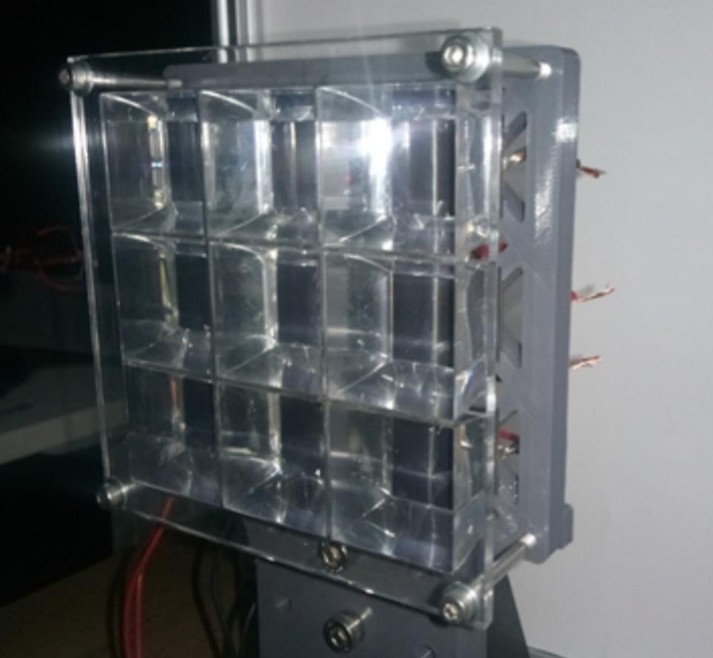
Researchers in Spain have developed a 3 × 3 low-concentrator photovoltaic (LCPV) receiver combining crossed compound parabolic concentrator (CCPC) optics with current-based cell grouping for wireless laser power transmission (WLPT) under non-uniform irradiance. The prototype achieved 16.3% power conversion efficiency.
Researchers from Spain’s University of Jaén have fabricated a low-concentrator photovoltaic (LCPV) receiver incorporating a crossed compound parabolic concentrator (CCPC) to improve optical coupling under static yet inherently non-uniform laser irradiance.
The system is intended for applications in wireless laser power transmission (WPLT).
WPLT offers a promising approach for delivering power over distances without physical connections, particularly for applications such as autonomous systems, remote sensors, and aerial platforms. However, its practical deployment is constrained by optical alignment requirements, atmospheric losses, conversion efficiency, eye and fire safety considerations, and the effects of non-uniform or dynamic irradiance on photovoltaic receivers.
Future opportunities lie in improving laser-to-electricity conversion efficiency, developing receivers with wider acceptance angles and better tolerance to spatially varying illumination, and integrating adaptive beam steering and power management. These advances could enable more reliable and efficient long-range wireless power delivery in applications where conventional wired or battery-based solutions are impractical.
With this in mind, the Spanish researchers developed and experimentally demonstrated a 3 × 3 low-concentrator photovoltaic receiver that combines optimized cell interconnections with CCPC optics to improve power-conversion efficiency and angular tolerance under non-uniform laser illumination.
Described in the study “Development and experimental characterization of a c-Si low concentrator photovoltaic receiver for wireless laser power transmission (WLPT) under non-uniform irradiance of 808 nm,” published in Optic & Laser Technology, the system integrates a 3 × 3 array of 20 × 20 mm² monocrystalline silicon cells with interdigitated back-contact (IBC) architecture, with each cell being coupled to the CCPC redirecting incident radiation toward the cells while providing a wide acceptance angle under static illumination.
The CCPC geometry was optimized with an entrance aperture 2.5 times the cell area, enabling a 60% reduction in semiconductor material compared with an equivalent non-concentrated receiver. The concentrators were fabricated from polymethyl methacrylate (PMMA), selected for its high optical transmittance, favourable dielectric properties and ease of manufacturing.
The complete receiver has a frontal aperture of 104 × 104 mm², including the supporting frame, and a measured mass of 123 g.

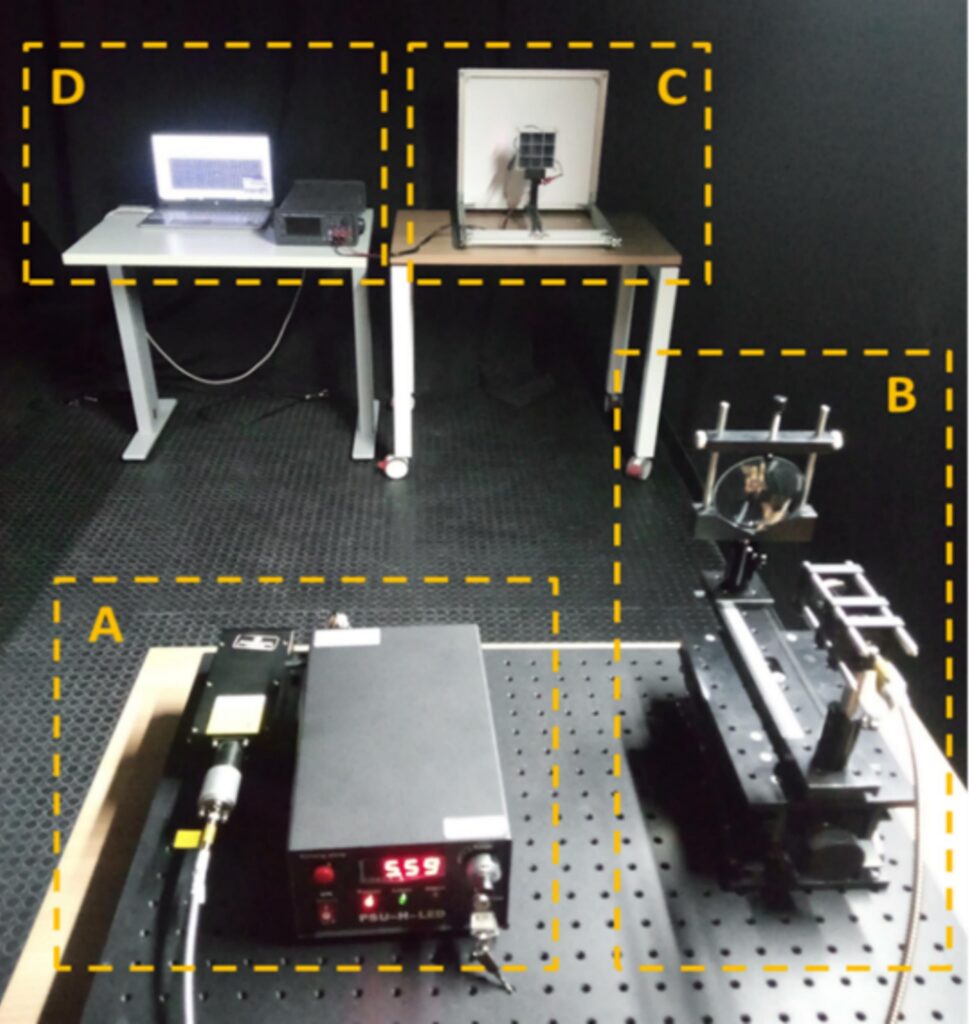
The scientists assessed the optical and electrical performance of the system under 808 nm monochromatic laser illumination using a 1.523 W Gaussian beam. I–V measurements were performed with and without the CCPCs, while spectral response measurements were used to quantify optical absorption losses introduced by the concentrator material.
The electrical response of each of the nine cells was measured at different incident powers and angles to evaluate optical–electrical coupling and the effects of non-uniform illumination. Mismatch losses were then calculated for different series and parallel interconnection schemes by comparing the measured module power with the ideal sum of the individual cell maximum-power outputs.
The electrical measurements confirmed that short-circuit current was the dominant source of cell-to-cell variation, ranging from below 0.1 A in peripheral cells to about 0.45 A in the central cell at 5 W. By contrast, open-circuit voltage and fill factor remained relatively stable, indicating that current mismatch is the principal limitation at the module level.
The researchers also found that grouping cells according to similar photocurrent significantly reduced these losses, with the ring interconnection architecture producing almost the same output as the ideal mismatch-free configuration. At 5 W, ring losses remained below 3%, compared with more than 58% for the series configuration and approximately 6% for the parallel configuration.
Moreover, the ring configuration achieved power conversion efficiency values close to 16.3% at 806 nm, compared with 6.9% for series and 15.2% for parallel interconnection, while the theoretical optimum at 955 nm reached 18.4%.
The team also explained that thre receiver also demonstrated relatively good angular tolerance, with maximum power generally remaining at 80–90% of its nominal value at 30° incidence. At 45°, however, photocurrent and maximum power decreased substantially as beam displacement exceeded the effective collection area.
“Overall, the results demonstrate that effective current-balancing strategies and tailored interconnection schemes are essential for achieving high-efficiency laser-powered photovoltaic reception under realistic irradiation conditions,” the academics concluded. “In particular, when employing high-efficiency semiconductor devices the incorporation of dedicated optical elements becomes a fundamental design requirement that enable a substantial reduction of active semiconductor area while preserving high conversion efficiency and angular tolerance.”
Other researchers at the University of Jaén recently developed a semi-transparent crystalline silicon solar photovoltaic module with rear-side optical concentrators for agrivoltaics applications. To suit agricultural applications, it was designed to balance high efficiency and optical transparency with minimal panel shading.
This content is protected by copyright and may not be reused. If you want to cooperate with us and would like to reuse some of our content, please contact: [email protected].