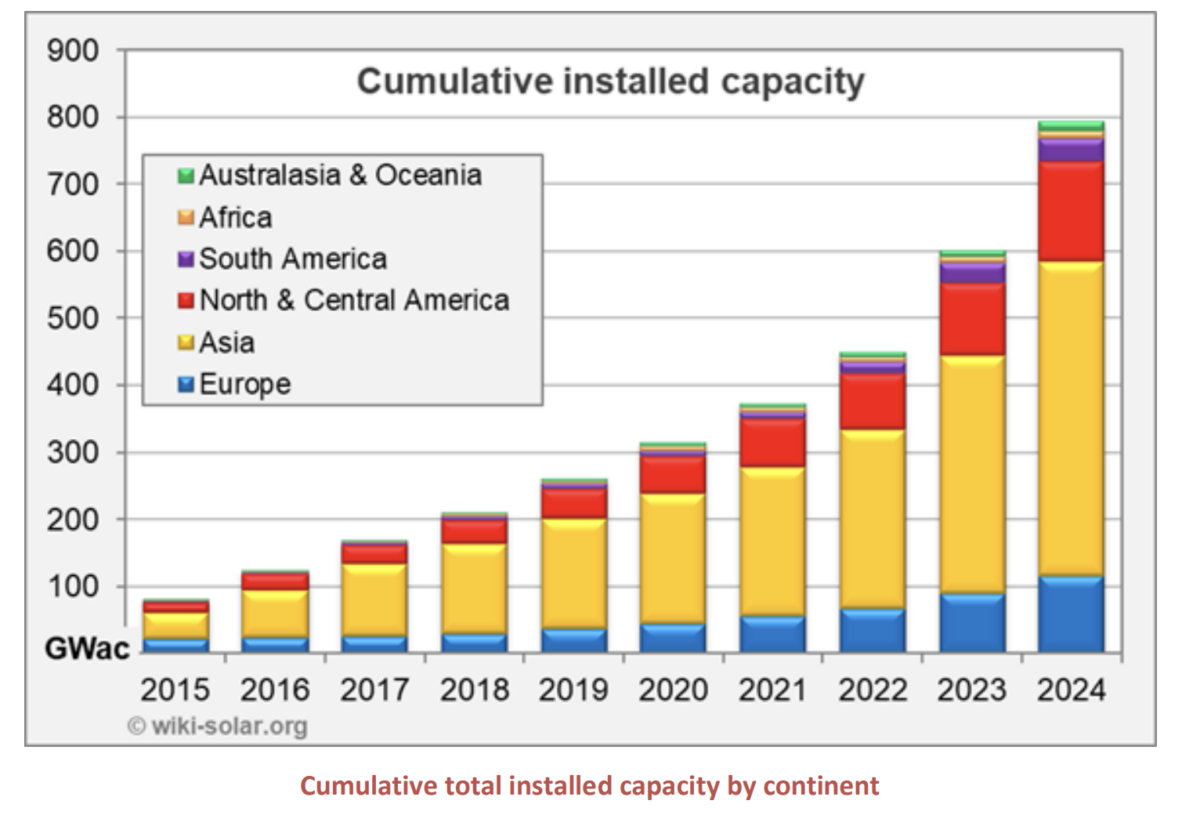
Analysis from Wiki-Solar finds the world’s 33 largest utility-scale solar markets had a cumulative capacity of 1,008 GWac by the end of last year.
The world’s large-scale solar capacity surpassed 1 TWac in 2025, according to analysis from PV data consultancy Wiki-Solar.
Wiki-Solar’s database of utility-scale solar, consisting of projects 4 MWac and larger, now covers 23,285 projects across the 33 leading countries for large-scale solar, which together account for 1,008 GWac as of the final quarter of last year.
These countries represent around 92% of the world’s total, according to Wiki-Solar’s analysis. Last year’s additions represented a record in a calendar year, nearing 250 GWac.
 by continent </p>
<p><i>Image: Wiki-Solar</i></p>
</figcaption></figure>
<p><span>Wiki-Solar founder, Philip Wolfe, said that at current growth rates utility-scale solar </span><span>should match wind power by the end of 2026. </span></p>
<p><span>Total solar generation, also including rooftop and distributed systems, is already much larger. Recent figures from the International Renewable Energy Agency (IRENA) put current global solar capacity at <a href=) around 2.4 TW.
around 2.4 TW.
Wolfe also predicted that solar power will become the world’s primary energy source within twenty years “despite being written off as irrelevant when I joined the sector fifty years ago.”
China remains the world’s leading large-solar market, with 5,639 plants totaling a cumulative capacity of 446 GWac in Wiki-Solar’s database. The United States and India follow, with 3,796 and 1,965 large-scale solar plants with cumulative capacities totaling 162.8 GWac and 109.6 GWac respectively.
Spain and Germany sit at fourth and fifth on the list, with 39.3 GWac and 25.1 GWac of large-scale solar. The top ten is rounded out by Brazil and Japan, each with 21 GWac of large-scale solar, followed by Australia (16.2 GWac), France (12.6 GWac) and Chile (12.5ac).
Saudi Arabia is the leading country in the Middle East, sitting at twelfth with 11.9 GWac of large-scale solar, while South Africa is the lone African nation in the leading 33 nations. Its 6.2 GWac of large-scale solar places it eighteenth in the ranking.
Mexico, Ukraine, Malaysia and Taiwan are all new entries to the top 33 ranking since Wiki-Solar’s equivalent analysis from early last year, sitting at positions 14, 27, 30 and 32 by the year end.
Wolfe also told pv magazine Wiki-Solar is evolving into RenewAtlas on an enhanced platform with a database of over 30,000 utility-scale solar projects, around three-quarters of which are operational. The platform also features battery energy storage systems and other hybrid systems.
This content is protected by copyright and may not be reused. If you want to cooperate with us and would like to reuse some of our content, please contact: editors@pv-magazine.com.
Popular content