







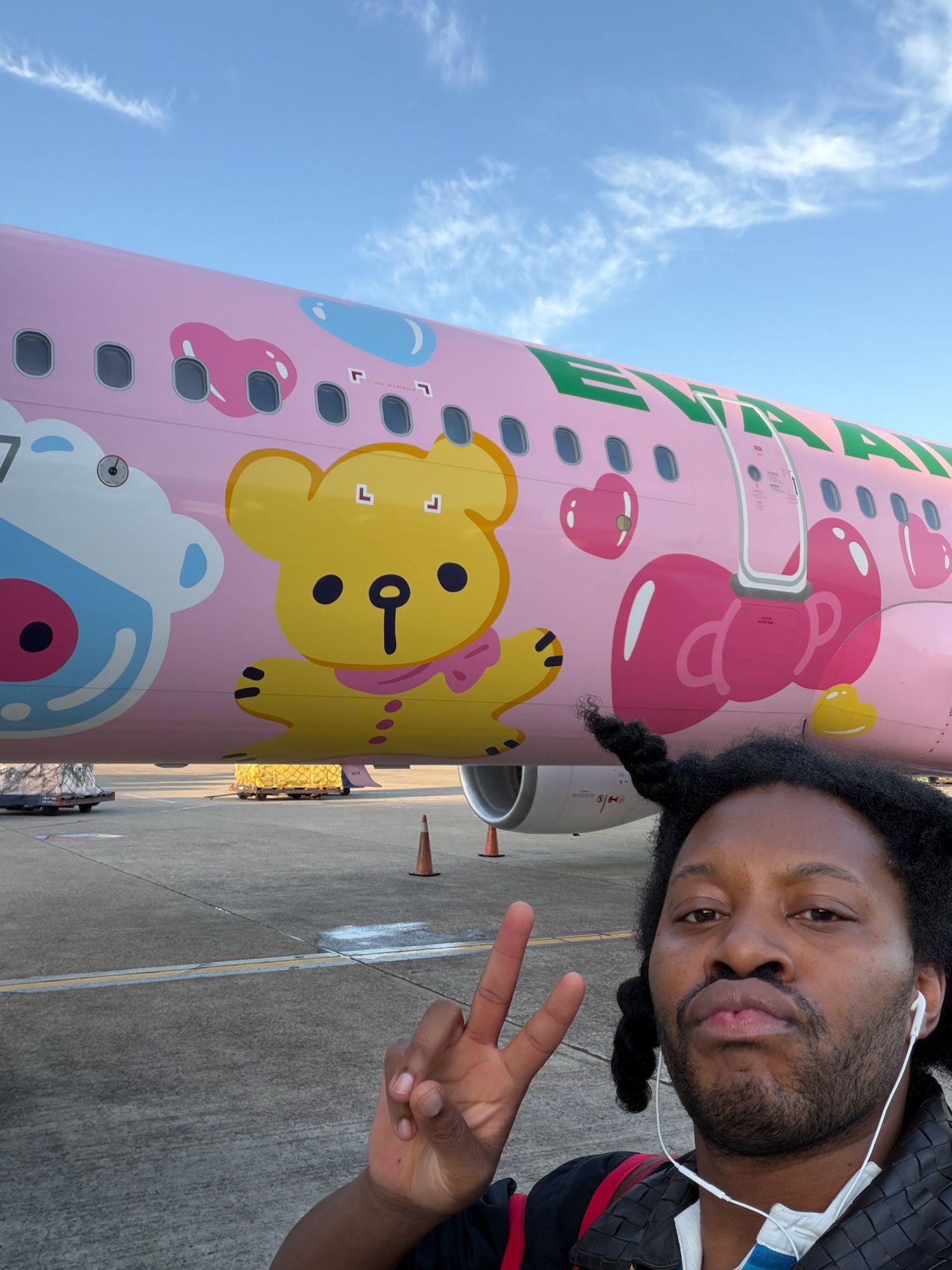
I had forgotten how much I had missed the scent. It is the first thing you notice when you step off the elevators into the lobby of the Toranomon Edition in Tokyo, its enveloping scent: a sort of pine with oud dancing with rose. For weeks I had been conscious of only an absence of scents. An absence, that is, until Wednesday or Sunday rolled around (the days when I was allowed to bathe) and my own scent began to offend my nostrils. I stood awkwardly in the lobby just smelling, my large bags seeming even larger after a week and a half of travel had finally landed me at the closest place to a home I had in Japan.


Jeremy O. Harris out with filmmaker Xavier Tera in Tokyo, where they ran into Baz Luhrmann, who took them to Ray Suzuki’s new bar CHOWA.
Three years prior, I had spent four weeks flitting in and out of this lobby with irrepressible glee that after years of dreaming, I had finally made it to Japan. As a teenager in a small town in Virginia the idea of being greeted as “Mr. Harris” with a bow in the lobby of a Tokyo hotel had been added to my bucket list the minute I witnessed Bill Murray experience it in Lost in Translation. When a Japanese production company asked to produce my play “Daddy”: A Melodrama in the middle of the COVID-19 pandemic I was on the first flight offered. The minute I stepped into the lobby of the Edition, tucked away in the business district of Tokyo, I was met with exuberance by a chic woman known to all as “Mami-san” with a “Welcome to Tokyo Mr. Harris” and a bow. As is the custom.
As I rounded the corner and walked to the front desk where Mami-san stood once again, I was greeted by that same bright smile as I presented my passport with two hands (another custom) and bowed so she could begin my check-in process. Yet unlike my previous trip where the eyes that met me across the desk were warm with naivete, the eyes today were searching and curious (as the eyes of many had been the past 10 days of travel), hungry for me to add color to a tale they felt they already knew, in part because 14 days before Reuters had published a headline that in ten words read like a movie: American Playwright Jeremy O. Harris Arrested in Japan on Alleged Drug Smuggling.
November 16, 2025
My own impatience three hours into the affair should have been my first indication that something had gone horribly wrong, yet my unflappable optimism and obviously my abundant American brio pushed me to ask without thought, “How much longer will we be? My friends and I have dinner reservations at 7.”
I had taken an early morning flight from Taipei to Okinawa after traveling from Poland, where I had just premiered my latest film at the American Film Festival in Wrocław and London, where I’d spent 18 hours presenting a reading of a new play I was producing. From the theater I had gone straight to Heathrow, where I flew from London to Bangkok, then switched planes for a night flight from Bangkok to Taipei where I’d decamped to two different hotels (my first was overbooked) to rest in a bed for six hours before taking the 9 a.m. flight to Okinawa, where I was to begin work on a new film. We had landed at 10 a.m.. I was at the last customs check point at 11. It was now 1 p.m..
“I’m wondering if I’ll make it to the dinner or if I should tell them to reschedule.” My translator, a woman in her 60s with mannerisms of a woman who hadn’t left her 30s, looked from me to the customs officer standing over me, then back to me before saying softly, “I don’t think you’re gonna make it, hon.” There was a damp, dry odor of a cigarette smoked two hours before hanging like an atmosphere about her, tickling my nose and making me go crazy at the thought of having my own soon. I was unable to register what she had said because I was so tickled by how she said it. Although it was clear that she was a Ryūkyūan (a native of Okinawa) her English comforted me because the placement of her words and the drawl in her vowels were undeniably learned from someone undoubtedly from the South and undoubtedly Black.
“Can I at least get my phone so I can let them know? They are probably worried sick.” I said, starting to stand up to get my phone sitting on the table just out of my reach. The customs officer shook his head no as he placed a hand on my shoulder and forced me back down before he and my translator went back and forth in whispered Japanese about what had sparked my rise. This had been the case a few times since they’d brought me to this sterile white room to look through my bags, item by item. The customs officer began speaking to me very fast and pointing—the translator scribbling down notes all the while.


Harris, Pete Ohs, the director of his new film ERUPCJA, and Monika Uchiyama, their translator, at a hole in the wall gem in the business district.

“I was told the prettiest girls and best food was in Fukuoka so that was the first place I visited with Pete,” says Harris. “This was Warayaki Mikan where the phenomenal chef gave us a hero’s welcome.”
“No. You will not be seeing your friends this evening for dinner. That is very doubtful.” It always felt as though she wrote more words than she ever ended up saying. I did cringe a bit though, whenever she read from her notepad, the Southern lilt faded as she spoke for the officer. She became metallic and robotic when embodying him. When the performance as “officer” faded I was able to relax again. In the hours we had spent together we had begun to nurture a rapport. The fact that she turned to me with a warm smile, her teeth charmingly jaundiced, made me lower my guard. Although, I should have known then that my situation was dire, yet it’s not in my nature to despair. Pessimism wasn’t allowed in my home as a child, and besides, I had learned that I could meet all situations as though they were a negotiation. It’s the American way.
In the back of my head there was a manager with whom I would soon be able to speak. He/She/or They would be the cooler heads that would prevail and allow me to make my reservation at Okinawa’s best izakaya. Knowing better than to ask for them to come to my aid, I turned back to my translator and reestablished our camaraderie by asking her what she liked most about Okinawa. Two hours prior, when I arrived, I had been asking Redditors the same question attempting to build out a side itinerary for myself of haunts off the beaten path. I hate being told in advance places to visit. I’m spontaneous in all ways, or I attempt to be. Stumbling upon a place others haven’t told me about, that is only populated by locals, thrills me and there’s no better time to do that than when your IP address matches that of the destinations you’re searching out. I was scrolling a particularly exciting blog that looked more like a LiveJournal than a Discord of Okinawa’s self proclaimed “Top Teen” foodie who had compiled a list of his ten favorite locales to have local delicacy “taco rice” when I walked past a sign listing all the prohibited items when crossing the Japanese border.

Ohs and Harris saw a traditional geisha dance in Kyoto and paid for a meet and greet afterwards.
Having been to Japan before I was aware the country has barred basically anything in the medicine cabinet of your average American coastal elite, as well as anything you’d find in a raver’s tool kit, from entering the country. That means your Adderall prescription is just as prohibited as his poppers or her cocaine. Each stop along the way had their own version of the same sign. Each stop along the way my bag had been checked. Each stop I breezed through with a smile. This would be the same I thought as I stood before a masked guard. I handed the masked guard my passport and put on my thousand-watt smile to disarm and charm as one must when traveling 6’5” and Black, ignoring the fact that I was sporting my travel hair (protective Coolio plats) and the face of a man who had barely slept three hours in a Taipei hotel.
As he stared at my passport and my bags I soldiered forward with my charming “Amerika-jin,” “writer desu ka,” using what little Japanese I had at my disposal to show my respect for not only his land but his tongue. He was not endeared. He asked me if I had any of the items that were listed and presented a notebook and pointed to each one slowly. As his fingers passed a bottle of rush, my heart skipped a beat and I remembered a gift I had received a few weeks prior at the opening of Prince Faggot of a bottle of poppers, and feared they might be on me. Yet, I soldiered on, deciding my memory of setting them in my desk drawer was reality and not fantasy. But there was a pause and a twitch at the corner of my mouth that must have telegraphed something, because suddenly a small woman who had been standing in my blind spot appeared out of nowhere, shaking her head, and said something in quick Japanese that sounded like “drugos” while pointing at my bags.
I looked down and saw a large container of lion’s mane mushroom gummies, nature’s Adderall, that, while legal, inconveniently had a large drawing of a mushroom teasing her from its top. “Drugos,” she seemingly said again, and as I protested I was slowly wheeled away from the customs desk towards a door far away from the exit. Still attempting affability, I smiled and conceded looking towards the exit into the Naha Airport arrivals hoping that the friends waiting for me might see me being rolled away and intervene. I imagined their flowers and balloons, their exuberance for my arrival would telegraph my innocence, but figured in less than five minutes I’d be back to them anyway.
Instead, it took less than five minutes to find a container in my bag that, in five months of carting it around, I had failed to see even once.
I had been so preoccupied with the manner of their search that I hadn’t even thought to do some cursory scan of my rarely used toiletry bag. I was watching as they pulled each item of clothing from my bag and carefully palmed it for illicit substances while calling out the brand names with various levels of intrigue and surprise. The biggest gasp came when the masked guard held up a large scarf tied to a yellow purse and yelled out “Tory Burch!” It was my first time recognizing the global reach of my favorite Met Gala date.
“We went to the Met Gala together,” I said meekly. Wondering what favor that information might curry me, if any. The answer was none, because he didn’t speak English. But his partner did or at least enough to ask why I was there. Wanting to get through this quicker and aware of the fact that they wanted to tirelessly go through my bag even less than I did, I attempted to hurry it along by explaining I was there to make a film. That was why I had the mushrooms, which were not drugs, but in fact a natural supplement to help me focus better while away from home. If only they would just google! That was when I picked up my toiletry bag and told them all my liquids would be in here. “Just skin care I never use and my electric toothbrush!” I said with a smile. The female guard looked through it and seemed to be pleased that was all there was as she passed it to another masked guard who lowered his mask to smile at me. He began a cursory look as well before finding something at the very bottom of the bag. “Makeup?” He asked the female guard. She looked closely before shaking her head. She looked from what was in his hands to my face and back, trying to piece together what nefarious thing I might have been bringing into their country.
He held it up for me to see. “What is?”
My heart stopped.
I didn’t know yet exactly what it was, just what it wasn’t. Which was mine. A thousand excuses for what it might have been crossed through my mind, but the clearest thing I could think of was to say, forcefully, “Drug test me! Whatever that is…, I swear I don’t do it. I swear it’s not mine.”
And that’s when they pulled me back from the table. When they took away my phone and patted me down before locking me in a small room where I waited for a translator who told me I would then have to wait for an investigator who, when they arrived, meticulously took notes on my story. All I wanted was to get out. And, naively, I always felt I would as long as each of their inquiries was met with pure honesty. In hindsight, I might have done something different, but given the result I can’t think of what that could be. Perhaps I would not have so graciously given up the code to my telephone if I knew an investigation into the contents of my phone was being consented to, and that that investigation would last almost 20 days, during which I’d be confined because inside that toiletry bag, we’d all come to discover, was MDMA.
Perhaps before being handed to the police I would have more diligently attempted to get a message to my family and friends so that for the first 36 hours they would not have been in the dark about my whereabouts, calling any number they could get their hands on in Okinawa until the Japanese lawyer they found discovered me in detention at the Tomishiro police station.
A different course of action never occurred to me because, it was not until the strapping young detective entered the room and the translator with whom I’d quickly befriended had stopped talking and had swiftly exited, that the sense that I wasn’t going to go home that night started to set in. Behind him was a new translator, the one I called “the young one”, who I gave a barely passing grade to in my journal when ranking my translators two weeks later. He began reciting to me the Japanese version of my Miranda rights.
All I remembered were my demands for a lawyer and a phone call. My articulation that I’ve never been arrested, this is some sort of mistake. The tropes learned from theater, TV, and film of what one does when arrested. The young one held my hand before placing handcuffs on me and said, “These are your customs. We have our own.”
The detective took me by the hand and placed handcuffs on my wrists once again. He extended a rope from my waist to my wrists and anchored me to him. He gestured for me to stand up. Then pulled me down a hall and past three large locked doors where four guards awaited. The oldest guard held up a placard with three numbers on it: 166. He pointed from the placard to me, then back again. “You. One. Six. Six.” And for the next 23 days One Six Six was my name.
Here are things one must know if ever you or someone you love find themselves in a similar situation:
- In America, a lawyer can swoop in, call in a favor with the DA she went to law school with and you’re saved. A wealthy parent or a friend can post bail. In Japan, a gaijin (foreigner) is on their own. Left to drown in a sea of legalese in a language they do not speak. The process dictated, as it was to me, through a broken translator app on a device from the early aughts translating the details of your life post arrest was: “One Six Six…we investigate. While in the investigation period, the prosecutor and judge meet within 72 hours. If yes, you stay 9 days. Prosecutor and investigator interview. Each day. They ask for 9 more days as well if you are not innocent. Total 23 days. If not charged you will be free, One Six Six.” Then a man will look at you and say “Genki?” The embassy is full of kind diplomats I’m sure, but in my experience, they are useless. Their function is still a mystery. If you are a foreigner, you are told you can call the embassy or a lawyer as soon as you are arrested. You have to know a lawyer’s number by heart (my fiancé is a lawyer, I know his number by heart). That lawyer’s number must be Japanese (his is not) and a lawyer barred in New York State does not qualify. In light of this, I demanded they call the embassy.
- Little did I know that they would arrive 15 days into my 23-day stint. They arrived with wide smiles and two novels (science fiction from the ’80s) which they informed me were very popular among other American criminals who had read them. I did enjoy them the way I imagine a parent enjoys soggy Frosted Flakes their child has left out on the counter. There’s a hint of sweet familiarity, but pleasures are all gone. Nothing crisp, all mush. (This is how I described one of the books in my journal and I still don’t know what it means, but at a certain point I stopped judging what it is I wrote there). They also left behind a pamphlet detailing everything they couldn’t do and a list of useful Japanese phrases in case of emergency like, “Geri o shite imasu. Tasukete kudasai,” which translates roughly to “I have diarrhea. Please help.”
- If you’re like me and the world has been overwhelming you with emails and countless deadlines, this will be your chance to turn off the world if you so choose. I read 23 books and turned in an outline for a movie at a major studio while being there because I realized how loud my life had been. In the quiet of my cell I found myself consistently marveling at how many minutes are actually in an hour. How many hours in a day. Reading two books in one sitting was no longer a thing only possible in the crucible of graduate studies. It was possible on a Tuesday after yoga. My day as dictated by the Tomishiro police: Wake up at 7:00. Lights up. Deliver your blankets to your locker. Grab a bucket and the broom. Clean your cell. When finished? Wash your face. Brush your teeth. Breakfast at 8:00. Bread and milk. If you’re me, you often skip. Milk is gross and you never want to utilize the little Japanese the embassy has taught you. Exercise at 8:30. Your little patch of blue. You’re still inside. On the third floor but with a caged view of the sky. For thirty minutes a little patch of blue that keeps you from going mad. After that, you read your book or you start to write in your journal. Lunch at 12:00. Rice and some sort of protein. Usually an egg. Maybe a fish stick. After, you write in your journal or you read. At this point in the day writing in your journal can take on a trancelike quality and it can become the closest thing to doomscrolling you have access to. Supper at 17:00. Miso soup, rice, and another protein, maybe a type of chicken. After, more reading. You’ve read so long that now, the Japanese history book you’re reading feels as addictive as a Ryan Murphy show. Every twist and turn of Japan’s rapid industrialization explodes every dopamine receptor and you finally understand Ken Burns. Lights out at 21:00. You work out for 30 minutes so your body is so tired the tatami mat with no futon cradles you like a Scandinavian mattress.
- The food is no better because you are in Japan. You are still in jail. There is no jail on earth that will provide you with an omakase tasting menu. It’s just better jail food than jail food in America. Not that I would know. But I could assume. One still gets tired of the Wednesday rice and fish dish. Which is when you could have a bento box if you were lucky enough to have money on your books. Thankfully I was lucky. So every Tuesday, Wednesday, Friday, and Saturday I supplemented the menu with various bento boxes: chicken katsu, fried chicken, tonkatsu, hamburger. From that lens, I guess, the food is better but a hamburger in jail is still a hamburger in jail. It’s absent from umami.
- GOOP Detention Centers would do numbers in Malibu and Upstate New York. You may, like me, come out with a different resting heart rate, a new thirst for knowledge, and a recognition that if you were more callous you could recreate this experience and rich white people would pay for it.
January 15, 2026
“Jeremy! Oh my God! They let you out?”
I didn’t recognize him. He was tall, he was gay, and he knew my name, so the probability of us having a mutual friend was high. He also had the unmistakable upspoken whine of a California gay, so I had to also imagine he could be a coworker of my partner, an agent, or worse, an overfamiliar film exec.
I had been invited to the W Hotel in Aspen for Aspen Gay Ski Week and it was my first outing in America since the infamous Reuters headline.
When my phone was returned on December 8th, it lit up with so many messages I threw it across the table. Friends, friends of friends, mothers of friends, reporters, politicians, my niece’s middle school principal; they all reached out to ask me (a person they thought was in jail) what they could do to help? Or what happened? How was I? I didn’t respond. I couldn’t.
I called my mother. My fiancé. The six friends my fiancé told, and I spoke to them for three days straight while locked in a hotel room in Okinawa until my voice went out. I then traveled throughout Japan for two weeks. First Fukuoka, then Beppu, a ferry to Osaka, then Kobe, Kyoto, and finally Tokyo. I didn’t respond to any of those messages. I knew when I returned I would have to respond somehow. I figured in the mountains of Aspen with gays high on altitude, testorone, G, and cum, I might be able to safely audition what responses might look like.
“Hi you! Let me out, they did…” I thought this would be enough to sate the curiosity of the man standing before me in denim cut-offs and a long faux-fur coat covered in snow along its hem. Unfortunately, I forgot that the gays of Aspen Gay Ski Week are in attendance because they are insatiable. This led to the question of “Why did they let you out?” “Are you allowed to go back?” “Was it horrible?” “Did someone make a call?” “Someone must have made a call!” To which I responded simply: “They didn’t have enough evidence.” “Yes.” “No.” “No.” “Who the fuck would make a call?”
I realized there in that lobby that, knowing they didn’t have the evidence to prove my guilt, the prosecutor in Okinawa had found a way to sentence me still. Like some sadistic Greek myth, I was granted my freedom but sentenced this barrage of questions for the foreseeable future. Questions I’d have to answer during every interview. Every dinner party. For bourgeois, jet-setting creative class I had become the cautionary tale and my presence demanded they hear every detail lest it happen to them. To not oblige would be tantamount to confirming their fears that what had happened to me was the worst possible thing. That what I had endured was too harrowing to speak about. So I spoke about it, to anyone who would listen.

“The thing I feared the most after I was arrested was not being able to return to Japan to eat the food and see the theater,” Harris says. “When my charges were dropped I booked tickets to see a full day of kabuki in Ginza.”
As drinks were being poured at LadyFag’s après-ski, I told the stories of my roommate Tomo, who taught himself English after being in a cell for six months straight. At the gay rave I told the story of the judge who was so charmed that I was a Japanese literature minor that he returned the visitation rights my prosecutor had tried to take away. At the after-hours by the fireplace, as boys rolled around me on Ecstasy, I told them of the moment my detective brought me into a small room, held up a paper and said “166…Negative for MDMA”. For them it became a film. A good one. A fun one. A film where I was fine! An adventure that was even fun for the most part.
I didn’t tell them how my heart sank when my mother and fiancé told me of their dread. I didn’t tell them about that thought that every person in my life had lived with a fear that I’d be imprisoned for seven years in a foreign land, while I read Kafka on the Shore, ate bento boxes just praying not to be banned for life, naive to reality that a sentence hung over me had given me a panic attack my first night out. That I was free for 72 hours before I remembered I could play a song and listen to it. I didn’t tell them that I did tremble that first night inside as I reckoned with their “customs”, sleeping barebacked upon a tatami mat. That I sobbed, alone and afraid no one would know where to find me. I didn’t tell anyone that.
How could I? How could I tell anyone that even with all my optimism, boundless as it is, I still wondered in my last 24 hours in that cell if the call that would come would be the one that affirmed the fears I tried to assuage with my 1,000-watt smile and my spattering of Japanese: “You’re a Black man abroad and freedom of your gait elicits too much fear to allow you to roam free”. How do I tell them that it wasn’t until the sun hit my face as I stepped out of Tomishiro police department that I really knew it was over and I would be free?
I don’t.
Photos: courtesy of Jeremy O. Harris.
-
How Trump Turned The Power of Positive Thinking Into Delusion
-
Exclusive: Lindsey Vonn on Life After Her Horrifying Crash
-
How the Epstein Files Exposed Victims Instead of Perpetrators
-
Tradwife U: Where Right-Wing Women Seek Their Mrs. Degrees
-
Harry and Meghan’s Hollywood Dreams Hit a Speed Bump


