







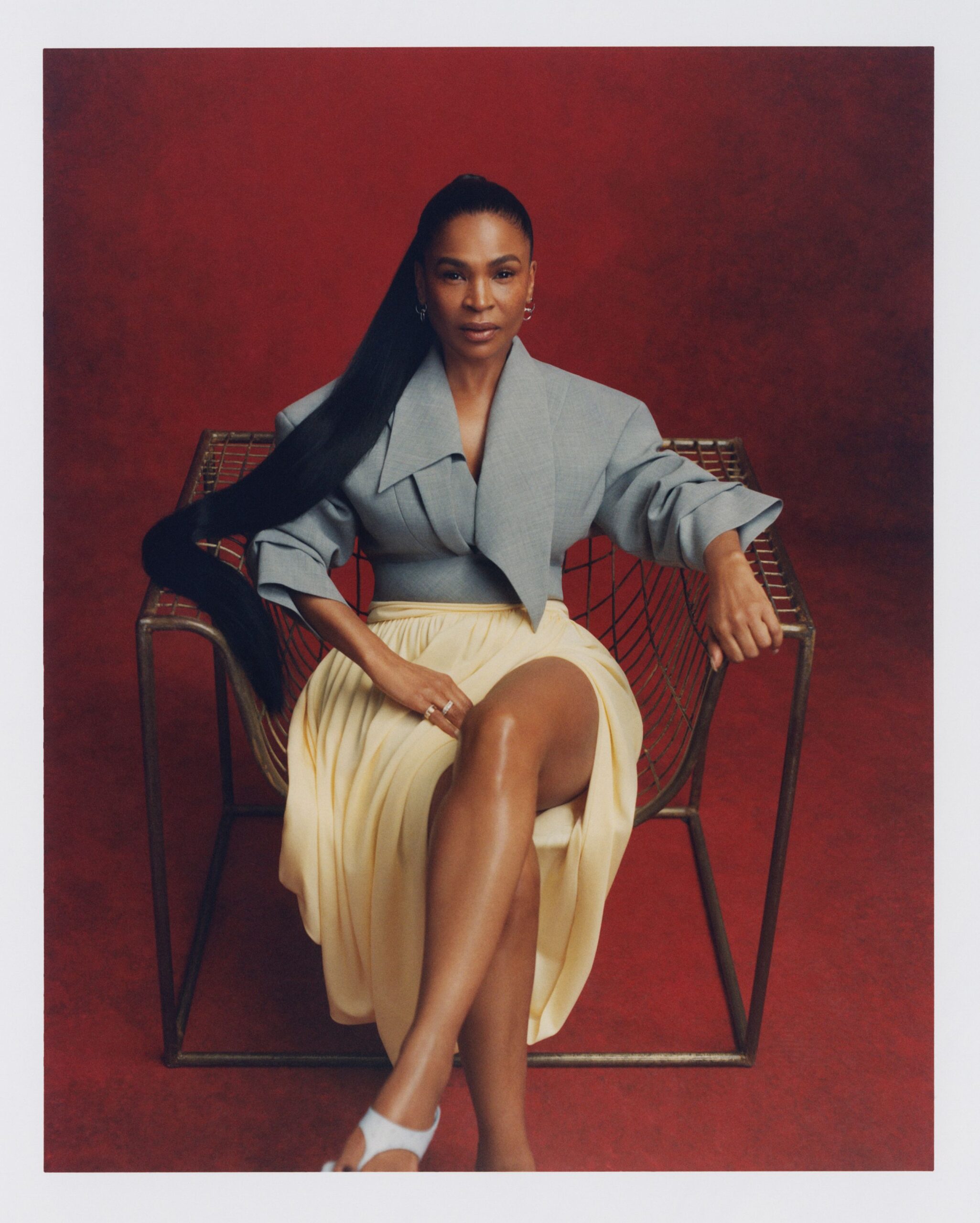
There is a specific kind of vertigo that comes with leaving a movie theater in the middle of the day. The world is suddenly too bright, too loud, and slightly unreal. You have, after all, been inside someone else’s carefully constructed reality for two hours. And then you’re back outside, blinking into the afternoon light, not quite returned to yourself, the movie still clinging to you like perfume. It’s in this particular state that I meet Nia Long for an early lunch in a quiet corner at the Chateau Marmont.
I have just seen Michael (the new Michael Jackson biopic) a month ahead of its April release. I’m still thinking about the film when Long, who plays Jackson family matriarch Katherine Jackson, arrives looking chic but low-key in an oversized blazer, wide-leg jeans, and a Miu Miu baseball cap pulled low. As we ease ourselves into the conversation, I’m struck by the strange doubling effect of the movie vertigo: the woman before me and the woman I have just watched, layered like two transparencies held up to the light.


Tod’s dress. Palomo Spain headpiece. Cartier earrings.
On screen, Long plays Katherine Jackson with a studied stillness. The first time we see her, watching her boys rehearse, the frame holds on her loving face for just a few beats. She says almost nothing. She doesn’t have to. Juxtaposed to Colman Domingo’s blustering portrayal of Joe Jackson and Jaafar Jackson’s uncanny performance as his late uncle Michael, Long has found a way to make silence load-bearing. Restraint is the most visible thing in any scene she occupies.
In person she seems the opposite of restrained. She is blunt but also quite warm, with a dry sense of humor and a deep well of emotional intelligence. She is very much a Scorpio. She notices everything. And, in playing Mrs. Jackson (who is still with us at the age of 95), Long has tapped into the part of herself that knows how to let silence do the work. The word she reaches for when she talks about the experience of playing the matriarch—a word she will return to several times during our conversation—is grace.
“There have been moments in my life where I’ve been required to be more graceful than I’ve ever had to be in the past,” she says. “And that requires a sense of really being able to dig deep into some sort of self-examination. Like, what do I stand for? What’s important to me, ultimately, regardless of Hollywood, the noise? And number one, for me personally, my children come before anything. And so I think when you look at Michael’s journey, and you look at Katherine’s journey, the only way you thrive and survive is through a tremendous amount of grace.” She pauses. “What I think I learned from her is that sometimes grace is really quiet.”


Burberry coat. Falke tights. Carina Hardy earrings.


Long occupies a place in our cultural memory that few actors do. She is, for a certain generation, the platonic ideal of ’90s Fine, a phrase that’s not only about beauty or aesthetic but also about a certain feeling. Watching her as Nina in Love Jones or Jordan in The Best Man or Lisa in The Fresh Prince of Bel-Air, you conjure up a place and time and attitude that feels synonymous with Long. Of course, there is the image, and then there is the human sitting across from me, eating her go-to order of salmon with a side of mustard. And as she does, I ask what she thinks about the iconography and the nostalgia that surrounds her.
“My commitment to work is not for accolades or attention, or even to be famous, quite honestly,” she says. “But I do think because of my commitment to truth and purpose, there is a thing, and I don’t know what that thing is, that people see in my work. And it makes them feel good. It makes them feel inspired. It makes them feel like they know me.”
In a fickle Hollywood landscape that’s even more fickle when it comes to Black actors, Long doesn’t take the longevity and love she’s cultivated for granted. “There’s highs and lows,” Long admits. “I’m having a great year, but I don’t know what’s happening next year.”
Long has starred in several iconic Black films, and she’s always been intentional about how she plays her characters. Much like with the Katherine Jackson role, she creates a version of the person that feels, to her, like something true.
“The only strategy I have in this game is my bank account. Let’s strategize how we’re going to make money and create generational wealth. That is where I’m strategic.” She laughs, scratches her palm. “My hand just started itching the minute I said money. That’s a good thing. Maybe something’s happening. Something’s coming.”
Once she’s in it, though, the work becomes something more personal. “I work hard to make sure that when I represent us, it’s not just someone putting their agenda on me. Whether it’s my hair, my makeup, my wardrobe, my lines.”


Loewe dress and jacket. Stella McCartney shoes. Calzedonia socks. Carina Hardy earrings.

Now that her eldest son is in his 20s and her youngest son, 14, is old enough to stay home by himself, the actor feels ready to expand in all directions. She wants to continue to produce more films, craft new stories both behind and in front of the camera. She tells me about a new film she’s just wrapped shooting in New York, Don’t Ever Wonder, a romantic dramedy (“If that even exists anymore”) three years in the making. It will feature her onscreen reunion with Love Jones leading man Larenz Tate. Directed by Eugene Ashe and featuring an ensemble that includes Blair Underwood, Susan Kelechi Watson, and Algee Smith, the film is all about second acts.
“This is not a continuation of Love Jones,” she emphasizes. “This is a continuation of love, and of what happens once you’ve had your kids, they’re off to college, and you’re empty nesters. And that’s kind of where the story begins. There’s a lot of funny and there’s a lot of heartbreak, and I think it’s a really honest story.”
In talking to Long, I get the sense that honesty and truth is what she values most in the stories she tells. It’s what she values in life as well. Perhaps that’s what compels me, somewhere in the middle of our lunch, to unmask. I mention that I am conducting the interview a little out of sorts, having just ended a 12-year relationship.
“Okay, but when was it really over?” she asks.
“You didn’t have to gag me like that!” I say.
She laughs. I tell her that I am trying to imagine what life will look like—what I will look like—on the other side of this break-up. That’s when the idea of grace comes up again.
In 2022, Long went through that peculiar part of fame where something private becomes public overnight: her partner’s cheating scandal that resulted in the end of their 13-year relationship. She doesn’t have to go too deep into it if she doesn’t want to, I assure her, but the actor doesn’t shy away. On the other side of the experience with her ex, with whom she now has a healthy coparenting relationship, she has an unflinching clarity about the whole ordeal.


Jacquemus dress. Jimmy Choo shoes. Leggs tights. Cartier earrings. Talent’s own rings.
“The amount of pouring into myself that I’ve done is strong and mighty and intentional. I’ve now identified the things that I need to work on and the things that I need to heal. But I have also identified what is intolerable.”
That clarity has been hard-won. When the cheating scandal happened, there was a groundswell of support from fans, a protectiveness over Long as a woman and as a cultural touchstone. But in the instances that she’s talked publicly about it, including in our conversation, I’m struck by how her gratitude for the support is always tempered with nuance.
“I’m proud of myself for giving so much grace. For being able to say people make mistakes and things happen. It’s life. When the stakes are high, the news is big. I can’t do anything about that, but I don’t have to protect my ego in any of this.” She says all this very matter-of-factly, which is the only way she seems capable of saying things.
In the same straightforward tone she suggests I write out everything I need to say to my ex without sending it, because ultimately “it’s not about another person’s behavior. It’s about your bottom line and the magnitude in which you’re committed to self-love,” she says. “I don’t think it’s healthy to hold onto things because then you’re just walking around with this burdensome energy. It could be writing it down. It could be meditation. It could be prayer. There’s a lot of ways to manage the noise. But you don’t have to respond to the noise with the undercurrent of your own trauma.”
I write down this last sentence because it is useful, but also because it is the key to something I’ve been watching Long do across the whole of our conversation: find the lesson in whatever she is given.
.jpg)

Burberry jacket. Carina Hardy earrings.
.jpg)
Loewe dress. Carina Hardy earrings.
Long is working on her first memoir, a process she describes as one of the “biggest, bravest, challenging” things she’s ever done. It’s been a two-year process, a constant negotiation with her own relationship to letting go.
“I can read something I wrote two years ago and go: ‘Oh no, that’s not actually how I feel about that now.’” Long’s father, Doughtry Long Jr., a poet who died in 2020, told her the hardest thing about writing is knowing when to stop. “And I’m like: When is that going to happen? Because I haven’t gotten there yet.”
The memoir takes her back to Iowa City, where she spent six years of her childhood while her mother attended university. She was born in Brooklyn, in a Trinidadian household where everyone on the block was Black. Living in the Midwest during her formative years, she encountered few other Black girls, which disoriented her relationship to race.
“In writing this memoir, I realized the impact that experience had on my own view of beauty,” she says. “And my own self-acceptance of being a pretty brown-skinned little girl growing up in Iowa. I thought I was beautiful because my mother said it and my family said it, but the world told me something different.” She lets that sit. “So to now be a face for Estée Lauder, it’s kind of ironic, because I didn’t feel beautiful until Black Hollywood said I was beautiful.”
That an entire generation of Black women found a reflection of Black beauty in Nia Long while Long herself was still waiting to see it tells us something about how beauty standards work, and how much labor goes into transforming them. Nineties Fine, after all, did not emerge from a vacuum. It was a corrective, Black Hollywood’s answer to a century of the larger industry rendering Black women invisible or, worse, making us visible in ways that were wholly out of our control. Long’s most iconic characters—and indeed, Long herself—reflected a new idea of beauty, of the Black leading lady, expansive in some ways and still restrictive in others. Now, some 30 years on, Long embodies a new facet of being a Black woman in Hollywood.
“Black don’t crack” gets lobbed at Black women constantly, ostensibly as a compliment, but one that sometimes erases the very real pressure that comes with aging—especially aging on a public stage, especially when people have a particular image of you stored in amber.
But Long is not interested in pretending that the body is not a thing that transforms. “I’m 55. I got hormonal stuff going. Your body shifts, changes. It’s a whole new body.” She is not wistful about this. She also ate the truffle parmesan fries and does not appear remotely conflicted about it. She mentions the coming press tour for Michael, how she wants to be in beautiful gowns but she also wants French fries.

A.W.A.K.E. MODE top. Alaia skirt. Cartier earrings. Talent’s own rings. Top & skirt provided courtesy of Moda Operandi.
“I don’t deprive myself of anything that I want,” she says. “I find the balance.”
Beauty was never her primary currency, she says. It had to be something else, other inheritances: her father’s curiosity, her mother’s fierce self-possession. Tattooed and free-spirited, her mother wore leg warmers in the middle of summer because they matched her outfit, and she did not care for one second what anyone thought about that. Embarrassed, Long would beg her mother to take them off. She never did. As an adult, Long sees the power and freedom in that.
Our plates are carted away. Long has to leave soon for a pizza party at home with her youngest son and his friends. Before she goes, I ask her what freedom, at this point, is to her.
“Being able to do what you want to do when you want to do it, because it serves your spirit, not what everyone else thinks you need to be or should be,” she says. That type of freedom, Long adds, doesn’t require an audience.“You don’t have to have anyone else’s permission to do what you love. And it doesn’t have to be on the big stage. It could be in your kitchen. I know I have freedom right now to make a pizza. I’m going to do it.”
Photographer: Emmanuel Sanchez Monsalve
Stylist: Dione Davis
Set Design: Henrique Ciriloneto
Hair: Naeemah Lafond
Makeup: Keita Moore
Manicurist: Sonya Meesh
Writer: Zeba Blay


