




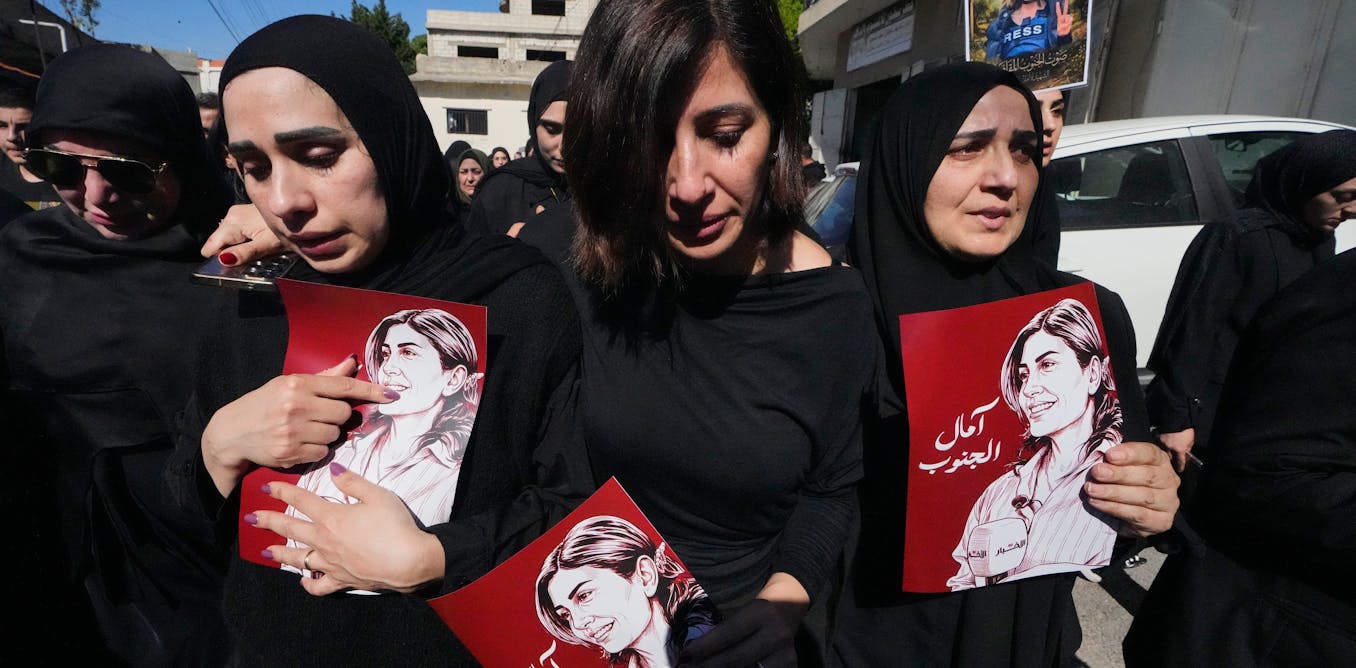
In late April, Amal Khalil, a 43-year-old Lebanese journalist, was killed in a double-tap Israeli strike in southern Lebanon. When rescue teams tried to reach her and another injured journalist, they reportedly also came under fire.
Lebanese President Joseph Aoun said Israel’s “deliberate and consistent targeting of journalists” was “aimed at concealing the truth of its aggressive acts against Lebanon”, despite a ceasefire that had been agreed to by Israel days earlier.
Both Aoun and Lebanese Prime Minister Nawaf Salam declared they would pursue international accountability for her death. Khalil was the ninth journalist to be killed in Lebanon so far this year. Israel says the incident is under review.
The incident had parallels to the killing of six-year-old Hind Rajab in Gaza in March 2024. She and her family were fired on by Israeli forces while trying to evacuate Gaza City by car. Hind survived the initial attack, but remained trapped for hours, on the phone with Palestinian Red Crescent workers trying to reach her.
Even after following an approved route, the two medics sent to rescue Hind in a clearly marked ambulance were killed, as was Hind herself. A subsequent investigation by Forensic Architecture found 355 bullet holes in the car carrying her and her family.
These are not isolated incidents. This is a clear pattern across war zones in Ukraine, Gaza, Sudan and Lebanon. Militaries using drones and AI-assisted weapons systems – marketed for their precision – are changing the face of war and driving increasing numbers of civilian deaths.
These growing attacks on civilians, journalists and humanitarian personnel are leading many to fear a new normal setting in: war without rules.
Performative adherence to law
At a Chatham House event in London last month, UN Humanitarian Chief Tom Fletcher spoke plainly: “1,000 dead humanitarians in three years – when did that become normal?”
Fletcher identified the absence of legal accountability as an enabler of escalating attacks on aid workers.
Part of this is the performative adherence to international humanitarian law – often repeated in political statements and media coverage – as militaries simultaneously carve out exceptions for the use of force.
For example, Israel has continued to issue evacuation orders for residents of southern Lebanon in recent weeks. It has cited its compliance with international humanitarian law, while also expanding its control over territory there.
When evacuation orders primarily serve to shift populations, rather than protect them, it is a violation of the rules of war.


Ariel Schalit/AP
Self-assessments of legal compliance have also enabled systematic attacks on civilian infrastructure in Lebanon to continue, such as healthcare and food and water systems. Some 1.2 million people now facing crisis levels of food insecurity.
Ceasefires, too, have become performative. Experts argue they are merely serving to divert public attention from Israel’s broader goals in both Gaza and Lebanon.
Six months on, for instance, the Gaza ceasefire is failing to meet its stated objectives. There is no peace or safety for residents. More than 800 Palestinians have been killed since the ceasefire came into effect and 60% of people have lost their homes. Humanitarian aid continues to be obstructed, while children suffer from acute malnutrition.

Abdel Kareem Hana/AP
The ‘Gaza playbook’
Last month, Israeli Finance Minister Bezalel Smotrich openly threatened to make Dahiyeh, a suburb of southern Beirut, look like Khan Younis in Gaza.
Israeli Defence Minister Israel Katz has also said all “houses in villages near the Lebanese border will be destroyed, in accordance with the model used in Rafah and Beit Hanoun in Gaza”.
This is precisely what is happening now, despite the ceasefire. Israel created a “buffer zone” in Gaza where it has expanded territorial control, and the same thing is taking place in southern Lebanon.
There were countless warnings, including from the UN secretary-general, that insufficient action over Gaza would have consequences – not only for Palestinian civilians and international law, but wider peace and security.
What can be done?
Now is the time for more principled confrontation from political leaders and concerned states to clearly call out performative adherence to international law and ceasefires.
The normalisation of Israel’s “Gaza playbook” strategies in Lebanon, without sustained outside political pressure, will only continue to escalate the threats to civilians and wider international peace and security.
Middle powers have important roles to play, too. Practically speaking, states can use what’s called “universal jurisdiction” to bring domestic legal action against Israeli leaders and individuals accused of crimes. This could include legal action for the targeting of aid workers and journalists.
A broad coalition of UN member states must also come together to reinforce international law against the forces and practices undermining it.
The “Hague Group” is one such path forward. Formed in early 2025, its membership has expanded to include more than 40 nations aimed at supporting international law, the right to self-determination and the prohibition on taking territory by force.
From Gaza to Lebanon to Iran, greater political action is needed to reinforce international law. The world cannot afford the reverberating human and security costs of continued impunity and war without rules.


