

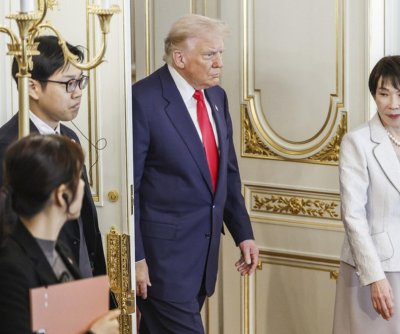
U.S President Donald Trump (C) was set to welcome Japanese Prime Minister Sanae Takaichi (R) to the White House for a return visit on Thursday after the pair forged a strong relationship at a Japan-US summit meeting in Tokyo during a three day visit in October. File photo by Franck Robichon/EPA
March 19 (UPI) — U.S. President Donald Trump was scheduled to host Japan’s Sanae Takaichi at the White House on Thursday on her first visit to the United States since becoming prime minister in October.
Japanese officials said the agenda for the working lunch and dinner would be discussing how to further strengthen the Japan-U.S. alliance and boost economic and security cooperation as China’s meteoric rise as an economic and military global power continues apace.
They said deals worth as much as $63 billion would be announced and that the pair would also reaffirm an agreement for Japan to invest $550 billion in key U.S. sectors, including energy, critical minerals, computer chips and ship building in return for lower tariffs on Japanese imports to the United States.
Before departing Tokyo, Takaichi told reporters her mission was to reaffirm the strong relationship with Trump in key areas, including security and the economy, amid a shift in U.S. focus toward the conflict in the Middle East, where she called for calm.
“I want to engage in substantial discussions based on Japan’s point of view and our way of thinking. The top priority is the early de-escalation of the situation.
“Global peace and stability is being threatened, including over the safety of shipping in the Strait of Hormuz and energy security. If the current unstable situation continues, things will get even harder for both Japan and the United States, as well as the rest of the world,” added Takaichi.
Analysts said that despite Trump and Takaichi’s mutual admiration for each other established at their first meeting in Tokyo in October, they expected Thursday’s meeting to be a difficult one for Takaichi.
Earlier this week, Japan was among a number of U.S. allies that declined a request by Trump for countries that are the largest users of oil exported via the Strait of Hormuz to send military vessels to help secure the sea lane, which has been effectively closed by Iran.
With almost 95% of Japanese oil imports originating from Persian Gulf-producing countries, analysts said it would be very tricky for Takaichi if Trump presses the issue during their talks.
Her hands are tied both politically and legally.
Japan’s pacifist constitution, adopted in the wake of its role in World War II, restricts its use of military force for any reason apart from if it were attacked directly, while public opinion is strongly against military involvement in a war they don’t agree with in the first place.
On the other hand, Takaichi will be seeking assurances from Trump regarding Japan’s inclusion in his proposed Gold Dome missile defense umbrella after she threw a spanner into relations with Beijing by appearing to say Japan would come to Taiwan’s aid if it were attacked.
The comments in November plunged ties between the two countries into a deep freeze but Takaichi has not backed down or apologized.
China has not ruled out the use of force to retake the island which it maintains is a renegade province.
The visit is also complicated by the launching of an unfair trade practises probe on March 11 by the office of the U.S. Trade Representative into Japan and 14 other countries, plus the European Union, that could result in fresh tariffs.
The investigation relates to “structural excess capacity and production in manufacturing sectors.”
Mireya Solis, Philip Knight Chair in Japan Studies at the Brookings Institution in Washington, D.C., said Tokyo has gone to lengths, probably greater than other U.S. trade partners, to deliver on the promises made to get reduced tariff rates.
With Japan grappling with inflation, a weak currency and torpid domestic consumption, the economic relationship with the United States is critically important and it will want to avoid emerging from Thursday’s meeting with worse terms than agreed in previous rounds.

Chair of the Federal Reserve Jerome Powell speaks during a press conference at the Federal Reserve on Wednesday. The Federal Reserve announced that it will hold rates steady. Photo by Bonnie Cash/UPI | License Photo
