



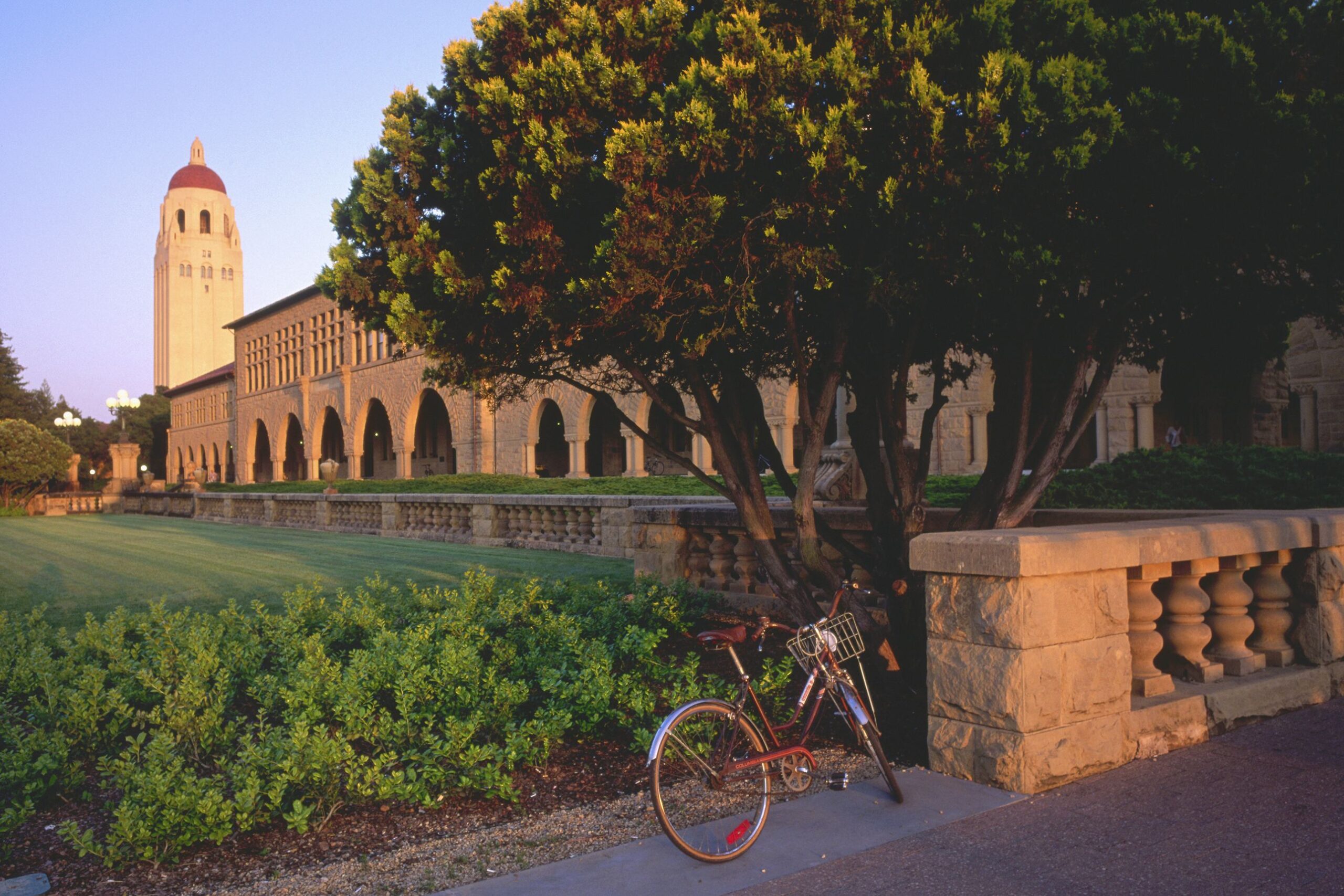
The first Friday of freshman year was meant to be when people really, truly, finally celebrated the amazing thing it is to be a college student. But, alas, it wasn’t to be.
Stanford had been my dream since I was seven, much to the surprise of everyone around me on the East Coast. It wasn’t just the tech or the innovation. Students constructed makeshift boats to traverse Lake Lagunita and built motorized couches to get to class. Irreverence was said to be an integral part of the experience. I loved the idea that the university, despite its competitive excellence, had somehow still retained the reputation of being laid-back, chill. I was ecstatic upon my arrival, ready to mark the occasion.
‘How to Rule the World: An Education in Power at Stanford University’ by Theo Baker
In 2022, Stanford’s traditional first party of the year—“Eurotrash,” hosted by the Kappa Sigma fraternity— was canceled by the university on short notice, with little explanation. No other events, parties or otherwise, took its place. I decided to go out and wander campus to see if there was something I’d missed. I found nothing. No concerts, no mixers, no parties, nothing to do. I encountered not another soul. It gave me the heebie-jeebies: Something about this place was off, like Disneyland after all the rides have closed and the park is emptied for the night.
It turned out that there was already a name for this. I’d just become an unwitting bystander to the “War on Fun.”
The phrase had been coined a year earlier by students frustrated that Stanford was exercising ever more control over their lives. The university had long before passed the threshold of employing more administrators than it enrolled undergraduates— and this showed.
To host a social gathering, I would eventually learn, one needed to apply far in advance to the Party Review Committee, which only met once a week, on Tuesdays. Few parties were approved, and even those that were could only last for a limited time, be hosted on certain days, and be open to specific people. A detailed proposal filling dozens of pages of requirements was required. And then there was the other essential component: the “Harm Reduction Plan.”
Every social event, in Stanford’s view, was a harm waiting to happen—the university’s goal was to minimize the fallout. This framing, while perhaps understandable from a lawyer’s perspective, had the effect of bludgeoning formative life experiences to death.
All decorations, even a few balloons, had to be approved ahead of time. Social media marketing and flyers were required to “align with the mission of the University.” The all-powerful Party Review Committee even claimed jurisdiction over parties held entirely off campus. Yes, this War on Fun crossed sovereign borders.
All of this at a university with the motto “Die Luft der Freiheit weht.” Let the winds of freedom blow.
Applying to run an event had become a full-time job. In fact, simply learning how to fill out the requisite forms and navigate the tangled institutional web required taking a specific registration-process course— with an exam you had to pass in order to apply to host a social event. Let me repeat that: You had to take a class. And pass an exam. To be able to apply to host a college party. “It’s like getting audited by the IRS to get boba for people,” one club leader confided in me.
Fraternities were the last groups on campus with enough dedication to continue waging battle with the bureaucrats. But the administration was determined to break them, too. A few months before I arrived, every single fraternity had been placed on probation, each receiving a letter from a lawyer on the same day.
By the time I landed at Stanford, students were fuming, and it was impossible to escape discussion of the War on Fun. Every possible action a student could take was governed by regulation, detailed on one of Stanford’s labyrinthine web pages. Officially, you weren’t even allowed to make more than fifty-five decibels of noise past 10:00 p.m. The average conversation is seventy decibels.
Clearly, this was no longer the college of generations past. Equally obvious: This so-called war would make for a great first article in The Stanford Daily.
My attempts to gather information quickly stalled. Dozens of emails to club leaders, administrators, frat bros, and safety advocates went unanswered. It was weird. There was this fear.
Stuck, I was going to have to resort to extreme measures. I was going to have to report from a frat party.
Yes, the first party I went to in college was for the purpose of journalism.
It was called “White Lies,” and everyone was asked to come with a confession written with Sharpie on their shirt in white lie form. I trooped out with a group from my dorm, sober and curious to see how the night would go.
Some wore risqué outfits with overtly sexual messages. “I don’t like anal” read one. Others were more reflective. “I don’t want to date my situationship” read another. (Mine was among the stupidest. “I am decisive,” I wrote, after spending thirty minutes deliberating over other options.)
At the top of the stairs was a table of frat boys wearing high-visibility vests— these were the so-called “sober monitors.” Stanford required them. The frat boys checked IDs, admitting only Stanford students, and then allowed five or six people at a time through to face their final hurdle to entry. Two signs awaited entrants: A pledge to ask for and receive consent, which attendees were asked to read aloud. Then a second message for recitation: “I am on stolen land,” it began, continuing in part, “I will commit to uplifting Indigenous and Black voices.” This, I learned, was standard for Stanford parties.


Photo courtesy of Theo Baker.
Inside, the room was overfilled. Condensation crept up the windows as sweaty bodies pressed together in a seething mass. Aside from the beer for that one chugging girl, there was no alcohol. Outside in a courtyard, groups socialized in too-loud voices. Some smoked, others took care of friends who sat with dazed expressions on any flat surface. Stationed at regular intervals were more sober monitors in their bright neon-yellow vests, looking bored.
In the party environment, thankfully, people were more willing to speak, giving me helpful anecdotes about the wilting social scene. I also got a few of the sober monitors to talk guardedly about the bureaucratic hurdles they faced.
I was still reporting when the lights came on and the music stopped. Although it was just 12:30 a.m., the fraternity had feigned an end to the party to clear out the freshmen. Those of us who weren’t in with the frat— in other words, the unknowns, the people without access to the hidden drink supply, the newbies— left disappointed. I reunited with my editors and three of us ended up back at the Daily House chatting until 3:00 a.m.
Leads I’d gotten from partygoers proved fruitful, and the president of a different fraternity— Sigma Nu— finally agreed to talk.
Moritz Stephan was nothing like the frat bro caricature I had coming into college. He was deeply Germanic, an impressive software engineer, and couched every one of his sentences in terms of “liabilities.”
Moritz was candid about the challenges facing his fraternity. With the new policies put in place by the administration, so few parties were being held that “when you do host them, there’s just way too many people. Last year, there were a couple of parties where six hundred to eight hundred freshmen and sophomores were trying to storm into our house, breaking through windows, physically and verbally assaulting members doing door security. And we just had to call the police on ourselves to get everything cleared out.”
He wanted to achieve an “inclusive” environment, but with the risks as high as they were and the process as onerous as it had become, “we have to be hypercautious now.” Indeed, “we have to control the risk and control the liability.”
Recent decisions to crack down on open drinking had led students to drink hard liquor in secret, taking a number of shots in quick succession because they knew that their resident assistants were required to report them if they were caught and that the scant few parties that cleared the bureaucratic approval process would serve no alcohol.
I collected stories about young women passed out in bushes, about faculty mentors so frustrated that they actively told resident assistants to ignore the school’s policies, about severe alcohol abuse by students who spiraled alone in their rooms. I talked to first responders who disclosed an increasing rate of “transports,” or hospitalizations, due to alcohol poisoning.
As an employee of the office of alcohol policy eventually told me, the university’s policies were “hopelessly out of touch with reality.” They were, he said, “absolute shit.” Attempts to curtail dangerous drinking had instead increased it. Indeed, when the Eurotrash party had been canceled, students with nowhere else to go had thrown a “nomad” party, wandering around campus and climbing light poles. Rules aimed at reducing fire safety risk ironically caused far more of it, because so few parties were approved that rooms would be stuffed way over their limits. The War on Fun was downright dangerous.
When I went to Stanford’s communications team for comment on my War on Fun investigation, the school enacted its own Harm Reduction Plan.
The director of the office sent an email to a group of employees “we are guessing” had leaked to me. “If you are approached by The Daily about your work . . . or anything related to what we do,” the director wrote, “it needs to get cleared by me first.”
Stanford declined to answer specific questions, but provided a statement acknowledging a drop from 158 parties that had been officially registered during the first few weeks of the fall quarter in 2019 to just 45 parties during the same time period in 2022. They pledged to earmark more funds for row houses to throw events. And they would respond publicly with an FAQ page: “Does Stanford hate fun? Of course not!”
My first-ever piece for The Stanford Daily was published just before midnight on October 24, 2022, exactly one month and four days after I moved in, quickly becoming The Daily’s most read article of the year. It was accompanied by a photograph of the Stanford Tree mascot waving a “Stanford Hates Fun” banner two days prior.
Later that week, the mascot was suspended for his protest.
From How to Rule the World: An Education in Power at Stanford University by Theo Baker, to be published on May 19th, 2026 by Penguin Press, an imprint of Penguin Publishing Group, a division of Penguin Random House, LLC. Copyright (c) 2026 by Theodore Baker.
-
Carlos Alcaraz on “Living the Dream Life” and His Rivalry With Jannik Sinner
-
Kylian Mbappé Is Scoring All the Goals—and Taking All the Heat


