

Get elegant performance, minus the $400+ price tag.
By


Bethany Allard
Lead Shopping Reporter
Bethany Allard is a Los Angeles-based shopping reporter at Mashable covering beauty tech, dating, sex and relationships, and headphones. That basically means she puts her hair through a lot, scrolls through a lot of dating apps, and rotates through a lot of different headphones. In addition to testing out and rounding up the best products, she also covers deals for Mashable, paying an especially obsessive amount of attention to Apple deals and prices. That knowledge comes in handy when she’s covering shopping holidays like Prime Day and Black Friday, which she’s now done for three years at Mashable.
on
All products featured here are independently selected by our editors and writers. If you buy something through links on our site, Mashable may earn an affiliate commission.


Credit: Bethany Allard
It’s a simple truth: Where there’s a Dyson product, there’s a dupe. With Dyson beauty products among the most sought-after (and expensive) on the market, the dupe pool has naturally grown. As a result, my mission to try as many promising Supersonic dupes as possible has become a years-long affair.
The brand entered the beauty sphere in 2016 when it released the now-iconic Dyson Supersonic hair dryer, which introduced an innovative design that maximized airflow and minimized hair damage. Nine years later, it remains the most coveted hair dryer on the market, making it clear that Dyson’s beauty tech bet was a huge success. While it’s an impressive product, Supersonics range in price from $299 to $649, depending on the model.
Luckily, you can still get excellent performance without shelling out hundreds of dollars.
Overview


These are the tech, tools, and products — from laptops to e-readers, from earbuds to robovacs, and more — that Mashable ranks best in class.
Table of Contents
The often-imitated hair dryer has a lot of copycats that dupe Dyson’s signature look but skimp on quality. A good rule of thumb: Avoid the sketchy $40 Amazon knockoffs that merely copy the iconic design. I promise they won’t perform the same, and you’ll be lucky if they last six months. The good news? In recent years, plenty of worthwhile competitors — or dupes — to the Dyson Supersonic have emerged on the scene.
So, what’s the best Dyson Supersonic dupe?
To answer that question, I tested a bunch of hair dryers. Some look similar to the Supersonic, and some look nothing like it. I wanted to find the best alternatives to the Dyson Supersonic that replicate the experience: That is to say, they dry your hair in a way that feels quick, easy, and at least a little luxurious.
My top recommendation as of August 2026? The Laifen Swift. Not only does it look like the real thing, but it utilizes ions to minimize damage and has a powerful 110,000 RPM high-speed motor. Plus, it’s affordable, which is why it’s consistently held the top spot in this guide.
Our Pick


The Good & The Bad
-
Sleek design
-
Simple interface
-
Compact and easy to store and use for long periods of time
-
Frequently on sale
-
Not too loud
- Excellent option for travel
-
Only three heat options, with the hottest feeling too intense
- Highest air flow setting is almost too strong
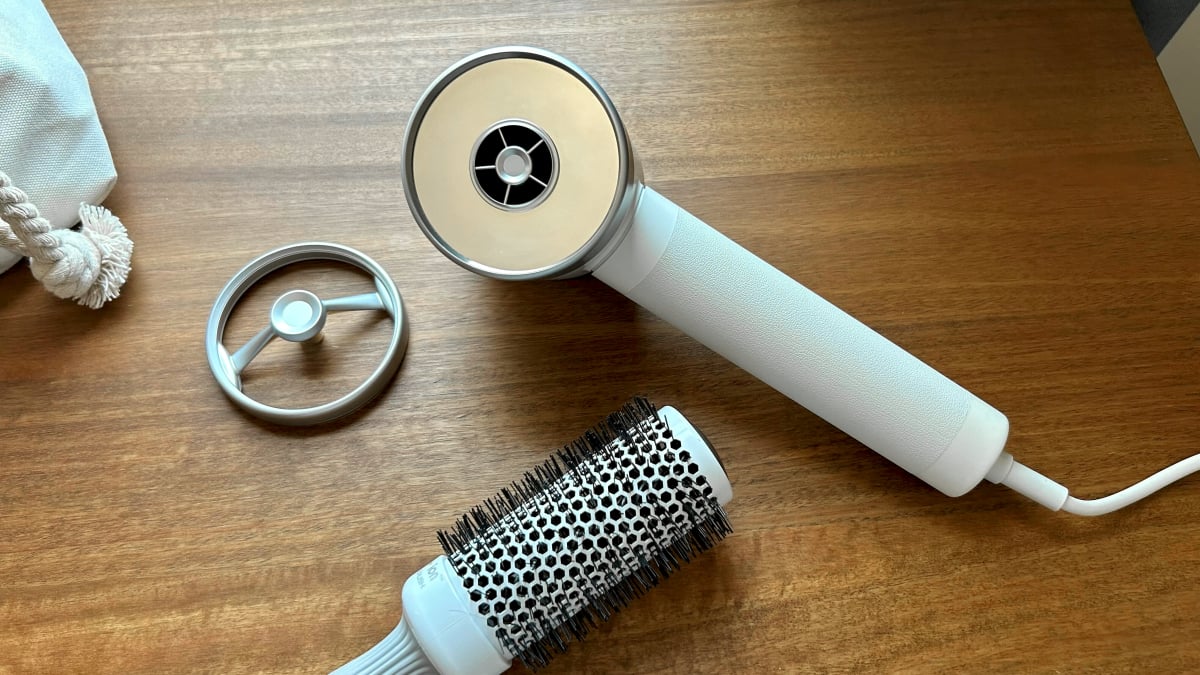
At $139.99, the Swift’s price inspires more confidence in its overall performance and longevity than a random knockoff. Beyond the design, it also has magnetic attachments (though you’ll have to pay a bit extra to get more than one) and that signature Dyson air sound I’ve come to know through my time using the Airwrap. However, what kept me reaching for it over and over again was its simplicity. For anyone who needs their blow dryer to be easy to use above all else, the Laifen is the way to go.
I can’t say the dry time feels astonishingly fast, but it doesn’t lag either. The two air speeds are strong, and I almost never found myself needing to go beyond the first one, even when doing an all-over rough dry to my wet hair before bed. The negative ions at work provided me with a super smooth dry, too. The heat options are more limited, with only cool, warm, and hot settings. I found the hot one gets hot, and even the warm one can feel a bit intense close to the scalp, so I recommend sticking with the lower two settings.
For the days I felt like diffusing my wavy hair, switching the attachments was beyond easy. Though this is when I found myself most wishing for a temperature setting or two more, the hottest setting never felt scorching. A long press of the temperature button auto-cycles through each temp, which sometimes feels useful for finding the middle ground between the warm and hot settings, but over time hasn’t been a setting that I typically use.
Some particular design choices I like that add to the all-over simple vibe are the single switch turning on the dryer and switching the airspeed, and the one button for adjusting the temperatures. The ring light at the back of the dryer changes color from blue to orange and red as you switch through the dryer’s three temps, or oscillates on a purple tone for the long press. At $139.99, this dryer feels like an investment, although not a hefty one — it clocks in at $260 less than the Supersonic with three attachments, and it’s frequently on sale.
Details

The Good & The Bad
-
Small and lightweight
-
Simple but dries hair quickly
- Great value
-
Not the best for frizz
-
Attachment magnet could be stronger
- Cheaper feel in the hand
When actually using the dryer, I found it to be easy to handle: it’s ever so slightly chunkier than the Laifen (though I had to hold them side by side to check), but the Dreame is a tad lighter. As for how it dried my hair, I was able to take my mid-length hair from dripping wet to completely dry in 15 minutes, with the assistance of my hair brush. It was easy to achieve plenty of volume with the one concentrator attachment, primarily using the warm setting. As with the Laifen, I found the highest setting to feel too hot to use for more than 10 seconds or so, especially when drying at the root. My hair looked shiny and like it hadn’t been overblasted with heat (again, I skipped the hottest setting), but it was also slightly frizzier than with the Shark hair dryer. Still, these are minor complaints for a hair dryer under $100.
Value aside, there are a couple of cases where I recommend springing the extra cash for the Laifen. One, the Laifen’s magnetic attachments also feel more secure. Though I didn’t have any issues with the Dreame attachment disconnecting from the barrel while in use, I do wonder if it would perform as well over time as the Laifen. The Laifen weight in the hand also feels a little more luxe without feeling too heavy. For some people, that may be a con, but if you tend not to like more plasticky, lightweight products, the Gleam dryer may not be for you.
Finally, the Laifen sounds like a Dyson, and the Dreame doesn’t. It’s a more superficial point, but if you want the closest Dyson experience possible, you’d probably be happier with the Laifen Swift.
Details

The Good & The Bad
-
Strong air speeds
-
Good variety of attachments
-
IQ feature sets optimal speed and heat for attachments
-
Twisting mechanism is great for storage
-
Thin handle and nozzle make it easy to target particular areas
- Good button placement
-
On the pricier end for a dupe
-
Not all hair types work with each attachment
- No storage case included
The attachments allow for easy styling, especially if you’re looking to achieve sleek volume, while the folding base makes finding storage space easier.
My first and lasting impression of this hair dryer was that it doesn’t play with its air speeds — they’re strong. While that meant I definitely preferred to use a brush instead of just rough drying, it also meant my hair dried quickly. Reliably, my whole head was entirely dry in less than 15 minutes. The QuickSmooth brush attachment was also helpful in keeping things from looking too windswept and more styled and volumized. A button on the side of the attachment lets you adjust the exact angle of the brush, and though I can’t imagine anyone would need to adjust it all that often, it was a nice detail.
The QuickSmooth brush, like the other three attachments that come with the dryer, automatically adjusts to the optimal air speed and temperature. Again, not super necessary, but a feature that matches the price range, and lets me style my hair with less thought. If you want, you can manually override both settings.
As I did with the FlexStyle diffuser, I loved the SpeedStyle diffuser for its adjustable prongs and size. The FrizzFighter finishing tool did exactly what its name promised, though I did find it flattened my hair after using the QuickSmooth brush. The styling concentrator was nothing crazy, but it was nice for targeting the strong airflow and distributing it more evenly. Unless you have wavy or curly hair though, you likely won’t need all of these attachments.
If you’re not too pressed for space, you can also grab the SpeedStyle without the Flex — I can’t speak to if it performs all that differently, but “folding” this dryer didn’t make a drastic difference. With that said, it does make storing it slightly less awkward, so if you are tight on space, it could definitely be worth it. Despite its size, this is the heaviest dryer on this list of recs, but it feels well-balanced and overall less bulky than the HyperAIR, so I never really noticed its weight while using it.
Details

The Good & The Bad
-
More temperature customization than Supersonic Nural
-
Changes attachment settings based on hair type
-
Hi-res display
-
Comes with a stand
-
Still $50 cheaper than the Supersonic Nural
-
Automatic pausing with all attachments (unlike Supersonic Nural)
- Often on sale for $299
-
Magnetic connection could be stronger
-
Controls have a slight learning curve
-
Hair can get caught in space near the filter
- Only three attachments (though this may be a plus for you)
In the Dyson Supersonic Nural, I didn’t find that exactly. Sure, it can be connected to the Dyson app, but the short “hair profile” I filled out didn’t really tailor to any specific styling guides it showed me. Plus, the app couldn’t be used to actually control the dryer. Here’s what intelligent drying actually entailed: attachment detection that adjusts the dryer to the optimal speed and heat settings, pause detection that lowers both settings automatically when the dryer is placed down, and scalp protect mode, which uses Dyson’s “Nural” sensors to change the air flow and temperature when you’re using it at the roots of your hair. For all this, you’ll pay $449.99.
With the T3 Aire IQ, intelligent drying doesn’t involve a companion app, but rather a whole host of controls directly from the dryer itself. The first time you start it, you can select your hair type from fine, medium, or coarse (the dryer will save these settings for future use, but they’re easily adjusted after the fact). Already, this distinguishes it as more “smart” than the Supersonic. However, like the Supersonic, the T3 Aire IQ senses which attachments are connected and adjusts the heat and speed, but it also takes the hair type you input into account. For example, when I used the diffuser attachment for my fine, wavy hair, the dryer adjusted to the lowest air speed and second heat setting. I also tested the diffuser on my mom’s curlier, coarse hair, and set it to the third heat setting and the lowest air speed.
If you’re not thrilled with the automatic settings, overriding them is as simple as hitting the right or left buttons on the back of the dryer. On the Supersonic Neural, you have to press an additional button before making an adjustment — it’s not the worst, but for $450, it added slightly more friction than I expected. On the T3, I had my choice between five heat settings, compared to the Dyson’s four — both dryers, however, have three air speeds. For $50 cheaper, the T3 also comes with a magnetic stand that can hold two of the three attachments (the aforementioned diffuser was too big to fit on it comfortably). Plus, its pause detection works with all the available attachments, while the Dyson didn’t pause automatically when I was using the diffuser attachment.
So, where does the T3 dryer show its lower price point? Not in the dry time — both took around the same time, and left my hair feeling similarly shiny and soft. However, your options for styling are more limited on the T3 dryer, as it offers three attachments to the Nural’s five. If your hair isn’t curly or wavy, though, there’s less of a disparity — two out of the Dyson’s five attachments are a wide-tooth comb and a diffuser. (I will say the magnetic attachment was generally more reliable on the Dyson — twice during testing, a small bump caused the T3 attachments to detach.) The Dyson’s diffuser was also more unique, with removable prongs that made pixie diffusing especially easy. Finally, the filter location on the back of the T3 dryer was a bit awkward, sometimes slightly grabbing my hair, though never painfully so.
All in all, the T3’s cons didn’t add up to a $50 price difference, so if you’re looking for a hair dryer that does all the setting work for you, I recommend it over the Dyson Supersonic Nural. Plus, the T3 hair dryer is regularly on sale for $299, making it $150 cheaper than the Nural’s regular price.
Details
What makes the Dyson Supersonic special?
The Supersonic has stood the test of time because with it, Dyson reimagined the hair dryer. Instead of a bulky, loud dryer, the Supersonic is sleek and compact yet more powerful than other dryers on the market (and a little less loud, too).
Dyson is known for this futuristic aesthetic on its products, but the look of this dryer also has a function. The ring-shaped head ditches the vented and coiled model of the traditional hair dryer and houses the tiny V9 motor in the handle. The combination of the V9 motor and the Air Multiplier technology makes for a dryer that clocks in at only 1.8 pounds yet still delivers a powerful airflow that’s notably quieter than the roar of a traditional dryer. That extra strong airflow also makes this dryer less reliant on heat and keeps hair damage to a minimum.
To further mitigate any heat damage, the Supersonic also measures the air temperature up to 20 times per second and uses a built-in ionizer to minimize static and give hair a sleek finish, which brings us to a quick ionizer science lesson.
Ionizers are pretty common in higher-end air dryers. Why? They blow negative ions at wet hair to reduce static electricity by sealing the hair cuticle and taking down the power of that positive ionic charge (aka what’s causing that annoying frizz). As negative ions make contact with hair, they’re also dispersing the positive ions of water, therefore cutting down on your drying time and reducing damage in the process.
Basically, it’s one of the reasons the Dyson Supersonic provides such quick and excellent results and why hair dryers with ionizers cost more money — they do more than simply dry hair.
Magnetic attachments designed to easily snap onto the blow dryer round out the futuristic feel of the Supersonic. Five are included: a styling concentrator, a flyaway attachment, a diffuser, a gentle air attachment, and a wide-tooth comb. It’s a nice array of included nozzles, even for high-end dryers, which might typically include three or four attachments at the most.
Why is the Dyson Supersonic so expensive?
At $399.99 and up, the Supersonic is definitely an investment. However, you’re paying for a high-end motor that’s built to last, multiple heat settings to protect hair, an innovative design, and of course, the ionic tech. Other dryers from popular hot tool brands like T3, ghd, and Harry Josh boast some similar features and run you anywhere from $150 to $350, but none quite capture the magic of the Supersonic.
When I tested the Supersonic, I found that it had a luxe feel that stands out from other hair dryers. But don’t forget: the Dyson Supersonic is now over 10 years old.
In 2024, Dyson released the updated Supersonic Nural (which you can find more info on in the FAQ section of this article), but it’s not a drastically different product, with the main upgrade coming in the form of smart features, including improved temperature regulation and attachment detection. I tested it for a few weeks and found the upgrades nice, but by no means game-changing, especially for a $449 hair dryer. I also tested it against other smart hair dryers and found that the T3 Aire IQ offered the best intelligent features for the price point (more on that below, too).
Even with the original Supersonic being an older model, there is something to be said about it standing the test of time, and for providing a luxurious (yet efficient) drying experience, especially for folks with thick hair. On the other hand, Dyson competitors have had plenty of time to develop alternatives, all at a fraction of the price.
Recent testing updates
With the release of Supersonic Travel in 2026, I’m testing compact, travel-specific hair dryers.
In August 2026, I also removed the Dreame Pocket from our list of recommendations as the best option if you also want an Airwrap. Dreame no longer sells the Coanda curling wand with the standard Pocket model — or the handful of other Pocket dryers it’s released since — making it a less viable Airwrap alternative. That said, there is one version — the Dreame Pocket Aura — that does feature the barrels. I’ve added the product to my testing pipeline, but it is $100 more than the original Pocket dryer. At $199, it’s a price that the Shark FlexStyle occasionally drops down to.
The newest addition is the Supersonic Nural dupe, the T3 Aire IQ dryer, which I added in April 2025. Prior to that, I added the Dreame Gleam hair dryer, the Dreame Pocket, and the Shark SpeedStyle Pro Flex in November 2024. In the same month, I removed the Shark HyperAIR from my recommendations, as it has largely been phased out of stores after Shark discontinued it. If you’re still especially keen to get it, a version with just one attachment is available at Walmart.
In February 2025, I tested the L’Oréal Airlight Pro, which at $475 costs even more than the original Supersonic and approaches the price point of the Supersonic Nural. The Airlight Pro looked and functioned very similarly to the Zuvi Halo, which makes sense — the hair dryer was developed in partnership with Zuvi. At the time, I didn’t include it as it wasn’t that different than the Zuvi Halo, and cost significantly more. However, since then, the Zuvi Halo appears to be discontinued — it’s been sold out for months on Zuvi’s website after a drastic price hike to $634. I reached out to a representative from Zuvi to confirm the discontinuation, but didn’t hear back. As a result, I’ve decided to remove the Zuvi Halo from our list of recommendations, and I’m reconsidering the inclusion of the Airlight Pro.
Frequently Asked Questions
If you go to Amazon and type in “Dyson Supersonic dupe,” you’ll see at least a few that mimic the Supersonic’s compact design with a short, circular nozzle. As more and more brands crop up, it can be easier to grab a dupe that may show promise initially, but ultimately isn’t built to last.
For most ultra-cheap models (we’re talking below $60), the infallible advice of “if it seems too good to be true, it probably is,” applies, as these hair dryers are likely to a) damage your hair more than a well-made dryer would, and b) break much faster. You’re much better off going for an advanced hair dryer that may not look like the Supersonic but does share similar features.
The Dyson Supersonic is a hair dryer with attachments that will help you achieve certain styles. Ultimately, they’re fairly standard hair-drying attachments. The Dyson Airwrap, on the other hand, is a multi-styler that uses hot air to help you blow dry and style your hair, from diffusing to straightening to curling. Basically, it’s more versatile, but it’s also more expensive — it’s $649.99 to the Supersonic’s $399.99 (for the three attachment model).
For some people, the price may be worth it, but for most people, I recommend at least giving Airwrap dupes a look before making the plunge.
In the past few years, Dyson’s gone through a few iterations of the Supersonic lineup.
For instance, Dyson released an “affordable” version of the Supersonic, called the Supersonic Origin, in 2023. It initially retailed for $399.99, then dropped down to $379.99, sat at $419.99 after a price raise of the entire Supersonic line, and finally, was phased out.
The standard Supersonic with five attachments and a $429.99 price tag has also been dropped from the main lineup — the cheapest base model now comes with three attachments are retails for $399.99. The ultra-light and easily maneuvered Supersonic r has also gone from a “Professional” only model to having both a Professional and slightly cheaper consumer model.
As of Aug. 2026, these are all the available Supersonic models you can buy (from least to most expensive):
-
Dyson Supersonic Travel ($299.99): The newest Supersonic is also the smallest and most affordable. It comes with just one styling concentrator attachment, slightly less power than the OG Supersonic, and three heat settings and two air speeds (compared to the four heat settings and three air speeds found on the standard version). It also features universal voltage compatibility for easy international travel.
-
Dyson Supersonic with three attachments ($399.99): The same exact dryer as the Supersonic, but with just three attachments: the styling concentrator, diffuser, and wide tooth comb. Attachments individually go for $29.99 to $39.99 and can often be out of stock, so if you anticipate using even two, this is likely the right option for you.
-
Dyson Supersonic Nural ($449.99): Dyson’s premium Supersonic is for folks who want those nice extras like automatic temperature changing for scalp health and pause detection, but are still at-home users that don’t need a professional-grade dryer. As a newer dryer, we don’t have the most historic pricing data, but we have seen it drop in price to $399.99.
-
Dyson Supersonic Professional hair dryer ($549.99): Unlike the r hair dryer (below), this Dyson retains the design of the original Supersonic, but comes with a few key upgrades that designate it for professional use, including a redesigned filter, sound level designed for conversation, and a professional concentrator attachment.
-
Dyson Supersonic r Professional hair dryer ($649.99): This is the dryer for professional stylists, with a design that makes it easy to blow-dry someone else’s hair and a longer cord for maneuvering — and it’s generally a machine that can withstand much more use than the standard Supersonic.
I started my Supersonic dupe search by wading through a sea of copycat listings with fake-sounding brand names and looking at hair dryers from established brands to select a pool of front-runners. Then, I set out to test the top Dyson Supersonic hair dryer dupes.
Here’s what I considered when testing blow dryers for this guide:
Heat and damage protection
In testing, I paid attention to how my hair felt right after drying, and in the days that followed. I used the same heat protectant before each testing session.
Did the dupe look like the Supersonic, and if so, did that design make the dryer more easily maneuverable, storable, and maximize airflow like the original?
I looked for hair dryers with automatic temperature regulation, helpful styling attachments, built-in ionizers, infrared light, or creative storage solutions.
I prioritized brands known for making hair tools that last. Wherever possible, I try to retest products after a longer period of time.


Bethany Allard is a Los Angeles-based shopping reporter at Mashable covering beauty tech, dating, sex and relationships, and headphones. That basically means she puts her hair through a lot, scrolls through a lot of dating apps, and rotates through a lot of different headphones. In addition to testing out and rounding up the best products, she also covers deals for Mashable, paying an especially obsessive amount of attention to Apple deals and prices. That knowledge comes in handy when she’s covering shopping holidays like Prime Day and Black Friday, which she’s now done for three years at Mashable.


Related Posts