- This essay is adapted from the article, “Information as Civic Infrastructure—and How Philanthropy Can Support the Ecosystem,” which was originally published in Nonprofit Quarterly on March 3, 2026.
- While philanthropy traditionally funds direct solutions like land conservation or technology, it often overlooks the fragile information environment that these interventions require to succeed.
- The lack of credible, verified data creates an “information gap” that allows environmental harms to go unnoticed and undermines the public oversight necessary for regulatory and market accountability.
- Investing in the core capacities of a healthy information ecosystem—such as data verification and digital security—provides the essential clarity needed to address our most urgent global challenges.
This essay is adapted from the article, “Information as Civic Infrastructure—and How Philanthropy Can Support the Ecosystem,” which was originally published in Nonprofit Quarterly on March 3, 2026.

Philanthropy has grown accustomed to funding the “final” solution. It is comfortable buying land, backing new technologies, and underwriting the services or policies that address urgent problems. Yet, it often overlooks the very social foundation those solutions stand on: a shared, reliable information environment. Today, that foundation is cracking.
This fragility extends beyond the spread of falsehoods. It appears as indifference to accuracy, fatigue from complexity, and a growing difficulty in judging what deserves attention. In many places, facts still exist, but they travel poorly. They arrive late and out of context, their credibility stripped away before they even reach the public. The result is not always disagreement; more often it is disengagement.
For donors concerned with climate change, biodiversity loss, public health, or democratic governance, this crumbling foundation puts even the best-funded programs at risk—a blind spot many donors haven’t yet addressed. Programs may be well designed and generously funded, yet fail to gain traction because the informational terrain beneath them has shifted. Projects that rely on public oversight, regulatory follow-through, or market response depend on the availability of trusted, usable information.
Environmental harm offers a clear illustration. Deforestation, overfishing, and illegal mining tend to accelerate where monitoring is weak and scrutiny sporadic. This is not because laws do not exist, but because violations go unrecorded or unnoticed. When documentation does surface, it often arrives through a mix of local observation, technical data, and independent verification. The specific institution matters less than the function itself: making private actions visible to the public in credible ways.
Independent journalism has historically played that role, though it is no longer the only actor capable of doing so. Data platforms, open-access research, satellite monitoring, and community-led documentation efforts now contribute as well. They are bound by a commitment to verifiability and public use. Their work does not prescribe outcomes. It supplies evidence that others—regulators, courts, investors, or communities—can act upon if and when they choose.
In practice, information work tends to follow a consistent pattern. Evidence is gathered and verified, then placed in the public record. That record enables scrutiny by these same actors—from the courtroom to the community center. Not every disclosure produces a response. Some pass without visible effect. Over time, however, the accumulation matters in that repeated exposure shifts expectations. Companies come to assume that claims may be checked. Officials anticipate that decisions could be examined. Communities gain leverage simply by knowing their experiences are documented and visible.
Impact in this field doesn’t follow a straight line. A single investigation may prompt enforcement in one case, market withdrawal in another, and no visible response in a third. Its influence is cumulative rather than predictable, and often indirect. Such impact is difficult to attribute neatly, which helps explain why it has often been underfunded. Philanthropy tends to favor interventions with clear outputs and predictable timelines. The work of gathering and verifying information resists that logic. It unfolds across jurisdictions, languages, and audiences. Its most consequential effects may surface only later, through the actions of others rather than the efforts of the original actors themselves.
When philanthropy does invest in the information ecosystem—still a relatively small share of overall giving—it often departs from conventional project funding models. In these cases, support is more likely to take the form of multi-year, flexible backing for core functions rather than tightly specified deliverables. It may be directed toward capacities that rarely attract earmarked grants despite their central role in credibility and reach. These include data verification, editorial management, legal review, digital security, safety protocols, impact tracking, and distribution.
The evidence for this investment is finally catching up to the intuition. Evaluations by foundations have shown associations between journalism funding and policy debates, regulatory reviews, and broader participation in public discourse. These assessments do not claim direct causality. Instead, they suggest that sustained access to credible information improves the conditions under which decisions are contested and made. In a crowded philanthropic landscape, that alone constitutes a form of leverage.
Concerns about politicization are understandable. Public-interest scrutiny often sits close to power and can provoke backlash. The answer, however, is not to avoid it, but to fund it carefully. Independence matters. Support should focus on capacities and core functions—skills, safety, data access, and distribution—rather than on messages or conclusions. Diversification also matters. A healthy information ecosystem depends on many independent actors working in parallel across different contexts and scales.
Trust-based philanthropy offers a useful model here. Donors such as MacKenzie Scott and Laurene Powell Jobs have argued that relinquishing control can strengthen outcomes by enabling recipients to respond to conditions on the ground on their own terms. In this context, flexibility is not merely philosophical. Evidence-gathering cannot be tightly scripted in advance without risking credibility. Flexible support allows practitioners to follow evidence as it emerges, even when it points somewhere unexpected.
The global dimension of this challenge is urgently felt. In many regions, civic space is narrowing and independent scrutiny carries real risk. Where local reporters, researchers, and monitors are silenced, corruption deepens and harms to nature and people become harder to contest. Where information flows persist—even through modest, decentralized efforts—governance tends to improve incrementally. The presence of reliable documentation does not guarantee accountability, but its absence almost ensures impunity.
Philanthropy already spends heavily on climate mitigation, adaptation, and conservation. By comparison, investments in information infrastructure remain small. This imbalance has consequences. Without credible data, public understanding falters. Without public understanding, political will weakens. Without political will, even well-funded solutions struggle to endure.
Information isn’t a silver bullet, nor is it a substitute for policy. It is a necessary but insufficient condition. Journalism does not enforce laws, restore ecosystems, or lower emissions. What it can do is clarify what is happening, where responsibility lies, and what choices are available. In an era of urgency, that form of clarity can matter more than any single intervention.
Supporting the information ecosystem isn’t charity; it is the upkeep of our civic infrastructure. It allows us to see the world as it actually is, rather than how the powerful present it. Amidst upheaval, this clarity may be the most durable legacy a donor can leave.
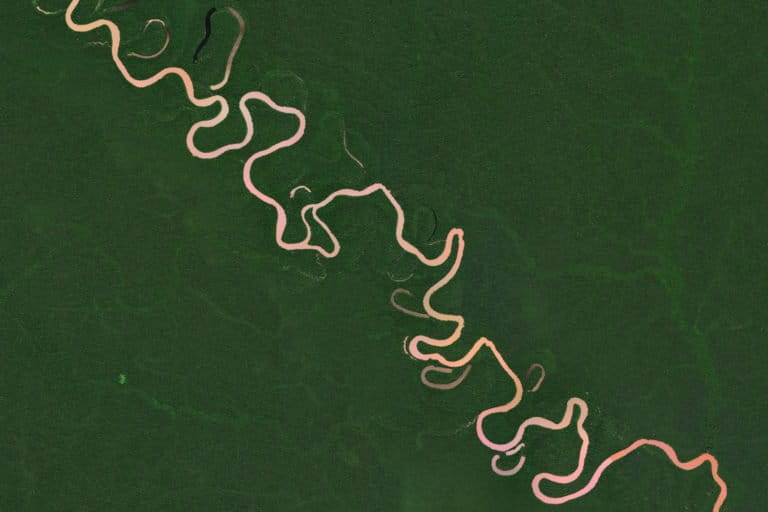
Banner images: NASA satellite image of a river in the Peruvian Amazon.