



On a balmy evening in July, the cobbled streets of historic Ibizan neighborhood Dalt Villa began to look more Berliner than Balearic. Streams of cool kids dressed in all-black tank tops, slip dresses and leather pants crammed into the old town, sipping cocktails as DJs slid faders. Only a few flyposters gave away that this wasn’t an impromptu street party, as did a stone facade carved with the text: “YSL Beauty.” The club-inspired event was part of the brand’s “Block Party” series, which has seen the house take over cafes and squares in cities including Marseille, Jakarta and Madrid.
It follows in the footsteps of other branded parties and hangouts on the island. This summer, Casablanca has been on tour across La Isla Blanca, continuing a long-running events series with Solid Grooves at airport-adjacent hangar DC-10 and taking over Six Senses’ beach with a more laid-back pop-up. “For me, Ibiza will always be more than a destination. It’s a place where fashion, music, design and culture naturally come together, making it the perfect setting for the Casablanca world,” says Casablanca founder Charaf Tajer. Armani Exchange, meanwhile, has been bunkering down at Ibiza’s Amnesia club for a series of Sunday parties. “It shows how fashion can become an authentic part of club culture,” says Beatriz Murillo, Amnesia’s marketing manager.
.jpg)

Casablanca took over Six Senses’s beach, opening a pop-up with a chill-out space, a detox smoothie menu and laid-back DJ sessions.
Photo: Courtesy of Casablanca
Of course, a fashion brand heading to Ibiza is nothing new — for decades, designers have leant into the wellness and culinary scenes of the island, with branded beach clubs and flashy influencer trips. Nor is throwing a sponsored party (see: almost every fashion activation, ever). But it’s fair to say that stepping into the rave scene has always been met with trepidation, a possible nightmare for brand safety officers.
But if brands can successfully attach themselves to DJs with die-hard fans and club nights full of young clubbers looking to amp up their wardrobes, there’s more than just clout on offer — there’s the chance of a serious afterglow. “Experiential activations are fast becoming the best way to access consumers, and few things are more impactful than a truly transcendent night on the dance floor,” says youth culture journalist, model and party girl Bee Beardsworth.
Good habits
Gen Z are increasingly searching for this transcendence, looking to escape from the permacrisis that’s pervading reality. Many have caught up to their older siblings’ partying ways; almost seven in 10 (68%) 23-year-olds reported binge drinking in the past year, while nearly a third (29%) said they did so at least monthly, up from 10% at age 17. “Gen Z are guided by wellbeing, but they’re increasingly aware of the traps of perfectionist wellness, and they’re looking to inject more pleasure into their leisure time,” says Annie Corser, senior trends editor, pop culture and media at Stylus.
But there’s also a sober curious group to cater for; it’s why the Milan edition of YSL Beauty’s Block Party was teetotal, reflecting a desire to enjoy banging beats without the equally banging headaches the next day. Similarly, while Casablanca’s DC-10 series, which has run since 2024, is not a sober affair, Casablanca’s Six Senses soiree focused on detox smoothies, not boozy cocktails. “We wanted to create a destination where celebration and restoration could exist together. Ibiza has this unique ability to balance vibrant energy with moments of calm,” says Tajer.


YSL Beauty’s Block Party.
Photo: Courtesy of YSL Beauty
For some, daytime dancing, rather than after-dark raving, is the new way to go out out — just 16% of the young people surveyed by Obsurvant in 2025 said they were staying out past 10pm more frequently. Partially, that’s because there’s nowhere to go — since 2020, a third of clubs have shuttered in the UK. “London’s dying nightlife is killing the fashion club kid,” declared Dazed in July. Or, as Charli XCX cheekily put it on Rock Music: “The dancefloor is dead.”
Some buzzy parties have bucked this trend and galvanized a new scene. Lost, the near-mythical night at the former Odeon Covent Garden, flashed back to past euphoria. Strikingly, it was phone-free, taking inspo from Berlin’s taped-camera policy and the 567% rise of off-grid club nights. “For even the most seasoned clubbers, there is something in Lost that feels like a revelation,” wrote Megan Townsend for Mixmag. “It’s the type of party that you will be telling everyone to try, without being able to explain exactly why and what they should try it for.”
Peckham’s new-ish club Palais is similarly offline. “The reopened basement club has a phone-free policy, but it’s not crafting or birdwatching going on down there — it is proper clubbing, and it’s packed every week,” says Corser. While Amnesia doesn’t have a blanket ban on phones, it does try to encourage a digital detox. “We must be realistic: sharing an experience is also part of how audiences behave today. The challenge is to find the right balance between digital visibility and truly living the moment.” With young clubbers more scared than ever of being filmed while dancing, ditching phones is a way to ease the vibes.
This highlights a drive toward more intentional, experiential clubbing. And for brands, this offers new opportunities to engage with club culture through listening parties, morning-after sessions or DJ workshops. “As iconic clubs shutter across London, Berlin, Southeast Asia, and beyond, something more intimate and intentional is quietly taking shape: elevated experiences,” Pigeon and Planes’ Tia Ho recently argued. “The club becomes a live editorial, where clothing, music and visual production create a shared atmosphere,” thinks Murillo.
A stitch to wear
Clubbers have always been ahead of the curve when it comes to new looks. “The club can be a laboratory for newness and innovation. It’s obviously not the only place where innovation happens, but it’s definitely somewhere you can see people putting things together before those ideas have been completely codified,” says Charles Jeffrey, whose legendary Loverboy Dalston club night, started while a student at CSM, informed his design. Chet Lo, the London-based designer who has often tapped into club culture, echoes this: “Club kids are always at the forefront of what style is going to be!”


Chet Lo’s runway debut for the talent incubator Fashion East, during London Fashion Week SS22.
Photo: Getty Images
But for brands wanting to address this consumer, their style is more fluid than ever. In many cases, it’s a throwback. “Younger clubbers are definitely drawing their references from 2010s Tumblr, like seapunk, indie sleaze, Jeffrey Campbell and American Apparel days,” says Beardsworth. “There is a lot of DIY — ripped shirts, stockings as dresses, underwear as outerwear — and they are buying it from Vinted, car boots and charity shops, which clearly displays a rebellion against the hyper-consumerism of fast fashion.”
It seems that the Cyberdog days are here again. “They’re emo. It’s a sea of emo kids and I freaking love it so much,” says Lo. “Statement pieces like small digi cams covered in plastic gems are common, along with furry boots and cat ears,” says Zak Hardy, founder of Dance Policy. “The Tumblr influence is certainly strong (re-imagined through the prism of Euphoria) — glitter, neon, the 2010s MGMT throwbacks,” Corser adds.
Other clubbers are taking cues from the DJs. Often, this stems from a desire to know where to go out. “I think club kids are increasingly looking to DJs and influencers to dictate their nocturnal adventures,” says Beardsworth. “I get people telling me all the time that they’ve gone to a night because I posted about it on socials, and we all know the era of the celebrity DJ is very firmly upon us.”
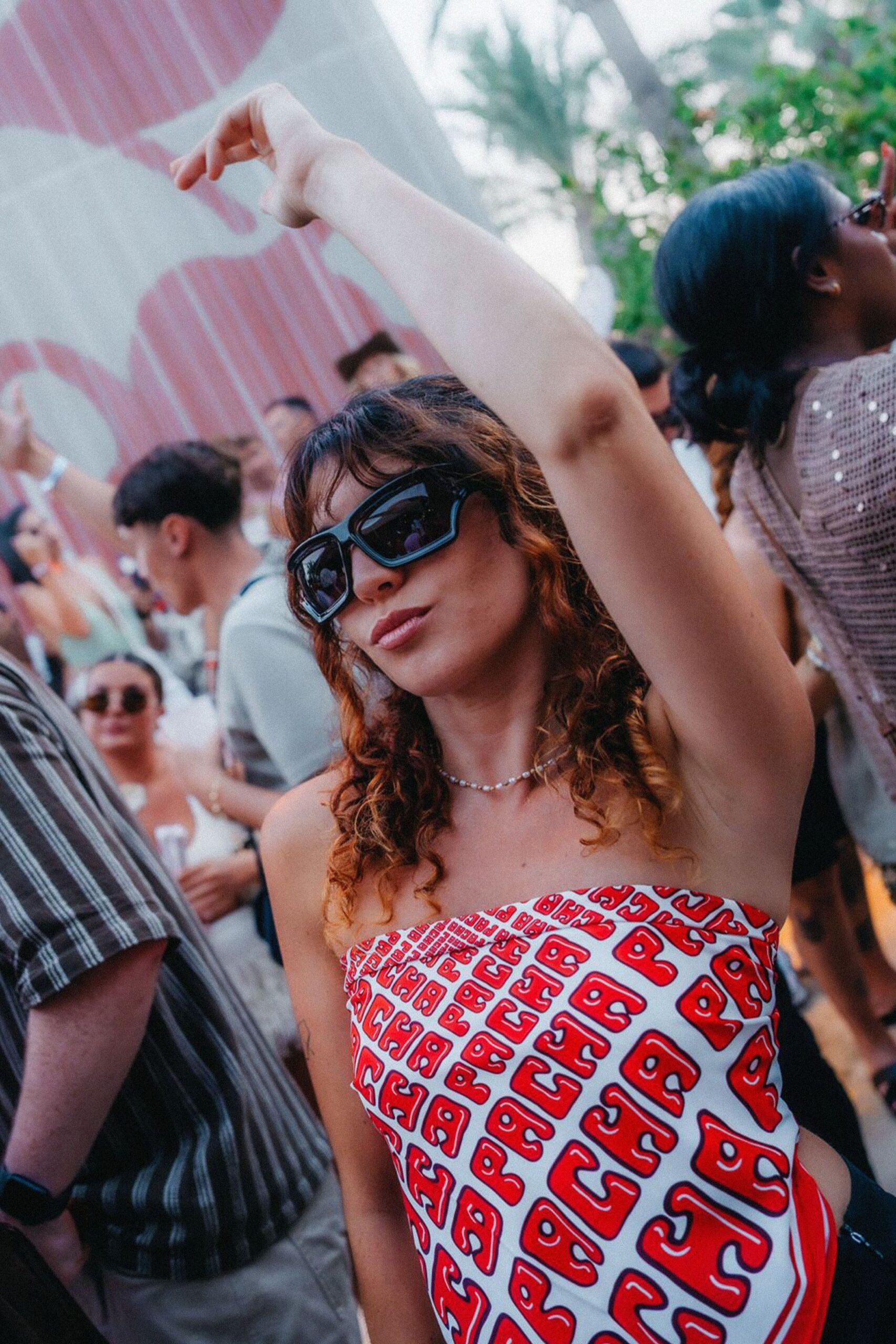
But they’re also having influence on what to wear. Peggy Gou, a regular on DJ Mag’s highest-ranked selectors, has made her personal brand more immersive by collaborating with the likes of Pacha Ibiza and Alpha Industries on capsule collections. Honey Dijon, meanwhile, has collaborated with Comme des Garçons and, most recently, attended Burberry’s Winter 2026 Show.


Alix Earle at Pacha Ibiza.
Photo: Courtesy of Pacha Group
Now, a new generation of social media-savvy DJs are building vast, fervent Gen Z fanbases and driving younger, more diverse audiences to the mainstream club scene. This year, US-based EDM DJ John Summit debuted his residency at superclub UNVRS, attracting a young crowd, many of whom had flown in from the States to see the show. The DJ has 2 million Instagram followers, 1.2 million followers on TikTok and over 42 million TikTok likes, and is known for sharing his journey, from being fired from his accountant job at Ernst & Young to launching a DJ career. Likewise, young UK-based DJ Josh Baker debuted his residency at Amnesia this year, drawing a younger crowd than some of the longer-standing resident DJs on the bill.
These mass-market, luxury-leaning DJs are waiting to be dressed by sportswear and streetwear labels. “They represent a huge opportunity for brands. Every artist has a highly engaged community, allowing brands to connect with very specific audiences through music, dance culture and shared experiences,” says Amnesia press manager Delfina Uriarte. In June, JD launched a private villa party with Baker. “We linked up with Josh at a luxury villa for an evening to remember. The ultimate party,” reads the what went down blog. “Got the flights booked for your own summer hol? Now it’s time to prep the suitcase.”
In another win for the nightlife overground, influencers are also hitting the club. Where the post-pandemic clean girl was about pilates and brunch, today’s top it-girls, from Alix Earle, Anastasia ‘Stass’ Karanikolaou and Justine Skye to Lila Moss, Rina Lipa and Olivia Neill, have posted from Ibiza and several music festivals this summer, sharing messy videos and images from the dancefloor alongside the usual fit pics. Earle was partly responsible for this shift, detailing her partying antics while studying at the University of Miami in 2022, the influencer became one of the top creators in the world.
But while influencers are on the guestlist of a new wave of superclubs, more discerning clubbers are still going to focus on what their friends say. “Club kids are following community and word of mouth now instead of a specific venue or night because their world is so much more individualistic,” says Beardsworth.
The risks of club activations
It means that brands can’t just crash the party with bespoke, glossy neon signs and hope to attract club kids. “The words ‘brand activation’ immediately suggest there’s some kind of exchange happening. You’re putting your body into a space, participating in something, potentially creating content within it and thinking about how that experience is going to be perceived outside of the experience itself,” says Jeffrey.
Jeffrey is also clear that branded parties aren’t “truly hedonistic.” Of course, hedonism itself has always been a consideration for brand safety officers — no one wants to get caught up in a debauched scandal. But more precarious is the risk of looking like you’re infiltrating an underground scene. If sportswashing is a thing, maybe clubwashing is, too.
“[Gen Z] are also increasingly less drawn to adhering to a homogenous mentality or handing their money over to one big dog who profits from it,” says Beardsworth, noting that nightlife magnates are increasingly being held to account. Hardy is emphatic: “Brands should generally stay away from running their own parties, it just doesn’t work. Kids shouldn’t be attending sober club nights organised by Chase banking, nor should they want to.”
It’s why brands need to offer something real. “They always need to think of how they can actually tap into working with the people really shaping and supporting nightlife, instead of just ripping it off,” says Beardsworth. “Gen Z and Gen Alpha respond more to genuine authenticity and grassroots activations than any other demographic, as they crave it so deeply, and they are incredibly savvy.”
Giving the keys to the talent is a surefire way to go. Hardy points to Club Nothing, a campaign from the disruptive tech brand that’s currently offering four lots of $10,000 to throw a party. “This isn’t a corporate function. We want to invest in your most outrageous ways of experiencing music,” reads the copy.
Taking this cautious approach means that brands shouldn’t feel like they’ve been totally uninvited from the party. “Although they exhibit a high level of anti-corporate sensibility, Gen Z are still more likely than other generations to see brands as potential cultural custodians,” says Corser. “They are capable of acting as a bridge between infinite scrolls of staid, bland content and offline experiences possible of generating spontaneity and less choreographed, potentially transformative experiences.”
Most importantly, the laser-focus should be on supporting the culture. Maybe the best way to do this is, like YSL Beauty, to orbit, rather than try to eclipse, the community. Getting your clothes on clubbers and advocating for the scene, rather than filling invite-only nights with branded lightboxes, enables you to be a +1 rather than give negative energy. “Ultimately, younger generations are incredibly good at spotting when a brand is simply borrowing credibility from club culture,” says Uriarte. “When brands become genuine contributors to the culture — not just sponsors — they stop feeling like outsiders and become part of the story.” Through this, and a move away from phones and decadence, brands can harness the true potential of club culture — euphoric memories that endure long after the lights have flicked back on.