







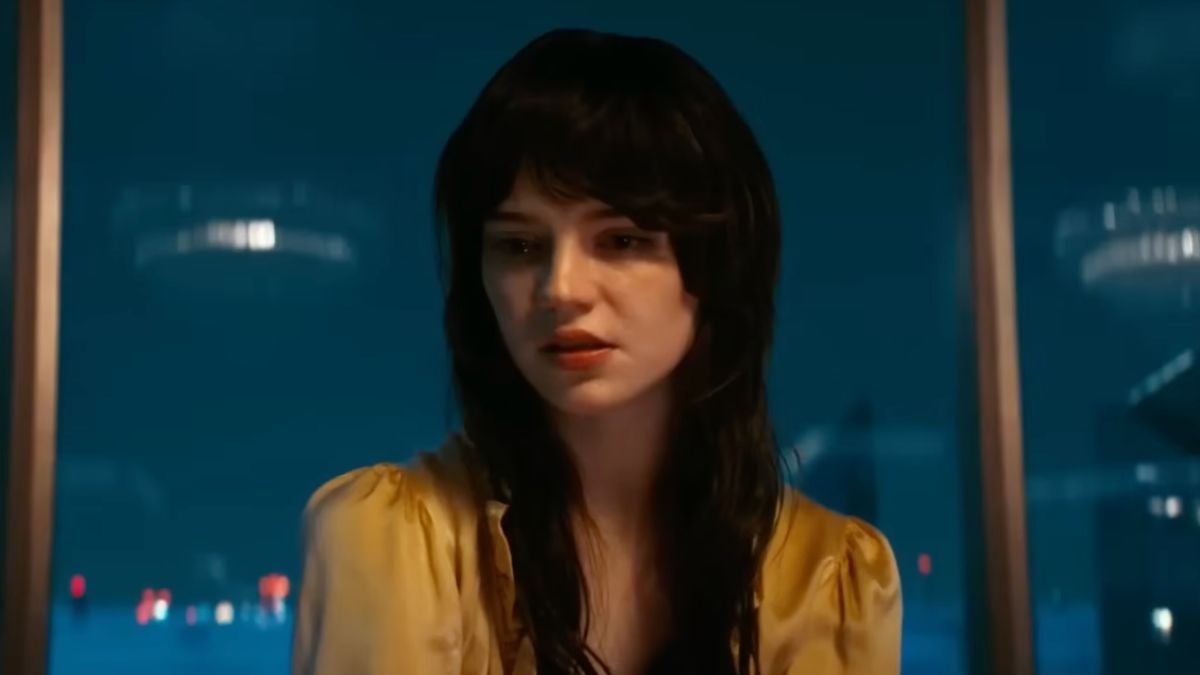
“This movie’s gonna be hell.”
So says Sophie Thatcher’s Elle fairly early on in Nicolas Winding Refn’s visually striking “Her Private Hell,” cheekily and accurately predicting the nightmare that’s to come. To even call the film a nightmare feels like a reductive way of describing the feverish purgatory that Refn thrusts us into. More closely resembling his underrated and underseen recent series, “Copenhagen Cowboy,” the director’s return to feature filmmaking is still a captivating cinematic experience all its own, launching us into a loosely connected series of vignettes that are erotic, gruesome and more than a little all over the place.
And yet, in the end, despite all the ways it very nearly gets lost in itself, it proves to be an ultimately captivating and uncompromising vision. That it could easily be seen as both Refn’s best or worst is what makes it such an interesting Rorschach test. It won’t win him any new fans, but that’s more than fine as those who’ve been awaiting his return to cinema after his foray into television wouldn’t want it any other way.
Premiering Monday at the Cannes Film Festival, the plot, for what little it matters, involves a luxurious apartment high up above a seemingly futuristic city that’s being consumed by mist. It’s there where we first meet Elle as she returns home from somewhere, seemingly both at ease and yet also anxious about what the future holds. She’s hurt by the recent departure of her father, a bizarre, brutal man who lights a match on his ear when we first meet him, and seems like she’s just trying to hold onto her sanity.


She’ll spend time with strangers, including a troubled man played by a scene-stealing Charles Melton, and friends alike, though a shadowy figure capable of inflicting great harm on all she has left looms largest. How much of this is real? That matters less than how deeply alive it all feels and how much the film grabs you by the throat.
As we get taken deeper and deeper into Elle’s mind, Refn, increasingly more interested in being a visual stylist unbound by narrative convention than he is the filmmaker who made the tense, tightly-constructed thriller “Drive,” pushes himself further than he ever has before. At many points, including an extended riff on “Star Trek,” he very nearly loses himself in what seems to be a film within the film that pointedly acknowledges the production within the production (the film won’t fix them, a character acknowledges at one key painful moment). But every time Refn comes close to losing us as an audience, there’s always a stunning visual pulling us back in.
His film, while definitely still an emotional, often darkly comic journey, is also primarily a series of visceral, vibrant and increasingly violent visions that you have to let wash over you. Fight the current and you might find yourself drowning. But for those willing to let go, there’s so much joy to be found in the film’s trip downstream into hell.
There are flashbacks and flash forwards, half-remembered dreams and stories of mythic figures, all of which are bathed in the neon light that Refn just can’t get enough of. However, none of this is just style for the sake of it. The way he uses it to catch characters in various stages of fear, excitement, grief and eventual joy, the flashes of each bringing into focus all the extreme angles of their faces, is quite breathtaking. More than the bursts of visceral violence, it’s Refn’s vibrant command of visuals that proves most exhilarating. Even if there was less plot, the consistently dark beauty of the film would be enough to carry it forward.
At the same time, Refn has found a perfect creative collaborator in Thatcher. A continually surprising performer, who broke out in “Yellowjackets,” but who was doing plenty of great work around that, including in the underrated sci-fi stunner “Prospect,” she gives what may be her most daring performance yet here. She goes from being more wounded and alone to vindictive and cruel in the blink of an eye, capturing all the various rough edges to the character even when just surveying a scene with her piercing stare. As one scene blurs into another, she remains a grounding, graceful force, capable of cracking a sly joke just as she is a dramatic monologue about how everything is falling apart.

When it does eventually fall apart, or at least fall more apart, both Refn and Thatcher let everything loose. The colors get more extreme, bringing the faces of the cast into harsher and harsher focus, and the performances more unhinged. Thatcher, almost channeling Jack Nicholson from “The Shining,” cackles and careens her way through the once tranquil apartment, seemingly right on the cusp of madness before pulling us back in close for a more unexpectedly moving, yet still plenty macabre, finale. Her cracked expression pulling together in a slight smile in the final frames is both emotionally profound as it is petrifying. It’s a tough balancing act to pull off, but both she and Refn make it look easy.
The film is still very much not for everyone or, potentially, even anyone other than Refn himself. If you haven’t connected with his prior work, which looks downright restrained compared to this, you will likely be incredibly put off and alienated by everything playing out here. But for those who’ve appreciated the way the filmmaker has increasingly stripped away plot to get right to making the equivalent of nightmarish neon paintings, it’s really something special.
As with all his films, your mileage still may vary with how far along you’re willing to go with Refn. But for those who have been looking for him to take things even further, it’s wonderful to see him cooking with gas once more and setting the screen alight.
“Her Private Hell” will release in theaters July 24 via Neon.


