



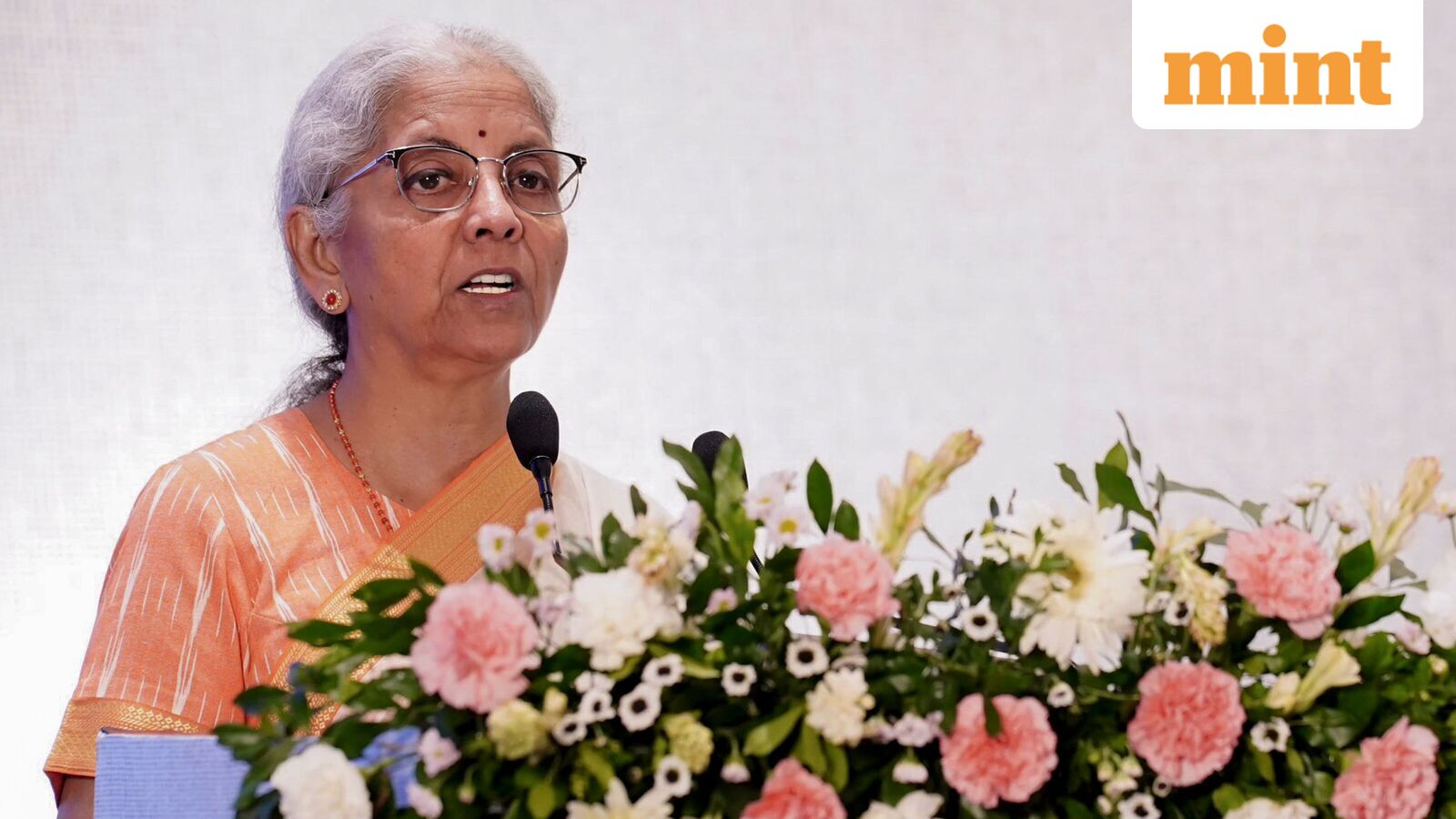
New Delhi: The government’s regulatory philosophy is anchored in enabling growth while keeping risks in check, with rules acting as guardrails rather than tollgates so as not to hinder business activity, finance minister Nirmala Sitharaman said on Sunday.
Sitharaman highlighted deregulation, infrastructure building and macroeconomic stability as key drivers of India’s growth.
Speaking at the NDTV Profit Business Leadership Awards, she said that the Centre is pursuing a trust-based regulatory framework that facilitates enterprise while protecting public interest. “Our conviction is simple. Regulation should be a guardrail, not a tollgate. Deregulation is a habit we intend to keep,” she said.
The finance minister said that the government has undertaken one of the country’s most extensive deregulation exercises, with the Centre and states working together to simplify compliance requirements. As part of the exercise, the government has extended the validity of licences and certificates, replaced several physical inspections with third-party certification and decriminalised routine business lapses, Sitharaman said.
Sitharaman’s remarks are in line with the Centre’s ongoing deregulation drive aimed at replacing approval-based compliance with a trust-based regulatory framework. Over the past two years, the government has decriminalised several business-related provisions, streamlined compliance requirements, expanded faceless and digital approvals, rationalized quality control orders (QCOs) and asked ministries to review and repeal outdated rules, while maintaining regulatory oversight through risk-based enforcement and quality standards.
She said that India’s long-term growth strategy rests on five pillars, which include a trust-based regulatory system, quality infrastructure, stronger global partnerships, macroeconomic stability and continued investment in future generations.
Highlighting the country’s economic performance, she said India continues to demonstrate resilience despite an uncertain global environment, with high-frequency indicators pointing to sustained economic activity. She cited GST collections, e-way bill generation, electricity demand, digital payments, vehicle sales, tractor sales and healthy order books as indicators of continued momentum.
On infrastructure, Sitharaman said that the government has significantly expanded highways, expressways, airports, ports and dedicated freight corridors over the past decade. The PM Gati Shakti National Master Plan has improved coordination across ministries, enabling integrated planning and faster execution of infrastructure projects, she said.
She also underscored the importance of international economic partnerships, saying India’s expanding network of free trade agreements is creating new opportunities for exporters across sectors, including micro, small, and medium enterprises (MSMEs), agriculture, textiles, leather, handicrafts and organic products. These agreements, she said, are also opening new avenues for Indian professionals and students overseas.
Sitharaman further said that macroeconomic stability remains a key strength for India, supported by prudent fiscal management, a stable financial system and continued public investment. She added that sustained investments in education, skills and innovation would be critical to ensuring that India’s demographic dividend translates into long-term economic growth.
About the Author
Dhirendra Kumar
Dhirendra Kumar is a seasoned policy reporter with about 20 years of experience in deep, on-ground reporting across key economic and governance sectors. His work spans finance, public expenditure, disinvestment, public sector enterprises, textiles, trade, consumer affairs, and agriculture, with a strong focus on uncovering structural policy shifts and their real-world impact.
Kumar has been awarded the Chaudhary Charan Singh Award for Excellence in Journalism in Agricultural Research and Development, recognising his contribution to reporting on critical issues in the farm sector. He has also been a recipient of a fellowship in international trade from the National Press Foundation, which has further strengthened his coverage of global trade dynamics and their implications for India.
Kumar is known for breaking complex policy developments into clear, accessible stories. His reporting focuses on uncovering under-reported trends, explaining policy shifts, and helping readers stay informed about developments that shape India’s economic landscape.
Get Latest real-time updates
Stay updated with the latest Trending, India, World and US news. Follow CJP Protest LIVE updates as Sonam Wangchuk ends his 26-day hunger strike following government assurances, while the Jantar Mantar protest continues. Get the latest updates on talks between the CJP delegation and the Centre, the demand for Dharmendra Pradhan’s resignation, possible arrests, Delhi security measures and developments in Parliament.
More


