




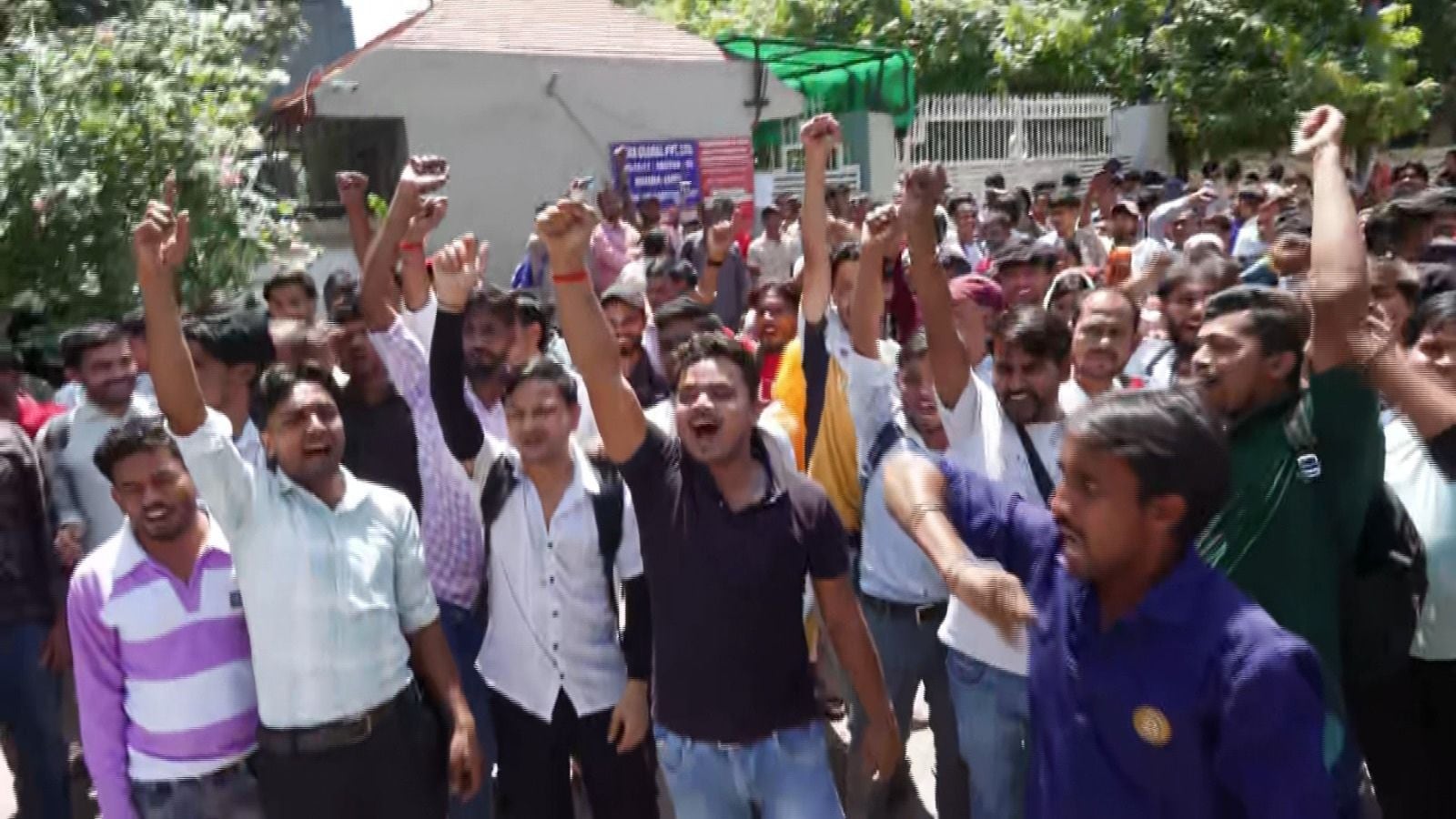
On a recent morning outside a factory gate in Noida, a group of workers gathered with placards, raising slogans for higher pay and regular employment. The protest — one among several seen across industrial clusters in Faridabad and parts of the National Capital Region — was triggered by rising living costs and long-standing complaints of underpayment.
Within days, state authorities responded by raising minimum wages. But for Sunil Kumar, a 26-year-old contract worker, the relief was short-lived. “Rates have gone up,” he says. “But now they are calling fewer people.” He has worked just 10 days this month.
From insufficient pay to insufficient work
The recent protests in NCR’s industrial belts reflect mounting pressure on governments to address wage concerns. Workers say current earnings are insufficient to cope with rising rents, food prices and transport costs.
Governments, in turn, have leaned on minimum wage revisions as a visible and immediate response.
Also Read: India’s minimum wage debate may be missing the real problem
For many, the issue is no longer just low wages, but irregular income. “We protested for higher pay,” says Meena Devi, who works in a packaging unit. Her number of workdays in a month has decreased to 12-15 days from 20 earlier.
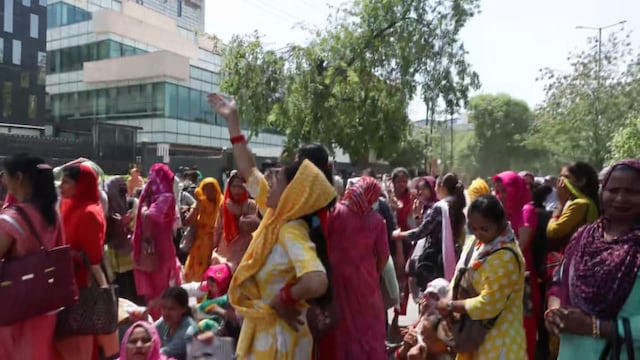

In an industrial unit in Faridabad, a supervisor—speaking on condition of anonymity—describes how hiring patterns have shifted following wage revisions.
“We cannot increase prices overnight, but wages have to go up,” he says. “So we reduce the number of workers or increase workload on existing staff.”
The competitiveness challenge
India’s labour-intensive sectors operate in a tightly contested global market. Exporters compete with manufacturers in Vietnam, Bangladesh, and China, where labour costs are often lower relative to productivity levels.
India’s minimum wages are about 50% higher on a GDP-adjusted basis than those in key competitor economies, according to the Foundation for Economic Development (FED), a New Delhi-based not-for-profit organisation, which advocates for economic reforms.
The same research pegs India’s minimum wage at roughly 1.7 times the median wage for a casual worker, compared to 0.26 to 0.6 times in countries such as the US, Japan, and the UK.
The gap, combined with other labour mandates such as double overtime pay, raises the cost of hiring, particularly for roles where the skill level required is relatively low.
The informal workaround
Faced with rising costs and regulatory constraints, many firms adapt in ways that keep them afloat—but push workers further into informality.
In Noida’s industrial clusters, workers describe a growing reliance on contractors, cash payments and short-term hiring.
“Companies don’t want to hire directly anymore,” says Sunil. “They call through agents, pay daily, and there is no guarantee.”
Such arrangements allow firms to bypass formal wage requirements—but leave workers without job security or social protection.
Also Read: Why minimum wage hikes won’t solve India’s income problem
India already has one of the highest levels of informality globally, with nearly 90% of its workforce outside formal employment structures.
“If nearly half of our workforce cannot be legally hired even after a 30% raise, then the minimum wage has backfired,” says Rahul Ahluwalia, Director at the FED.

Among its recommendations: allowing more flexibility in wage-setting, introducing wage subsidies to boost incomes without raising employer costs, and aligning labour regulations with global norms.
The challenge India faces is that of enforcement. Weakening wage protections could expose workers to further exploitation.
Meanwhile, the quiet return home
As work becomes less predictable, some migrant workers are choosing to leave. At a bus stand in Ghaziabad, workers board buses in a steady flow, heading towards eastern Uttar Pradesh and Bihar.
Among them is Rajesh Yadav, who recently left his job at a small manufacturing unit. “There were protests, then wage changes, but less work,” he says. “In the end, I decided to go back to the village.”
In his hometown, opportunities are limited—but living costs are lower, and family support provides a safety net. “In the city, if I don’t get work, I lose money every day,” he says.
This gradual reverse migration—less dramatic than during the COVID-19 lockdown in India 2020—is emerging as a quieter signal of stress in urban labour markets.
The contradictions are apparent: stable employment still remains elusive for millions of India’s poor even when there’s a policy response.
Also Read: Noida protest: Workers’ key demands, allegations, govt stance and more — Fact check