





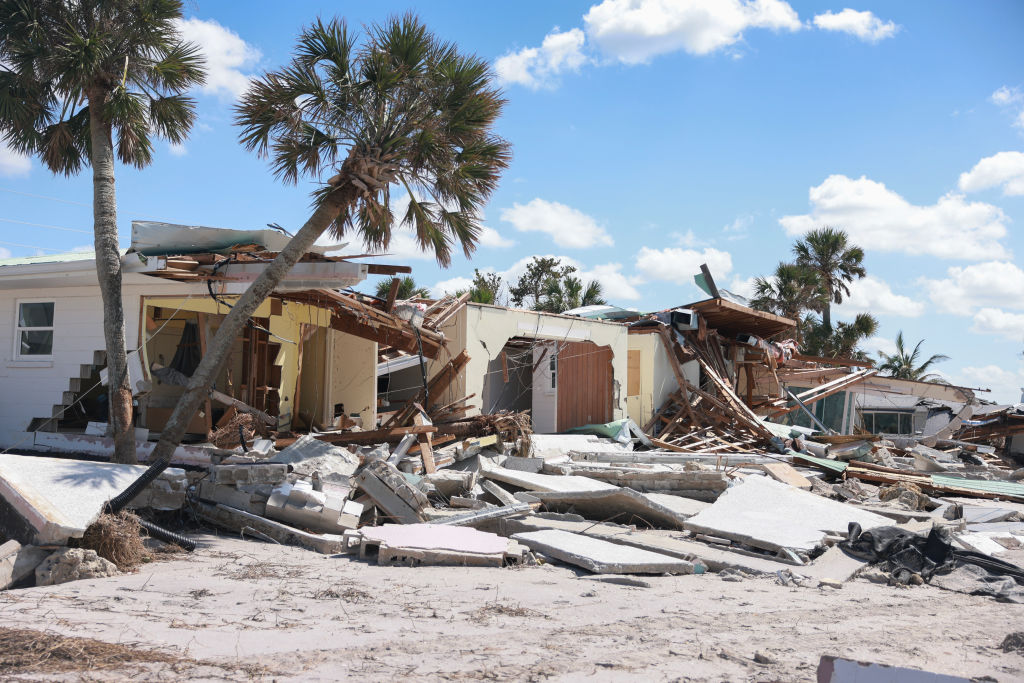
Two years after the water came, Jen and RJ Garbowicz still own a piece of St. Petersburg. It is an empty lot on a bayou off Tampa Bay, nearly an acre, with a few concrete pilings jutting out of the ground where their house once stood.
Hurricane Helene flooded it in September 2024. Hurricane Milton tore up the roof less than two weeks later. The couple had both flood and homeowners insurance. The flood policy paid in full, $250,000, and FEMA sent them about $33,000. Their homeowners insurer offered $2,279.41 against a $713,000 policy limit. They demolished what the hurricanes hadn’t and they estimate it will cost more than $1.5 million to rebuild their home.
Since then, the money has moved in strange directions. Their mortgage company is holding several hundred thousand dollars of the flood insurance payout until construction starts, which has been slowed as the couple wait on a permit. When they can finally draw on the Small Business Administration disaster loan they were approved for, $33,000 of it goes straight back to FEMA — a “duplication of benefits,” in the words of the government. “Even though that is a loan,” Jen Garbowicz said.
They are now living in their second rental, paying rent as well as the mortgage on a house that no longer exists. Last spring they flew to Washington to lobby for the FEMA Act, a bipartisan bill to overhaul the federal agency. They have still not heard from any of the lawmakers they met there.
“There really doesn’t seem to be a central place for people to go to navigate that,” she said. “It turns into a full-time job.”
The Premium
In many battleground states, the climate crisis is showing up on the ballot in the form of an electricity bill, driven higher by data centers, gas plants and utility rate hikes. In Florida, however, it arrives as a higher homeowners premium, a denied claim or a disaster relief system that the people who depend on it say is broken.
The numbers are among the highest in the country. Property insurance premiums average between $4,200 and $5,700 a year statewide. Insurers paid out more than $10 billion in claims in 2025 and 15 property insurers have become insolvent since 2020. Florida has absorbed at least $200 billion in hurricane damage in the last 10 years.
Jen Garbowicz has lived in Florida for 36 years. “We’ve seen rapid rises, at least over the last 10 years, in insurance premiums,” she said. “And then these weather events come along and the insurance system doesn’t work the way most people think that it does.”
Among their neighbors, RJ Garbowicz said, “A lot of people had to file bankruptcy because of their foreclosure just so they can buy another house.”
Jen Garbowicz notes that “sea levels are rising, and we do know that this area has been built up a lot since the 1990s.” Whatever the mix, infrastructure “really needs to be addressed — not only at the local municipality level but at state levels and federal levels too.”
Asked whether where candidates stand on weather events, climate change and disaster relief would shape her vote in November, she said, “For sure.”
The Ballot
The governor’s race in Florida offers the sharpest choice on those questions of any state this midterm.
Byron Donalds, the Republican nominee for governor, said he does not believe climate change is caused by human activity — “the science is not settled on that” — and has criticized European insurers for embedding climate risk into their actuarial models for Florida properties. His energy platform is built on expanding cheap generation: small modular and micro-nuclear reactors, hydrogen and an additional natural gas pipeline. He said he would let hyperscale AI data centers build in the state, regulating their power and water impacts rather than banning them.
David Jolly, the Democratic nominee, treats climate as a critical threat requiring sustained state investment in resiliency — raised roads, modernized building codes, sea walls, stormwater drainage. He wants utilities to integrate more clean and renewable energy sources, stronger net metering for rooftop solar, opposes offshore drilling and promises a one-year data center moratorium on his first day in office.
Spokespersons for the Donalds and Jolly campaigns did not respond to Capital & Main’s requests for comment.
Lisa Zayas, deputy communications director of the liberal advocacy group Florida Watch, said her organization is pressing candidates on their disaster-relief policies and ideas. Donalds, she said, “voted against the emergency fund twice” after 2022 and 2024 hurricanes hit Florida. “You’re the one voting. You were there. You could have helped.”
One issue that has galvanized Democratic candidates is HB 1217, which passed the Legislature in March and was signed into law April 22. It bars cities and counties from adopting or enforcing any policy referencing “net-zero” emissions, or spending public money to support such a policy. The bill came after St. Petersburg, Sarasota, Gainesville, Orlando, Tampa, South Miami, Dunedin, Safety Harbor, Largo, Cocoa, Satellite Beach, Clearwater and Pinellas County all had made a commitment to cutting emissions and energy costs; all of them are now barred from enforcing those commitments, and Leon County has had to rescind its climate emergency resolutions to comply.
Democrats argue the bill strips local governments of the tools needed to protect residents from flooding and rising seas. Republicans defend the bill as regulatory uniformity — one statewide policy instead of a patchwork of local ordinances that drive up business costs.
Then there is the congressional map, redrawn this spring at the urging of President Donald Trump and Gov. Ron DeSantis to increase the state’s delegation from 20-8 Republican to 24-4.
U.S. Rep. Kathy Castor, a Democrat who chaired the House Select Committee on the Climate Crisis, now finds herself running for reelection in a Tampa-area seat stripped of downtown Tampa and all of St. Petersburg, historically Democratic strongholds. The newly drawn district would have voted for Trump by more than 10 points in 2024. The Republican National Committee’s line of attack has been disaster response, hitting her for “shutting down FEMA ahead of hurricane season.” Jared Moskowitz, a Democrat who ran Florida’s Division of Emergency Management under Gov. Ron DeSantis, faces a similarly altered map on the Atlantic coast.
The Wait
The FEMA Act the Garbowiczes lobbied for would make the agency independent of the Department of Homeland Security, create a single application for disaster recovery, pay homeowners before they rebuild rather than reimburse them after and fund mitigation before storms hit. Introduced by Rep. Sam Graves, a Missouri Republican, and Rep. Rick Larsen, a Washington state Democrat, it carries almost 100 co-sponsors — 53 Republicans and 44 Democrats — and has the backing of the National League of Cities, the National Association of Counties and National Governors Association.
It has not come to a floor vote. RJ Garbowicz said Rep. Anna Paulina Luna’s chief of staff expressed interest in the bill and in the amendments the couple suggested, and even asked him to draft a white paper. He sent it to them but has not heard back.
A spokesperson for Rep. Luna did not return a request for comment.
Zayas, the Florida Watch deputy director, said the connection voters are making is not the one advocates once hoped for, but it may be more durable.
“It’s not anymore a climate thing — something that they see in the future,” she said. “They’re seeing it in their pocketbooks. They’re seeing it as an affordability issue.” Candidates may not say the words, she added, but voters “understand how it’s impacting them personally, and it’s not a future thing but something that’s actually happening now.”
On the bayou, the pilings are still waiting for a permit. “We’re getting forced to pay insurance,” RJ Garbowicz said. The insurers are not forced to pay out, and the victims, if they qualify, are forced to take on more debt “to just stay in the home that they’re already forced to pay insurance for.”
As he put it: “The whole system is convoluted.”
25 Years of Truthout: An important fundraising appeal
This September, Truthout is celebrating 25 years of publication. For over two decades, we have been a trusted source for fiercely independent journalism thanks to readers like you.
Looking to the next 25 years, we launched a special fundraising campaign. We still need to raise $16,000.
We are asking for your support at this juncture because we face greater threats than ever before in our organizational history. Trump and his MAGA allies are determined to control the information ecosystem, and movement-based organizations are subject to dangerous censorship and scrutiny.
If you can support Truthout with a one-time or monthly donation, you will make a significant impact on our work and our legacy. Anything you can do makes a difference!


