



A sign identifying Sandler Neurosciences Center on the UCSF Mission Bay campus, Feb. 10, 2025, in San Francisco.
Justin Sullivan/Getty ImagesA first-of-its-kind study from UC San Francisco published Thursday found a simple blood test for middle-aged adults may indicate who is more likely to show diminished cognition even without any dementia symptoms.
Alzheimer’s disease is a degenerative neurological condition that remains a top cause of death in the U.S. There’s increasing pressure to unlock who is at risk for the disease as its prevalence is growing: Cases are expected to nearly double by 2060, from a current estimate of 7.4 million cases to 13.8 million among people age 65 and older, according to a report by the Alzheimer’s Association.
Article continues below this ad
While the condition is mainly diagnosed in elderly individuals, researchers know the disease actually starts to develop in the brain decades before the first symptoms show up. But identifying those early developments and who at ages 40 to 50 is on a path to being diagnosed with the disease largely remains a mystery.
Dr. Kristine Yaffe, the senior author of the study and vice chair in the UCSF Department of Psychiatry and Behavioral Sciences, told SFGATE by phone Wednesday that, currently, diagnosing Alzheimer’s disease means looking at clinical symptoms in addition to sometimes costly medical scans or painful tests like a spinal tap. But in recent years, physicians have been able to detect key proteins linked to Alzheimer’s disease via a blood draw.
“This idea of being able to get a blood test for Alzheimer’s is just a huge breakthrough,” Yaffe said.
The problem with this method is that for young, unsymptomatic patients, researchers aren’t quite sure what high levels of these biomarkers mean in the long term. And now more companies are marketing the tests directly to those nervous about dementia risk.
Article continues below this ad
Nicole Weber, a UCSF phlebotomist, places vials of blood drawn for a study of chemical exposures, comparing women firefighters and women who work in offices, in a specimen bag in Supervisor Katy Tang’s office at City Hall on Tuesday, Oc. 14, 2014, in San Francisco.
S.F Chronicle/Getty Images“The floodgates are about to open,” she said. “… There’s a lot of people doing direct-to-consumer marketing.”
In order to help physicians better understand these test results for younger patients, Yaffe and her team examined data from 1,350 individuals who are part of the long-running Coronary Artery Risk Development in Young Adults Study (CARDIA), running since 1983. The data was from year 35, or 2020-2022.
As the individuals headed into midlife, generally thought to be ages 45-65, Yaffe and the team wanted to see if those with key biomarkers for Alzheimer’s disease also had noticeable cognitive differences. The mean age of those studied was 61, with 58% women and 42% men involved. The cohort racial makeup was 55% white and 45% Black.
Article continues below this ad
The team used a blood test to measure key biomarkers linked to Alzheimer’s disease including tau proteins and amyloid plaque. While 6% of participants had a high level of tau and amyloid, they found from 4% to 15% of the study individuals had signs of high levels of at least one of the biomarkers, indicating a “positive” sign.
They then administered cognitive tests to all study participants to see if they could spot any differences. They found those who tested positive for at least one of the biomarkers had noticeable differences compared with those who tested negative.
The positive group had worse processing speed, which is how long it takes for someone to absorb and respond to new information, and also tested lower on executive function tests, which look at how a person manages everyday tasks like making plans.
“These weren’t huge differences, but still it was interesting that we’re able to find this,” Yaffe said.
Article continues below this ad
Importantly, five years after the year-35 results, the researchers found the positive individuals were at significantly higher risk for a major decline in cognitive skills. They were from 2.5 to 4 times more likely to have a rapid decline in verbal memory and 3 to 4 times more likely to have an accelerated decline in their processing speed, a known risk for Alzheimer’s disease.
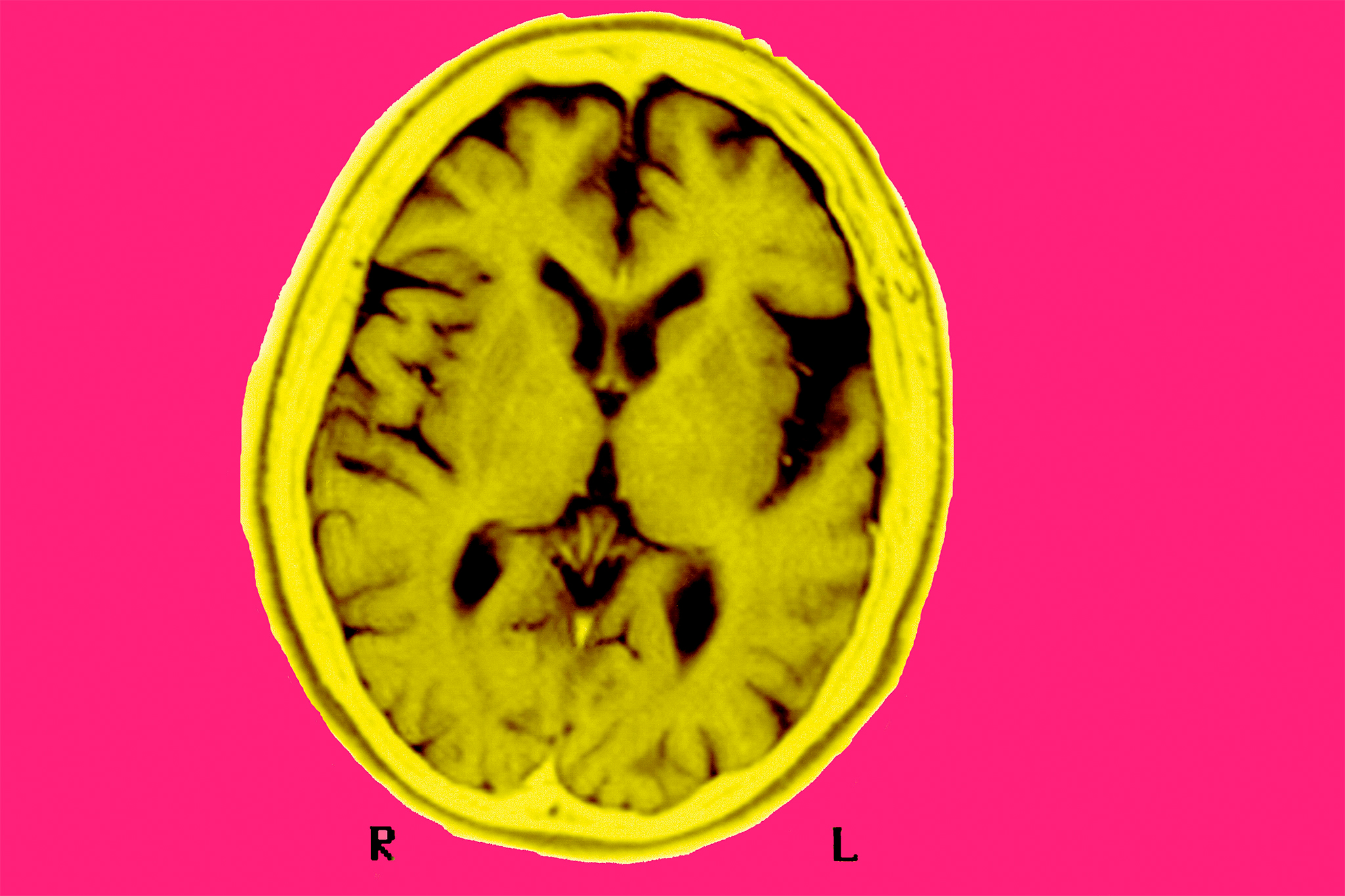
MRI of the brain of a patient affected by Alzheimer’s disease, axial cut-away view.
BSIP/Universal Images Group/Getty ImagesYaffe emphasized that these people were not yet showing signs of clinical Alzheimer’s disease and they will need to be followed to see if they ultimately develop the condition. She also highlighted that there are many ways to reduce the risk of developing Alzheimer’s disease and dementia, including adopting a healthy lifestyle and avoiding tobacco and alcohol.
Xue Zhong, an assistant professor in the Division of Genetic Medicine and Clinical Pharmacology at Vanderbilt University Medical Center, said the study may be helpful for clinicians as it wasn’t limited to patients at a memory clinic but rather used a broader sample of people in a community. But Zhong said the study still had limitations, such as only measuring biomarkers once.
Article continues below this ad


Stay informed, and entertained.
By signing up, you agree to our Terms Of Use and acknowledge that your information will be used as described in our Privacy Policy.
“The finding should be viewed as hypothesis generating rather than [a] definitive pinnacle prediction,” Zhong, who was not involved in the study, told SFGATE by phone Thursday.
Yaffe agreed more research needs to be done to understand what these results will mean in the long run, but said there’s an urgent need for this research now.
Technology “is moving faster” than we know how to interpret it, she said. “We’re hoping that this study helps a little.”
Article continues below this ad
Gillian Mohney is a breaking news editor at SFGATE. Previously, she worked at Healthline and ABC News, where she covered health, science and national news. She is a graduate of the Columbia University Graduate School of Journalism and has lived in the Bay Area for nearly a decade.


