







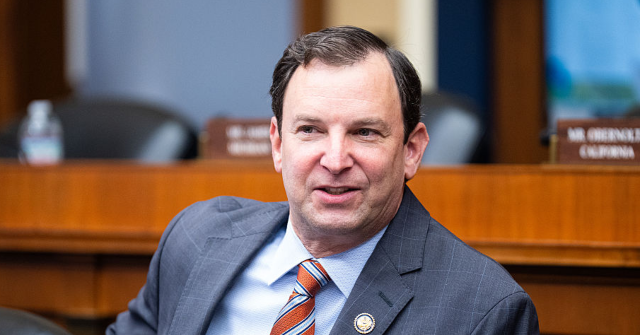
Rep. Craig Goldman (R-TX) introduced legislation Thursday directing the United States Trade Representative (USTR) to investigate European Union sustainability regulations that the bill says reach beyond Europe and impose obligations on American companies, with possible remedies including tariffs, the suspension of trade-agreement benefits, or other actions under Section 301 of the Trade Act of 1974.
The Stop EU Overreach Act covers the European Union’s Corporate Sustainability Due Diligence Directive, Corporate Sustainability Reporting Directive, Deforestation Regulation, and Carbon Border Adjustment Mechanism, as well as successor measures imposing substantially similar obligations.
The bill states that the rules can reach the operations, subsidiaries, affiliates, suppliers, and value chains of American companies even when the relevant conduct occurs wholly or substantially outside EU territory and complies with U.S. law. Those obligations can include supply-chain and value-chain mapping and due diligence, emissions and sustainability reporting, deforestation-related traceability and geolocation requirements, third-party verification and auditing, and public disclosures.
The measure argues that the regulations burden U.S. commerce and conflict with American legal principles involving limited liability, state corporate fiduciary duties, federal securities requirements, and domestic energy and environmental policy. It also cites an August 21, 2025, joint statement in which the EU committed to addressing U.S. concerns about the extraterritorial application of its rules, while asserting that subsequent amendments have not resolved the central problems identified by the legislation.
According to the bill, Argentina, Australia, Brazil, India, South Africa, and the United Kingdom have expressed shared concerns about the rules’ extraterritorial reach, which it characterizes as a multilateral objection rather than solely a bilateral dispute.
Under the legislation, the USTR would have 30 days after enactment to initiate an investigation under Section 302(b) of the Trade Act to determine whether the EU measures constitute unreasonable or discriminatory practices that burden or restrict American commerce. The investigation could examine compliance costs, legal exposure tied to overseas subsidiaries and suppliers, and competitive disadvantages faced by U.S. companies.
The USTR would consult affected American persons, trade associations, labor representatives, and designated federal officials before issuing a determination within 12 months, subject to one possible 60-day extension under extraordinary circumstances.
If the agency makes an affirmative determination, it would consider remedies including measures addressing imports from EU member states, suspension of trade-agreement benefits, duties proportionate to the burden imposed, or other actions intended to eliminate that burden. A negative determination would require an explanation to Congress.
The bill would also require an initial report within 90 days of enactment and a determination report within 30 days after the agency’s decision, describing the findings, any proposed or completed remedy, and the expected effects on U.S. commerce, consumers, and the U.S.-EU trade relationship.
The legislation would preserve the president’s and USTR’s existing trade authorities and would not itself declare that any EU measure violates federal law or a trade agreement. Its requirements would end for an individual measure once the USTR certifies that the EU repealed or formally amended it to eliminate its application to American persons, or entered a binding agreement shielding them from obligations involving conduct, operations, or relationships outside the territory of any EU member state.
Goldman told Breitbart News in an exclusive interview, “Some of your best ideas for legislation come from constituents or people you represent in the state, and that’s exactly the case with this.” He said that the proposal arose from seeing “how unfair it is for American businesses to try and conduct business in the EU” under what he called “extreme green energy mandates.”
“They’re charging American companies basically to do business in their countries,” Goldman continued, referring to “an added expense for an American company to follow the green energy mandates of the EU.”
Goldman linked the Stop EU Overreach Act to H.J. Res. 75, his resolution eliminating stricter federal energy-conservation standards for commercial refrigeration equipment, which President Donald Trump signed into law on May 9, 2025. He described it as “the very first piece of legislation” he passed and had signed by the president, adding, “We want to end those for American companies too.”
Asked whether any of the four European measures posed a greater threat than the others, Goldman said he viewed them similarly.
“I don’t think one is greater than the other,” he said. “We think they’re equally abusive to American companies trying to do business over there” and amount to “completely unfair business practices.”
A Hudson Institute study provided to Breitbart News by Goldman’s office estimated that the Corporate Sustainability Due Diligence Directive could impose more than $1 trillion in initial compliance costs on U.S. businesses, with recurring annual costs of up to $43 billion when implicit costs are included.
Addressing what those costs could mean for workers, consumers, and smaller companies, Goldman said, “We think Texas would be the most affected state if these rules are implemented,” adding that the legislation would protect “Texas businesses” and “American businesses.”
Goldman said he is a “free trader” but said President Trump’s explanation of his use of tariffs helped him better understand “the amount of unfair trade that was going on,” including U.S. products facing tariffs in the EU and other countries while the United States was “free trading their goods on our side. We certainly want free trade,” he said, “but again, ‘Fair’ being capitalized there because there’s no sense in having free trade if we don’t have fair trade.”
Goldman said the European Union is the legislation’s immediate focus.
“This was kind of the first bite of the apple, if you will, seeing the unfair trade practices with the EU on the green energy mandate,” he said. “We’re certainly looking at the other countries around the world to see if we need to implement legislation in regards to them.”
Goldman said lawmakers his office approached about joining the bill responded that it “actually makes common sense,” adding that “common sense” can be “two tough words to use in government.”
“We’re starting to talk to members’ offices and getting great responses,” he said. “So we should see a lot more co-sponsors hop on this quickly.”
The legislation is supported by Reps. Jodey Arrington (R-TX), Greg Steube (R-FL), Gus Bilirakis (R-FL), Randy Weber (R-TX), Buddy Carter (R-GA), Warren Davidson (R-OH), Pete Sessions (R-TX), and the Small Business & Entrepreneurship Council.


