

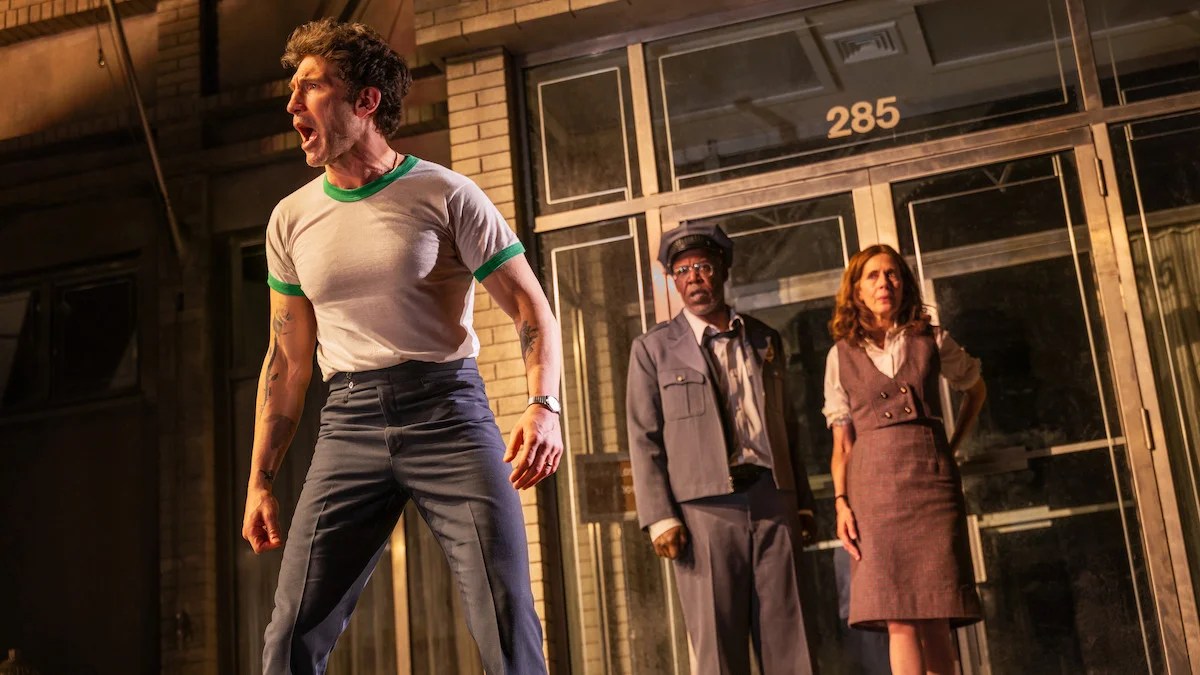
West 52nd Street is an intriguing, schizoid place in the small universe of Broadway theaters. On the south side of the street, there’s the Neil Simon Theatre and, on the north, the August Wilson Theatre, where Stephen Adly Guirgus’ new play, “Dog Day Afternoon,” opened Monday.
Although they didn’t have much else in common, Simon and Wilson were two of Broadway’s most prolific playwrights. Guirgus, not so much. His stage adaptation of Sidney Lumet’s 1975 bank-heist film starring Al Pacino and John Cazale is only Guirgus’ third outing on the Rialto. It’s also the first play by the Pulitzer Prize-winning playwright (“Between Riverside and Crazy”) that has a lot more in common with the very popular Neil Simon than the far edgier August Wilson.
Guirgus’ “Dog Day Afternoon” is a big, hugely entertaining and laugh-filled dramedy that’s crafted to delight the typical Broadway audience. “Dog Day,” set in a bank, has a bit in common with Wilson’s first play, “Jitney,” set in a taxi operation. The workers in those two establishments could not be more different, however. Wilson wrote vivid characters. Guirgus instead gives us easily recognizable types: the terrible boss-manager (Michael Kostroff), the no-nonsense bank teller (Jessica Hecht), the floozy bank teller (Elizabeth Canavan), the fiery bank teller (Paola Lazaro), etc.
Amusing but casually delivered moments in Lumet’s film (Oscar-winning screenplay by Frank Pierson) have been blown up into comic set pieces in the new “Dog Day”: A bank teller’s need to pee now features the off-stage urination sounds of a horse; a bank teller’s discovery that there’s no money in the vault becomes an hysterical meltdown; the mere ordering of donuts brings back to life a near-comatose security guard (Danny Johnson).

The comedy is so broad under Rupert Goold’s direction that the central drama — will any of these hostages, much less the two bank robbers, come out alive? — is almost beside the point. The film version is a thriller. Guirgus’ play, not so much.
There is suspense in the new “Dog Day,” but it has little to do with what’s going on between the hostages and the bank robbers (Jon Bernthal and Ebon Moss-Bachrach) or between the bank robbers and the cop (John Ortiz, beautifully grounding every scene in which he appears).
Playing those two incompetent criminals, Bernthal and Moss-Bachrach take over for Pacino and Cazale, respectively. Bernthal rarely leaves the stage, where he delivers a splashy, bravura and ultimately exhaustive performance. Pacino had the advantage of being able to go home after working a day on the movie set. Bernthal must deliver one big scene after another, often at full-throttle volume within two and a half hours. His Sonny is even more of a showoff than Pacino’s, which makes sense since Bernthal is literally standing on a stage. And this actor clearly relishes being there.
Moss-Bachrach’s Sal is a very different thief from Cazale’s. In fact, the only suspense in this new “Dog Day” incarnation is whether or not Moss-Bachrach’s Sal will finally break mentally, or not. He’s high on drugs, he’s a total psychotic. What this nutjob does next is anyone’s guess, and that includes his good friend Sonny’s.
Lumet turned the bank into a claustrophobic purgatory. David Korins’ set on Broadway is so huge it could house two, if not three, Citybanks.
Pierson’s “Dog Day Afternoon” screenplay came from a Life magazine article titled “The Boys in the Bank,” a cheap reference to “The Boys in the Band.” Clearly, the article puts Sonny’s homosexuality up on page one. Pierson’s screenplay delays that big reveal until well after the film’s halfway point. Guirgus’ play does the same, with the appearance of Sonny’s “wife” Leon (Esteban Andres Cruz) postponed until the second act.
Nothing on stage today can replicate the shock on-screen in 1975 of Pacino playing a gay man who has wedded a male partner, played by Chris Sarandon, in need of a sex-change operation.
Guirgus drops the movie’s scene where Sonny dictates his will to a bank teller. In its place, he offers an extended phone call between Sonny and Leon that achieves (and then some) the pathos that the dictated-will scene brings to the screen. In this conversation, Sonny softens considerably, and Bernthal turns it into yet another showstopping scene. The transition isn’t subtle, but it’s very effective. You won’t forget it.
On stage, “Dog Day” also can’t duplicate the crowd scenes outside the bank that distinguish the movie version, where Sonny becomes an instant folk hero to the bystanders. In a masterstroke of writing and direction, Guirgus and Goold turn the theater audience into those very willing enablers.

