







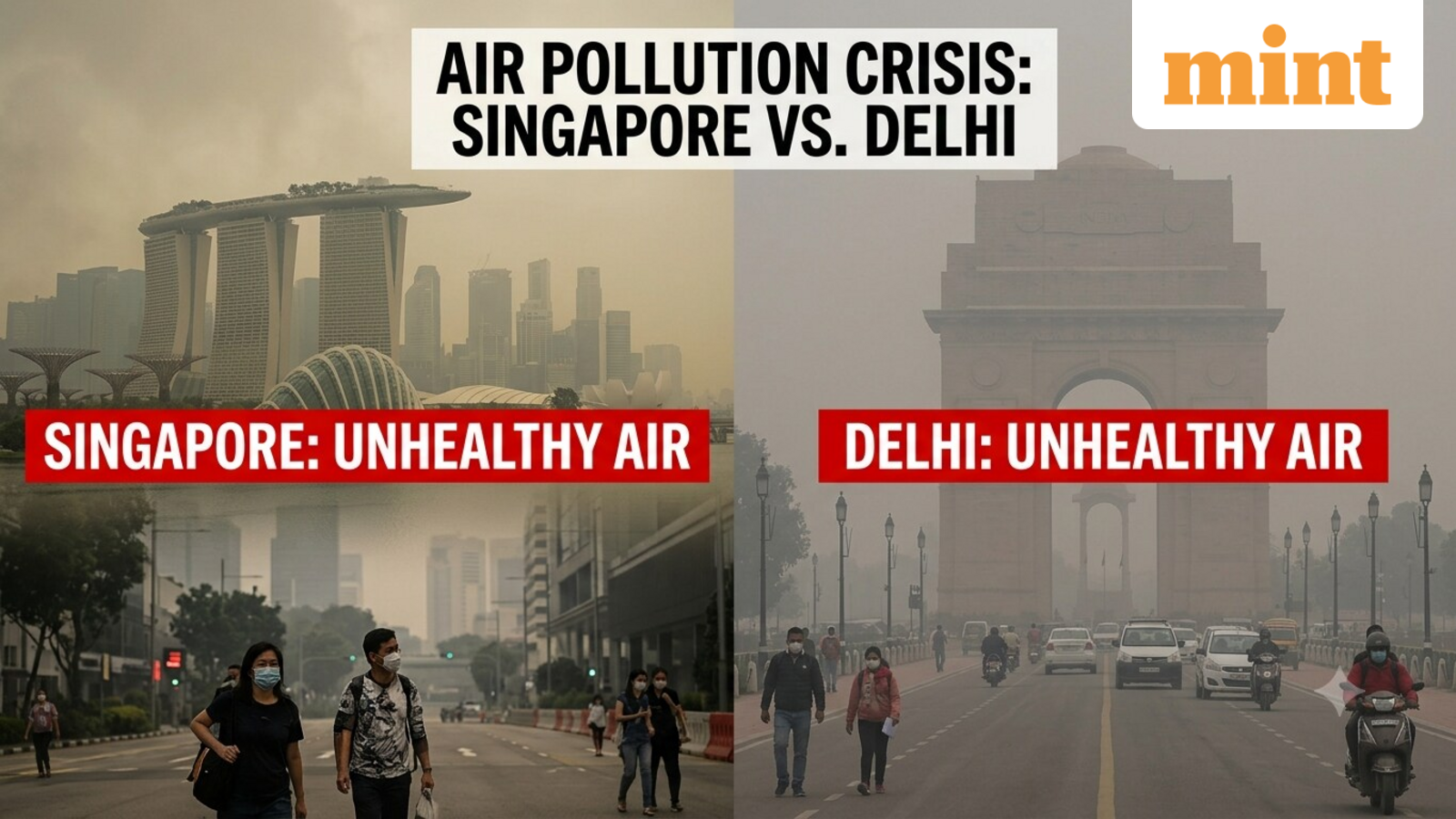
Singapore’s air quality deteriorated to an Air Quality Index (AQI) of 287, classified as unhealthy on a live air-quality dashboard, as smoke from Indonesian wildfires intensified across Southeast Asia. The reading showed PM2.5 concentrations of 116 micrograms per cubic metre and PM10 levels of 164 micrograms per cubic metre. Delhi, meanwhile, recorded an AQI of 165 at 9 am on Thursday, placing it in the moderate category, according to Central Pollution Control Board (CPCB).
Singapore vs Delhi AQI: How do the pollution levels compare?
Singapore’s reported AQI was 122 points higher than Delhi’s reading on Thursday, 15 October. The air quality in India’s national capital was recorded in the ‘moderate’ category at 9 am, with an Air Quality Index (AQI) reading of 165, the Central Pollution Control Board (CPCB) data showed.
Under India’s CPCB classification, an AQI between 101 and 200 is moderate, while readings between 201 and 300 are considered poor.
Singapore’s live dashboard categorises its reading of 287 as unhealthy, reflecting differences in the terminology used by air-quality monitoring systems.
Singapore’s pollutant readings included carbon monoxide at 1,611 parts per billion (ppb), sulphur dioxide at 1 ppb, nitrogen dioxide at 2 ppb and ozone at 10 ppb.
View full Image
PM2.5 refers to fine particles with a diameter of 2.5 micrometres or less. Because these particles can penetrate deep into the lungs, prolonged exposure can pose health risks. PM10 includes larger airborne particles, which can also affect the respiratory system.
The two cities’ readings were recorded at different times and may follow different reporting systems. They therefore provide a snapshot of their respective pollution levels rather than a direct, simultaneous comparison.
Indonesian wildfires intensify haze across Southeast Asia
Singapore’s pollution spike comes as Indonesia experiences its most intense wildfire season in 11 years. Dry weather conditions linked to El Niño have contributed to the fires, worsening air quality across the region and raising concerns about respiratory illnesses.
East Timor announced a three-day suspension of face-to-face learning beginning Thursday, citing pollution from wildfires in neighbouring regions or countries. Although its government did not name Indonesia, East Timor shares an island with Indonesia’s East Nusa Tenggara province, where multiple fire hotspots have been reported.
Delhi’s winter pollution in numbers: AQI readings can exceed 1,000
Delhi’s winter pollution is not simply a seasonal spike. Government data show that the city’s average AQI in November reached 377 in 2021, 373 in 2023, 374 in 2024 and 354 in 2025. December’s average AQI was 351 in 2025, while January averaged 355 in 2024.
The scale of individual pollution episodes can be even more alarming: the Centre for Science and Environment recorded a city-wide winter PM2.5 peak of 732 micrograms per cubic metre in 2024, compared with 580 in 2023 and a station-level peak of 806 in winter 2018.
So how does Delhi’s AQI sometimes appear to cross 1,000? India’s official AQI scale is capped at 500, so a reading above 1,000 is not an official CPCB AQI figure. Such numbers can appear on international air-quality platforms using different calculation methods.
They should also not be confused with PM2.5 concentrations, which are measured in micrograms per cubic metre and can exceed 1,000 during extreme episodes.
Winter conditions, including weak winds and temperature inversions, can trap pollutants near the surface, while vehicle emissions, industry, construction dust, waste burning and crop-residue fires add to the pollution load.
Delhi Notifies Winter Pollution Master Plan
Delhi has introduced a permanent Winter Pollution Master Plan, with restrictions scheduled for the winter of 2026-27. The measures include a ‘No PUCC, No Fuel’ rule, under which vehicles without a valid Pollution Under Control Certificate will be denied fuel.
From November 1, 2026, to January 31, 2027, petrol and diesel vehicles registered outside Delhi that do not meet BS-VI emission standards will also be barred from entering the city, subject to specified exemptions.
The plan also calls for 50% work-from-home arrangements in government and private offices, staggered office timings and double parking charges at authorised municipal sites, with Delhi Metro parking facilities exempt.
Dust-generating construction and demolition activities will face restrictions from November, followed by a reported blanket ban from December 10, 2026, to January 20, 2027. The permanent framework is intended to make winter pollution controls an annual measure rather than a series of ad hoc orders.
Indonesia deploys more than 69,000 personnel
Indonesian President Prabowo Subianto has ordered additional resources to tackle the wildfires.
More than 69,000 firefighting personnel had been deployed, compared with around 44,000 in mid-September. Authorities are also testing specialised chemicals to improve firefighting operations.
About the Author
Sayantani Biswas
Sayantani Biswas is an assistant editor at Livemint with seven years of experience covering geopolitics, foreign policy, international relations and global power dynamics. She reports on Indian and international politics, including elections worldwide, and specialises in historically grounded analysis of contemporary conflicts and state decisions. She joined Mint in 2021, after covering politics at publications including The Telegraph.
She holds an MPhil in Comparative Literature from Jadavpur University (2019), with a specialisation in postcolonial Latin American literature. Her research examined economic nationalism through Eduardo Galeano’s Open Veins of Latin America. She also writes on political language, cultural memory and the long shadows of conflict.
Biswas grew up in Durgapur, an industrial town in West Bengal shaped by migration, which drew families from across India to the Durgapur Steel Plant. As the only child in a joint family, she spent years listening—almost obsessively—to her grandparents’ testimonies of struggle, fear and loss as they fled Bangladesh during the Partition of 1947. This formative exposure to lived historical memory later converged with her training in Comparative Literature, equipping her to analyse socio-economic structures and their reverberations.
Outside the newsroom, she gravitates towards cultural history and critical theory, returning often to texts such as Paulo Freire’s Pedagogy of the Oppressed. As a journalist, she is committed to accuracy, intellectual rigour and fairness, and believes political reporting demands not only clarity and speed, but historical depth, contextual precision, and a disciplined resistance to spectacle.


