





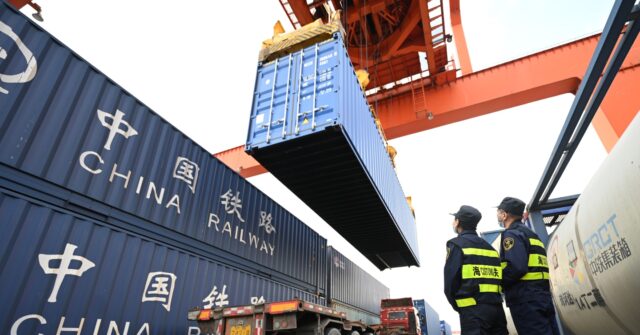
Beijing’s trade surplus with the European Union rose to a record high as the communist country continues to use state-directed funding to undermine international competition in countries like Germany.
According to Chinese customs data released this week, the communist country’s trade surplus with the EU rose to a record $32.9 billion in June, representing a 27 per cent increase over last year.
For the first half of the year in total, Chinese exports to the EU climbed to $312.3 billion, a 17 per cent increase over last year, while European imports to China rose by 9 per cent to $135.6 billion, China Finance Net reported.
The growing disparity was driven in large part by trade with Germany, where Chinese imports rose by 27.2 per cent year-on-year in June, compared with an increase of just 3.1 per cent in German imports to China during the same period.
In the first six months of the year, Chinese exports to Germany amounted to $67.5 billion, while imports to China stood at $45.2 billion. Thus, China’s trade surplus with Germany stood at $22.3 billion.
It comes amid a broader shift in the trading relationship between Germany and China, which previously saw the European manufacturing powerhouse benefit greatly from exports of cars and machinery to the rising economic force in Asia.
However, Berlin appears to have been short-sighted with this strategy, as Beijing is now flooding Europe with cheaper electric vehicles, severely undercutting German auto manufacturers.
According to German broadcaster Deutsche Welle, Germany is also becoming increasingly dependent on China for critical goods such as pharmaceuticals.
Berlin’s Mercator Institute for China Studies (MERICS) think tank has warned that, while Germany and other Western nations previously had an edge over China in high-tech goods and machinery, this advantage is now eroding. In part due to Beijing’s mercantilist system, Chinese producers have been able to keep their prices lower than those of international competitors, thanks to state subsidies and a lower labour cost.
Visiting Fellow at MERICS, Esthery Goreichy, remarked: “European buyers may appreciate the benefit of such low prices in the short run. But China’s export-led economic model is enabled by state support that far exceeds international practice and often contravenes international trade rules.
“As this level of subsidies is not replicable elsewhere, for European and other third market competitors, higher volumes at relatively lower prices mean that competitive pressure is only intensifying.”
Earlier this month, the German coalition government announced a raft of policies intended to turn around the country’s faltering economy. While the proposals did not explicitly mention China, German Finance Minister Lars Klingbeil said that Berlin would seek to counteract unfair competition from Beijing. This will include “a faster and sector-wide application of anti-dumping and anti-subsidy measures at [the] European level,” the German government said.
“We do not want trade imbalances of the current magnitude to arise or grow further,” Chancellor Friedrich Merz said.
This would mark a departure from the German government, which has long sought to deepen trading ties with China. Indeed, former German Chancellor Angela Merkel even went so far in 2013 as to oppose EU anti-dumping tariffs on Chinese solar panels, most of which are alleged to be produced with slave labour.


