






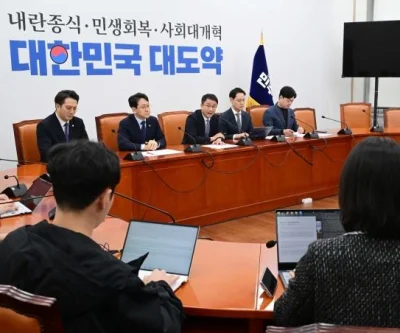
Han Byung-do, floor leader of the Democratic Party of Korea, answers reporters’ questions during a press briefing at the National Assembly in Seoul on March 2. Photo by Asia Today
March 3 (Asia Today) — South Korea’s exports are riding a semiconductor boom, but lawmakers risk undermining that momentum by delaying legislation tied to a major U.S. investment plan.
According to the Ministry of Trade, Industry and Energy, exports in February reached $67.4 billion, the highest ever for the month, despite fewer working days due to the Lunar New Year holiday. Exports have set new monthly records for nine straight months since June.
Still, vulnerabilities are emerging. Automobile exports fell 20.8% from a year earlier in February, reflecting the impact of U.S. tariffs on specific items. Even after the U.S. Supreme Court struck down reciprocal tariffs, the administration of President Donald Trump has continued to pursue tariff measures. Lawmakers should move swiftly to pass the Special Act on Investment in the United States to remove potential grounds for further trade friction.
Semiconductors once again drove export growth. Chip exports surged 160% from a year earlier to $25.1 billion, marking the third consecutive month above the $20 billion mark. The gains reflect increased artificial intelligence investment by global technology firms and a sharp rise in memory chip prices. The price of DDR4 8Gb DRAM has climbed 863% over the past year, while 128Gb NAND prices have risen 452%.
But heavy reliance on semiconductors has deepened disparities across industries. Of the country’s 15 key export categories, only five posted gains last month, including computers, wireless communication devices, ships and biohealth products. Exports of auto parts, petrochemicals and steel declined amid global oversupply and tariff pressures.
Geopolitical risks add further uncertainty. The recent U.S. airstrikes on Iran have heightened concerns about instability in the Middle East. According to the Korea International Trade Association, every 10% increase in global oil prices reduces South Korea’s export volume by 0.39%. A prolonged conflict could jeopardize the government’s goal of achieving $800 billion in annual exports this year.
Against this backdrop, the ruling Democratic Party and the opposition People Power Party remain locked in a dispute over passage of the Special Act on Investment in the United States, which would support a planned $350 billion investment in America.
On Sunday, Han Byung-do, floor leader of the Democratic Party, warned that his party would take “a major decision” if the opposition continued to block proceedings. The People Power Party has boycotted related committee activities in protest of separate judicial reform bills passed by the majority party.
While the ruling party bears responsibility for pushing through controversial judicial legislation, it is also unwise to hold a bill tied to national economic interests hostage to partisan conflict. The government has already conditionally approved Google’s request to export high-precision map data in an effort to avoid giving Washington grounds for additional tariffs.
Failure to pass the investment bill in the coming days could carry further costs. Both sides should exercise strategic flexibility to safeguard national interests amid mounting external risks.
— Reported by Asia Today; translated by UPI
© Asia Today. Unauthorized reproduction or redistribution prohibited.
Original Korean report: https://www.asiatoday.co.kr/kn/view.php?key=20260302010000303


