







Matthew Smith
As Oilprice’s South America correspondent, I cover Colombia (where I currently live), Venezuela, Ecuador, Peru, Brazil, Argentina, Chile, Bolivia, Paraguay, Guyana, Suriname and Uruguay. I…
Set us as your preferred Google source
Premium Content
By Matthew Smith – May 29, 2026, 2:00 PM CDT
- Colombia’s oil and natural gas production has fallen sharply under Petro-era policies that halted new exploration contracts and discouraged investment.
- Left-wing candidate Iván Cepeda supports a continued energy transition, while right-wing candidates Abelardo de la Espriella and Paloma Valencia advocate expanding hydrocarbon production and allowing fracking.
- The election outcome could determine whether Colombia deepens its shift away from fossil fuels or seeks to revive domestic energy production to strengthen energy security and economic growth.

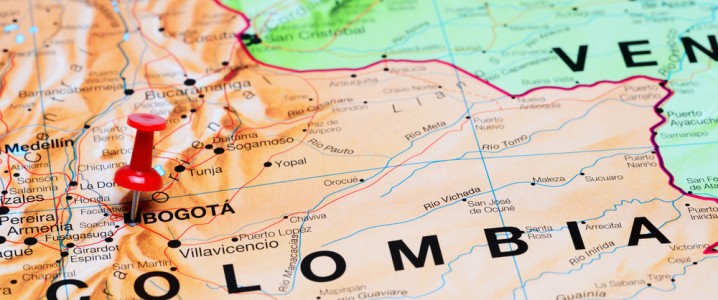
Colombia’s rapidly approaching 2026 presidential election is generating considerable concern about the economy, notably the country’s oil industry. Gustavo Petro, a former guerrilla who won the 2022 election to become Colombia’s first left-wing president, introduced policies aimed at reducing the country’s reliance on fossil fuels. While this spurred the development of renewable energy, it is responsible for sparking an energy crisis in Colombia. There is hope that a new president will revive Colombia’s economically vital oil industry by delivering a more sustainable energy policy.
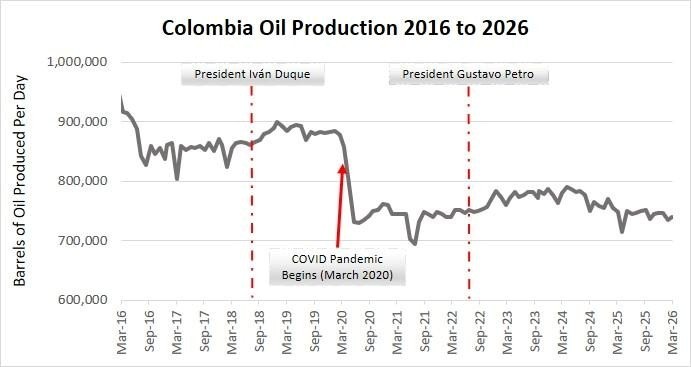
Key among the policies implemented by Petro was a ban on issuing new exploration and production contracts, significantly hiking taxes, and attempting to legally prohibit hydraulic fracturing in Colombia. Those decisions are responsible for a sharp decline in the Andean country’s hydrocarbon output. As data from Colombia’s regulatory authority, the National Hydrocarbon Agency (ANH), shows, oil and natural gas output is at or close to historical lows. By March 2026, the country was lifting 740,497 barrels per day, well below the 917,210 barrels produced daily for the same period a decade earlier.

The marked decline of Colombia’s single largest export, which government data shows earned $12.5 billion during 2025, is endemic of the headwinds impacting a fiscally fragile, debt-laden economy. Among the hardest hit by the marked long-term decline of Colombia’s hydrocarbon sector, and Petro’s policies, is natural gas. ANH data shows that the March 2026 output of 700 million cubic feet per day, despite climbing nearly 1% month over month, is at the lowest levels in decades.
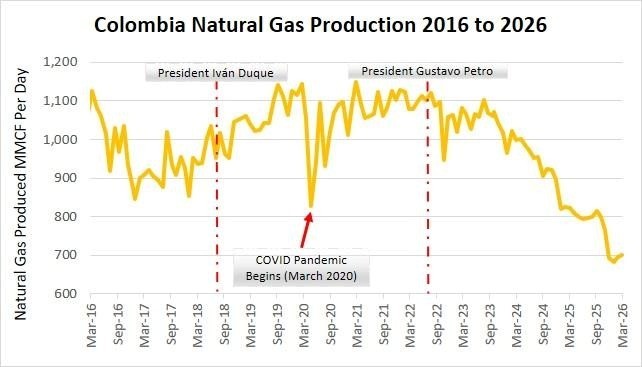

This is behind the growing risk of a serious energy crisis emerging in Colombia, especially with the country increasingly dependent on liquified natural gas (LNG) imports, which exposes it to global geopolitical headwinds. Indeed, only a decade ago, Colombia was largely self-sufficient when it came to natural gas, with domestic production generally keeping up with demand. That, however, began to worsen as domestic supply plummeted, forcing Bogota to begin importing LNG in December 2016.
Today, natural gas shipments supply over a fifth of the fuel consumed in the Andean nation. This will only worsen as domestic natural gas production and reserves, which are at a trillion cubic feet, continue to decline. There are fears Ivan Cepeda, the continuation candidate for President Petro and his Pacto Historico, will continue with current government policies that are sharply impacting Colombia’s energy patch.
At an April 2026 campaign rally in Barrancabermeja, the capital of Colombia’s energy patch, Cepeda said:
“The country requires a comprehensive energy policy that diversifies the economy and avoids dependence on hydrocarbons,”
He did, however, temper that statement by pointing out that it will involve a gradual transition to renewable sources of energy rather than an immediate dismantling of the hydrocarbon sector.
During early May 2025, Cepeda rounded out his position, stating he will work to transition the agricultural sector into Colombia’s main economic engine while moving the country away from its historical dependence on extractive industries. Cepeda went on to say mining and energy exploitation is an exhausted economic model and that “Colombia will not be a country of commodities.”
With the senator leading in the polls, his economic policy is weighing heavily on Colombia’s economy and the Andean country’s oil patch. If Cepeda emerges victorious, then oil and natural gas production will continue its downward decline, with foreign energy investment set to fall further. Indeed, there are concerns that the few remaining drillers operating in Colombia will not only dial down investment but also exit the country in a manner like Big Oil exiting after Petro’s victory.
Behind Cepeda in the polls is wildcard far-right candidate Abelardo de la Espriella, a high-profile criminal attorney who usually resides in Miami. A tremendous part of his platform is focused on security and public order. Initially, this will be achieved by militarizing Colombia while simultaneously ending Petro’s failed policy of total peace, which left illegal armed groups in a stronger position. Greater security in the country bodes well for the energy patch, with upstream facilities located in many remote regions where illegal armed groups pose a hazard to operations.
De la Espriella intends to reinvigorate Colombia’s hydrocarbon sector, prioritizing energy sovereignty over the clean energy transition. He supports hydraulic fracturing, known as fracking, which has long been a controversial hydrocarbon extraction technique in the Andean country. Colombia’s highest court rejected the operation of fracking in Colombia and placed a moratorium on its use.
De la Espriella also proposes the awarding of new hydrocarbon exploration and production contracts, the banning of which is a key driver of the recent collapse in production. This will reinvigorate Colombia’s oil patch to the point where it will once again become a key contributor to the economy and De la Espriella’s goal of 7% annual growth of gross domestic product (GDP).
At third place in the polls is right-wing candidate Paloma Valencia, the protégé of President Alvaro Uribe and a long-time senator who is a member of his Democratic Center party. It was during Uribe’s eight years in office, from 2002 to 2010, that Colombia’s oil industry was transformed into a major economic driver with the restructuring of national oil company Ecopetrol and its listing on the New York Stock Exchange.
Valencia’s energy policy resembles that which existed during the presidency of her mentor Uribe and then under Juan Manuel Santos Calderón and Iván Duque Márquez. Valencia supports the exploitation of fossil fuels with plans to lift oil production to one million barrels per day, the volume long targeted by Bogota to balance the budget. The candidate believes fracking, conducted in an environmentally responsible manner, is a solution for Colombia’s dwindling hydrocarbon reserves and production.
Under Valencia’s leadership, Colombia will see a reinvigorated hydrocarbon sector with oil and natural gas production rising from recent lows if she wins office. Valencia’s vice-presidential candidate, Juan Daniel Oviedo, in an interview with El País, said;
“We will reactivate the exploitation of fossil fuels, and we will promote fracking with environmental responsibility, but also with a lot of innovation”.
Reactivating the exploitation of fossil fuels in Colombia will boost the country’s energy security and the stability of the electricity grid. That will support a planned foray into energy-intensive data centers, which support the development of artificial intelligence.
Valencia, like De la Espriella, will end Petro’s policy of total peace, which failed dramatically, leading to an escalation of internal conflict. She will instead focus on bolstering security by recruiting 30,000 additional police and adding 30,000 new military personnel, which will be used to secure remote regions where the government’s presence is weak.
A Cepeda victory bodes poorly for Colombia’s beaten-down hydrocarbon sector, with the presidential hopeful set to continue with energy policies like those implemented by the current president, Gustavo Petro. While much of the rhetoric around promoting the development of renewables and weaning Colombia off a deep dependence on fossil fuels makes sense in a global context, it creates considerable economic and geopolitical risks.
There are fears that Colombia is on the cusp of an energy crisis, with plunging natural gas production impacting the economy and threatening the stability of the electricity grid. With imported natural gas comprising an ever-greater proportion of supply, there will be a sharp impact on an already fragile economy, where annualized inflation spiked to a worrying 5.68% for April 2026. A victory by either right-wing candidate will benefit Colombia’s oil industry and business in general. It will lead to greater security, notably in remote rural regions where the petroleum industry operates, while forging a more industry-friendly regulatory environment.
By Matthew Smith for Oilprice.com
More Top Reads From Oilprice.com
- Bernstein Sets Long-Term Oil Price Target At $75 Per Barrel
- Suriname Wants Two Wins From One Block: Gas Is Done, Oil Could Follow
- India’s Energy Investment Set for Record $170 Billion in 2026
Download The Free Oilprice App Today



Matthew Smith
As Oilprice’s South America correspondent, I cover Colombia (where I currently live), Venezuela, Ecuador, Peru, Brazil, Argentina, Chile, Bolivia, Paraguay, Guyana, Suriname and Uruguay. I…


