







By Alex Kimani – Jun 08, 2026, 7:00 PM CDT
- Governments are pouring record amounts into strategic industries, with global subsidies reaching $108 billion as countries try to secure supply chains.
- China is outspending the West by a wide margin, providing firms with 3–8 times more state support than OECD peers and helping Chinese companies dominate sectors such as semiconductors and solar panels.
- The result is a growing global subsidy race, as Western countries respond with tariffs and incentives while debating whether free-market capitalism can compete against China’s state-backed industrial strategy.

The COVID-19 pandemic and the geopolitical conflicts to follow exposed severe weaknesses in global supply networks, prompting governments, caught off guard and complacent, to pour money into critical sectors like semiconductors, critical minerals, and pharmaceuticals to prevent future shortages and reduce dependence on geopolitical rivals. Consequently, governments across the globe have increasingly been doling out state subsidies to local firms in a bid to secure supply chains, accelerate the transition to green energy, and protect domestic manufacturing against aggressive foreign competitors. A landmark report by the Organisation for Economic Co-operation and Development (OECD) has revealed that global state subsidies have surged to a total of $108 billion, good for an average of 1.3% of company revenues across 15 key industrial sectors and the highest level since the 2008-2009 financial crisis. But China takes this game far more seriously, giving the state natural resource power the West only dreams of, and making this the onset of what could be a subsidy race that changes the rules of capitalism in order to compete with Beijing.
According to the OECD, Chinese firms in strategic sectors received between three and eight times more state support than competitors in OECD countries over the past 20 years, giving Chinese firms a huge leg up in highly competitive markets. Indeed, OECD estimates that this massive government aid–spanning direct grants and below-market loans– drove roughly 60% of Chinese companies’ global market share gains over the past two decades. Chinese companies receive subsidies equivalent to roughly 2.5% of their revenue, compared to just 0.3% seen by firms in peer nations like Japan and South Korea.
The disparity is most extreme in the semiconductor and solar panel industries, with China’s booming semiconductor sector receiving government subsidies equivalent to ~10% of revenues in recent years, compared to 2% of revenues for the global semiconductor sector. China’s state-backed investment vehicles, including “Big Fund III” established in 2024, are channeling roughly $47.5 billion into advanced logic and memory capacity. And, Beijing’s largesse is driving massive growth here: China’s integrated circuit (IC) exports surged by 83.7% year-over-year to $103.5 billion in the first four months of 2026, reflecting a massive expansion in domestic chip manufacturing capabilities driven by billions in state-backed investments and soaring domestic demand.
Chinese memory firms are now challenging global industry leaders: Domestic players like Yangtze Memory Technologies Corp (YMTC) and ChangXin Memory Technologies (CXMT) are rapidly taking market share and preparing for major public listings to fund further expansion, with YMTC poised to become the world’s third-largest NAND flash producer after South Korea’s Samsung (OTCPK:SSNLF) and SK Hynix. Despite global trade restrictions, Chinese firms are achieving important breakthroughs: Chinese engineers have reportedly developed working prototypes of advanced EUV lithography machines, a critical step toward complete manufacturing self-sufficiency by 2028-2030. Additionally, companies like Huawei are pioneering new “logic folding” architectures to boost performance without relying on traditional miniaturization methods.
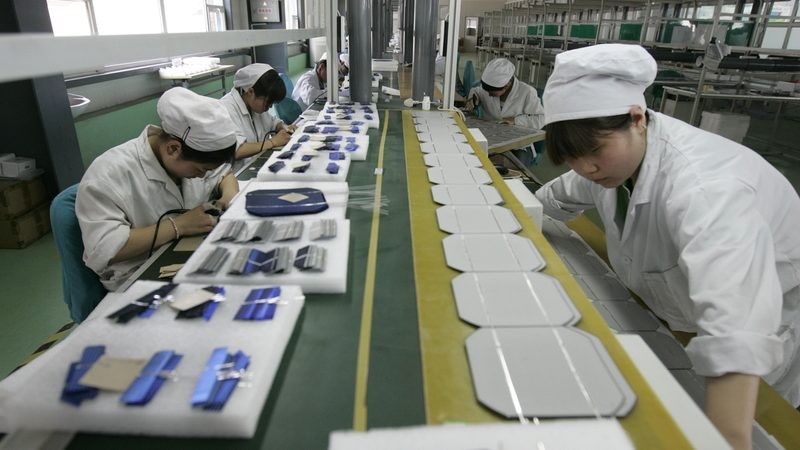
China’s solar panel manufacturing continues to receive heavy state funding, helping it to dominate the global market regardless of short-term market conditions.
State-backed Chinese subsidies averaged nearly 3.2% of annual firm revenues, enabling manufacturers to heavily outinvest competitors and secure over 80% control of the entire photovoltaic supply chain.
This generosity has incentivized Chinese producers to expand manufacturing under any market conditions. China’s annual solar manufacturing capacity has reached approximately 1,200 GW, nearly double the total global installation demand. According to the OECD, this aggressive support has resulted in subsidy-fueled overcapacity and driven the average selling price of solar panels down by 90% over the last decade and a half, often forcing panels to be sold below the break-even point.
But while it may give states more power to wield, the OECD warns that these ongoing, large-scale subsidies are fueling global industrial overcapacity, artificially depressing international prices and undercutting firms that are actually better and more innovative.
And overly generous government subsidies have backfired on Chinese companies before. Whereas the overcapacity and subsequent price cuts have made solar energy highly affordable globally and driven historic deployment records in emerging markets (such as a 176% jump in Chinese module exports to Africa), it has also resulted in severe financial distress, declining profitability and heavy domestic consolidation for Chinese solar companies. To address those problems and maintain some balance, Beijing has begun to phase out support. For instance, the Chinese government reduced and fully abolished the 9% Value Added Tax (VAT) export rebate on photovoltaic products, while battery energy storage systems saw their export tax rebates reduced from 9% to 6%, with a full phase-out expected by 2027.
Meanwhile, Western nations and trading blocs are increasingly trying to come up with ways to keep China’s clean energy hegemony in check with its own incentives. But more often, with retaliation. Most recently, the U.S. unveiled significant levies across China’s renewable sector products, including 50% tariffs on solar cells (whether or not assembled into modules) and strict actions against Chinese steel, aluminum, and advanced batteries. The Trump administration has also announced a 100% punitive tariff on Chinese EVs, making entry into the American market prohibitive. Additionally, the European Commission has adopted definitive countervailing duties of up to 35.3% on BEVs from China, valid for five years. These are applied on top of the standard 10% vehicle import duty.
The uncomfortable reality is that Western economies assumed for decades that private capital, comparative advantage, and open markets would determine the industrial winner. However, China has spent that time building national champions with patient state capital, cheap financing, protected domestic markets, and long-term strategic planning. Tariffs can slow the flow of Chinese products across borders, but little else. The West’s biggest economies now face the choice of whether to try to compete with China on similar terms or whether there is still faith in a private market free-for-all to operate in the national interest.
By Alex Kimani for Oilprice.com
More Top Reads From Oilprice.com
- EU Says No Jet Fuel Shortage Coming Despite Middle East Supply Loss
- UK Conservatives Blast Labour North Sea Ban as ‘Utter Madness’
- Australia’s 344-Million-Barrel Oilfield Could Finally Get the Green Light
Download The Free Oilprice App Today





Alex Kimani
Alex Kimani is a veteran finance writer, investor, engineer and researcher for Safehaven.com.


