


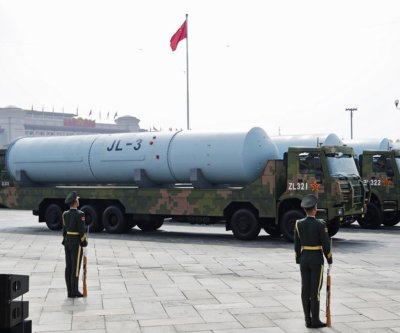
JL-3 intercontinental-range submarine-launched ballistic missiles are seen during a military parade in Beijing, China. Photo by ANDRES MARTINEZ CASARES / EPA
July 6 (Asia Today) — China launched a strategic missile into international waters in the Pacific on Monday, prompting concern from Japan and other regional powers as a U.S. nuclear and missile expert said the weapon was likely a JL-3 submarine-launched ballistic missile.
The People’s Liberation Army Navy said on social media that one strategic nuclear submarine successfully fired a submarine-launched strategic missile carrying a dummy warhead toward the Pacific at 12:01 p.m. local time.
The Chinese military said the missile landed accurately in the target sea area but did not disclose the missile type or the exact impact location.
Wang Xuemeng, a spokesperson for the Chinese navy, said the launch was part of annual military training and that relevant countries were notified in advance.
“The launch complied with international law and international practice,” Wang said. “It was not aimed at any specific country or target.”
China also launched an intercontinental ballistic missile into international waters in the Pacific in September 2024. That test was China’s first ICBM launch toward the Pacific since a Dongfeng-5 launch in 1980. Based on photos later released, analysts assessed the 2024 missile as likely a Dongfeng-31AG, a road-mobile missile capable of reaching the U.S. mainland.
Monday’s launch was China’s first Pacific-oriented strategic missile test in about one year and 10 months.
The Japanese government expressed serious concern over the launch. China notified Japan of the plan in advance and designated areas near Shionomisaki, south of Wakayama Prefecture, as possible falling zones for space debris, Japanese media reported. Japan asked China to reconsider so the launch would not threaten Japanese safety.
The Japanese government said some of the projected debris zones included Japan’s exclusive economic zone, but the missile appeared to have landed outside the zone. It also said there were no confirmed reports that the missile passed over Japanese territory or the exclusive economic zone or that aircraft or ships were damaged.
Chief Cabinet Secretary Minoru Kihara, the Japanese government’s top spokesperson, said China’s military activities are a serious concern because of Beijing’s lack of transparency.
“China’s military trends lack transparency and have become a grave concern for Japan and the international community,” Kihara said.
China’s Foreign Ministry rejected international criticism, saying the launch was a routine military training activity conducted under safety standards and professional procedures.
“We hope relevant countries will not overinterpret the matter,” the ministry said.
In the United States, analysts said the missile used in the test may have been China’s newest submarine-launched ballistic missile, the JL-3.
Jeffrey Lewis, director of the East Asia Nonproliferation Program at the Middlebury Institute of International Studies at Monterey, told The New York Times that the Chinese military most likely tested the JL-3.
The JL-3 is China’s third-generation submarine-launched ballistic missile. It is believed to have a range of more than 10,000 kilometers, or about 6,200 miles, putting most of the world, including the U.S. mainland, within reach.
Submarine-launched ballistic missiles are considered a key part of nuclear deterrence because they are harder to detect than land-based missiles once deployed at sea. China publicly displayed the JL-3 during a military parade in Beijing in September 2025.
Lewis said the test signals that China’s nuclear force modernization has entered a new stage.
“Historically, China has conducted fewer ICBM tests than other countries,” Lewis said. “The reason was political, but the political dynamics have changed, and they seem to be adopting an approach of testing more frequently.”
Lewis said China may conduct more frequent tests of long-range missiles capable of carrying nuclear warheads in the future.
— Reported by Asia Today; translated by UPI
© Asia Today. Unauthorized reproduction or redistribution prohibited.
Original Korean report: https://www.asiatoday.co.kr/kn/view.php?key=20260706010002183