






In a new weekly update for pv magazine, OPIS, a Dow Jones company, provides a quick look at the main price trends in the global PV industry.
China mainstream TOPCon modules held steady for another week as market liquidity remained thin ahead of China’s Golden Week holiday, with market participants reluctant to commit to transactions amid uncertainty over forward price direction toward year-end.
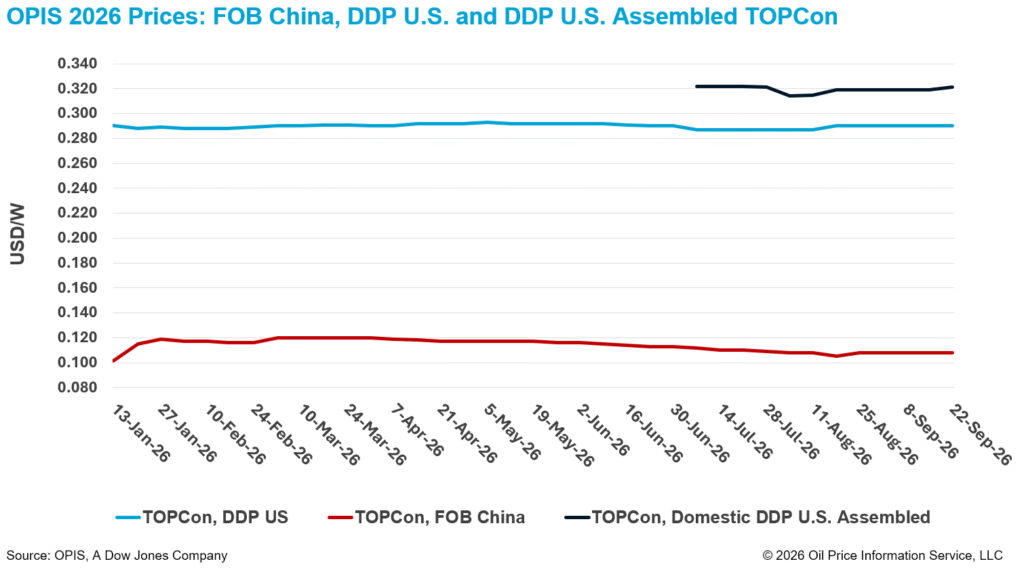
According to the OPIS Global Solar Markets Report released on Sept. 22, the Chinese Module Marker (CMM), the OPIS benchmark assessment for TOPCon modules below 645W from China, was unchanged at $0.108/W Free-On-Board (FOB) China.
Manufacturer offers remained wide-ranging, reflecting differing expectations for prices in the coming months. Industry participants also pointed to continued availability of lower-priced, less-efficient modules as a factor weighing on the overall module market.
Weak domestic installations since the start of the year have further pressured module demand and prices. China’s cumulative solar installations totaled 97.19 GW in January-August, down more than 57.9% from the same period in 2025. August additions totaled 11.04 GW, down 21.6% month-on-month.

Some industry participants said that weak domestic module demand has also made local module prices more sensitive to broader market fluctuations, prompting manufacturers to place emphasis on overseas sales. This shift in focus may explain the relative stability in export module prices, sources said.
Since the start of August, domestic ex-works (EXW) China mainstream TOPCon module prices have risen around 3.4%, while FOB China prices have remained flat.
The forward curve has also weakened over the past few months. OPIS assessed FOB China TOPCon module prices for Q1 2027 loading at a $0.02/W discount to spot prices this week, compared with a slight $0.01/W premium in late June.
In the U.S., imported module spot prices held steady as market participants continued to weigh the impact of Section 232 minimum import prices (MIPs), set to take effect Dec. 4.
Delivered duty paid (DDP) U.S. prices for TOPCon modules 645W and below were unchanged at $0.290/W, with quotes for Southeast Asian cargoes at $0.277/W and Indian cargoes at $0.332/W.
Quotes for U.S.-assembled TOPCon modules with imported cells, delivered on a domestic DDP U.S. basis, rose 0.63% to $0.321/W.
The Section 232 proclamation from early August continued to be reflected in the U.S. forward curve. DDP indications for TOPCon modules in the first two quarters of 2027 were assessed at $0.345/W, compared with $0.29/W in July.
Post-December supplier pricing remained unsettled, however, with a distributor saying the company had yet to receive firm prices as suppliers waited to see how competitors priced their products.
Uncertainty continued over whether the proclamation’s “first arm’s-length sale” rule would subject U.S.-assembled modules using imported cells to the $0.38/W module MIP. In OPIS’s Sept. 15 report, a source at a U.S. manufacturer questioned whether U.S. Customs and Border Protection would accept imported-cell transactions priced at the $0.22/W cell MIP plus the 15% tariff. If accepted, that treatment could allow U.S.-assembled modules to sell below the module MIP, the source said.
A policy source at a major supplier instead anticipated strict enforcement of the new price controls and argued that workarounds would undermine the mandate’s intent.
Views also differed on whether the enforcements would eliminate import demand. The distributor expected demand for imports to disappear, arguing that officials would raise tariff rates further if the announced controls failed to discourage imports.
The policy source, by contrast, believed imports could retain some cost competitiveness even if U.S. assemblers sold modules made with imported cells at $0.38/W, citing slim assembly margins.
For now, an early-stage project developer believed U.S. customers remained in contact with overseas suppliers and expected those discussions to continue while import prices stayed close to U.S.-assembled levels.
Beyond trade policy, the developer expected the industry to go on hiatus for a while after the final safe-harbor push for investment tax credit (ITC) eligibility, saying developers had stopped offering new projects when they no longer believed they could complete them before eligibility expired.
OPIS, a Dow Jones company, provides energy prices, news, data, and analysis on gasoline, diesel, jet fuel, LPG/NGL, coal, metals, and chemicals, as well as renewable fuels and environmental commodities. It acquired pricing data assets from Singapore Solar Exchange in 2022 and now publishes the OPIS APAC Solar Weekly Report.
The views and opinions expressed in this article are the author’s own, and do not necessarily reflect those held by pv magazine.
This content is protected by copyright and may not be reused. If you want to cooperate with us and would like to reuse some of our content, please contact: [email protected].


