



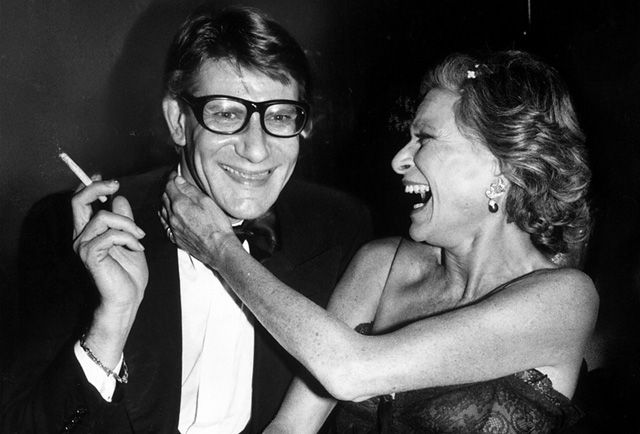
On August 1, Yves Saint Laurent would have turned 90. But more than just an anniversary, this is an opportunity to celebrate the cultural legacy of one of the greatest couturiers of the 20th century. Having passed away in Paris on June 1, 2008, at the age of 71, the designer left behind a stylistic legacy that lives on in his garments, in the writings of his partner Pierre Bergé, and in the places that still honor his memory today—from the Maison’s historic Paris headquarters to the Villa Majorelle in Marrakech, the creative retreat where the genius found inspiration and which he helped preserve alongside Bergé.


YSL, in an undated photo
Reg Lancaster/Getty Images
His impact, today, is not just on the archives of fashion. He also continues to speak to the present through documentaries and retrospectives of collections that scandalized the public, many found in museums that preserve his legacy. Remembering Yves Saint Laurent means rediscovering not just the garments that have become icons, but a visionary who knew how to change the way women dress and, above all, the way we express ourselves through what we wear.
Here are five ways to celebrate his genius 90 years after his birth.
1. Watch a YSL-focused documentary or biopic
More than just a fashion documentary, L’Amour Fou is a portrait of the man behind the legend. Directed by Pierre Thoretton, the 2010 film follows Pierre Bergé in the months following Yves Saint Laurent’s death and retraces their love story through the extraordinary art collection they built together. But it is also an essential document for understanding the couturier: his perfectionism, his vulnerabilities, and his relationship with creation and haute couture. Through archival footage, behind-the-scenes glimpses of the collections, and intimate testimonies, it reveals the human cost of creative genius. For fashion lovers, it remains one of the most profound documentaries ever made about a fashion designer.


Courtesy of The Weinstein Company.
A few years later, in 2014, director Jalil Lespert worked with Bergé to create Yves Saint Laurent, a fictionalization of the designer’s life and times. Bergé lent the filmmakers 75 ensembles, giving it an air of authenticity that remains unparalleled. It’s available to rent on most streaming platforms.
2. Follow the traveling exhibitions (while waiting for the reopening of the Musée Yves Saint Laurent Paris)
The museum, housed in the historic atelier on Avenue Marceau, is closed for a major renovation and expansion project and will reopen in the fall of 2027. The work will double the exhibition space and open areas previously inaccessible to the public—such as Pierre Bergé’s office—as well as a new documentation center.


Yves Saint Laurent’s atelier, reconstructed inside the Musée Yves Saint Laurent Paris.
BERTRAND GUAY/Getty Images
In the meantime, the Foundation continues to showcase the world of Saint Laurent through exhibitions organized at other institutions. Among the events not to be missed is “Yves Saint Laurent and Photography,” on view at the International Center of Photography in New York through September 28, 2026. The exhibition explores the relationship between the couturier and photography through more than 300 images, archival materials, and photographs by the great photographers of the 20th century who helped shape the Maison’s legacy.
At the same time, through September 28, 2026, the Musée Matisse in Nice is hosting “Henri Matisse – Yves Saint Laurent,” an exhibition dedicated to the dialogue between two revolutionaries of color. Through approximately 160 works—including haute couture garments, paintings, drawings, fabrics, accessories, and archival documents—the exhibition explores the deep connection between the artist and the couturier.
3. Read Yves Saint Laurent: The Scandal Collection, 1971
On January 21, 1971, Yves Saint Laurent presented his Spring-Summer Haute Couture collection. The result was a scandal. Mini-dresses, sky-high wedges, padded shoulders, bold makeup, and explicit references to the fashion of the Nazi Occupation years. The press called it “the ugliest collection in Paris.” The scandal was enormous, but short-lived: within a few seasons, that very aesthetic took over the streets, ushering in the vintage revival phenomenon and proving once again that Saint Laurent was always one step ahead of his time.
Yves Saint Laurent: The Scandal Collection, 1971 is the book that reconstructs this story through archival photographs, sketches, fabric swatches, newspaper clippings, and firsthand accounts. It is an essential book for understanding how a collection that was initially rejected became one of the most influential in the history of fashion.
4. Read the graphic novel that tells the story of the Le Smoking revolution
Among the most interesting publications of 2026 is The Yves Saint Laurent Revolution: The Story of ‘Le Smoking’, a graphic novel published by Thames & Hudson last February, which traces the creation of one of the most revolutionary garments of the 20th century. Through the illustrations of Benjamin Flao and the figure of Betty Catroux, the designer’s muse and friend, the book traces the moment when a simple black suit changed women’s wardrobes forever.


Betty and François Catroux at their Paris apartment, 1970.
By Horst P. Horst/Condé Nast Archive/Getty Images.
When Yves Saint Laurent presented “Le Smoking” in 1966, women wearing pants was still considered inappropriate in many social contexts. He, however, envisioned a new concept of elegance: an impeccable jacket, satin lapels, and clean lines. Not merely a garment inspired by men’s fashion, but a true manifesto of emancipation. As the designer himself stated: “Chanel liberated women; I gave them power.”
5. Rediscover the Mondrian Dress
To understand just how prescient Yves Saint Laurent was about the future of fashion, one need only look at a single dress: the Mondrian Dress. Presented in the Fall-Winter 1965/66 Haute Couture collection, it remains one of the most famous garments of the 20th century. You don’t need to visit a museum to admire it: it’s available online in the digital collections of institutions such as the Kyoto Costume Institute and through the Google Arts & Culture archives.


The famous Mondrian Dress.
PIERRE VERDY/Getty Images
Its apparent simplicity is actually a masterpiece of sartorial construction. A sheath dress featuring geometric sections in red, white, and black outlined by dark lines, inspired by the famous compositions of the Dutch painter Piet Mondrian. Saint Laurent did not merely reproduce a work of art on fabric: he transformed pictorial abstraction into a three-dimensional form by assembling panels of colored jersey. It is no coincidence that the designer, a great art collector, also owned works by Mondrian. For him, fashion was never a world separate from culture, but an aesthetic language in constant dialogue with art. And today, the legend continues.
Originally published by Vanity Fair Italy
-
Andrew Tate Was the Toast of Trumpworld. Has That Changed?
-
Inside the 30-Year Fight to Release Whitney Houston and Brandy’s Cinderella Soundtrack
-
The 10 Biggest Odyssey Updates From Homer’s Original Text to Christopher Nolan’s Latest Film