


It’s easy to go down a Carolyn Bessette-Kennedy rabbit hole after watching Love Story: John F. Kennedy, Jr. & Carolyn Bessette these last few weeks. Did the couple really meet at a fundraiser with Calvin Klein? Where did their big fight in the park happen? Did Carolyn’s mother, Ann, really give that speech at their rehearsal dinner?
Many of these stories can be answered by doing a comprehensive Google search, but there are others that we’ll never know the answer to. For instance, would John have run for political office? Would he and Carolyn have had a family? Would they have stayed together?
But there’s one question that hasn’t even really been brought up and it seems glaringly overlooked: Given the intense paparazzi camped outside Carolyn and John’s apartment, why didn’t they move to a more private building once it became obvious the attention wasn’t about to let up?
“We talked about this ad nauseam in the room,” Love Story creator Connor Hines tells Glamour. “Why not just move?”
In Love Story‘s seventh episode—titled “Obsession” and written by Hines—the show jumps ahead two months after the newly-named Carolyn Bessette-Kennedy and her husband have returned from their honeymoon, and it’s clear their situation is no paradise. The paparazzi have set up shop 24/7 outside their apartment on 20 North Moore Street, and they want to know why Carolyn hasn’t been seen in a week. (To answer their own question, how about the fact that eight weeks earlier, John specifically asked them for privacy and grace now that Carolyn was no longer a private citizen?)


The actual Daily News front page from Monday, Oct. 7, 1996.
New York Daily News Archive/Getty Images
As the episode progresses, Carolyn becomes more withdrawn, and tells her sister, Lauren, that she can’t go anywhere without attracting a circus. She’s asked about baby plans ad nauseam; her every outfit is scrutinized for signs of a potential bump. And when Carolyn chooses to ignore the paparazzi stationed outside her home, she’s often called derogatory names.
Glamour‘s digital director, Perrie Samotin, grew up down the street from John and Carolyn in Tribeca, and saw them regularly. Samotin says it’s important to understand that the Tribeca of today is completely different from the TriBeCa (as it was then spelled, to clearly indicate Triangle Below Canal Street) from the ’90s.
“The paparazzi situation barely existed for him in the neighborhood,” Samotin says. “It metastasized only once the ‘most eligible bachelor in the world’ got serious with Carolyn—which, in retrospect, feels deeply sexist. As soon as she started visiting, and later moved in, things turned feral.”
While Love Story takes creative liberties with John and Carolyn’s private moments, it’s hard not to imagine a situation in which Carolyn didn’t break down (heartbreakingly executed by Sarah Pidgeon, who plays Carolyn in the episode) and feel she wasn’t cut out for this. The flirty and charismatic Carolyn that viewers saw in earlier episodes is now a shell of herself; a caged-like animal trapped in a reality that no one saw coming, least of all her husband.
“Intense media interest and scrutiny was just part of his life—so he had trouble relating to Carolyn and her experience being thrust into the spotlight,” Caroline Hallemann, author of the forthcoming book, The Kennedys and the Windsors, and an editor at Town & Country, tells Glamour. “He thought she would come to terms with the press and would learn to deal with photographers in her own way, just as his mother did, but she really struggled. There wasn’t a playbook for her to follow. She didn’t get training in how to be Mrs. Kennedy. And of course we can’t know, but you have to wonder how Jackie would have helped Carolyn navigate life in the public eye if she had been alive to see her son get married. John was also naive in thinking that the press would scale back their coverage after the wedding; he thought, Okay, if I’m no longer America’s most eligible bachelor, the story starts to fade. But, in reality, interest in both him and Carolyn only escalated.”


John F. Kennedy Jr. and Carolyn Bessette-Kennedy in March 1997 on their way to a gala.
Ron Galella/Getty Images
While researching and writing the show, Hines often thought about the questions he’d most like to ask Bessette-Kennedy. For one, what does a sustainable life with John look like? “I don’t think it would be living in that Tribeca apartment anymore,” Hines says. “It’s funny, because she loved the city so much, but I think she was in desperate need of a retreat for herself. As you see in the show, if they weren’t in Tribeca, they were often at Jackie’s house in Martha’s Vineyard or the Kennedy compound. And it’s almost like everywhere she went, even as an escape from New York, she was still immersed in all things Kennedy. So I’d love to know, ‘What would be your idea of a safe haven from all of this?’”
Ironically, Tribeca was supposed to be that safe haven. Samotin was a pre-teen when John and Carolyn started dating, and back then she says the neighborhood wasn’t glossy, showy, or celebrity-packed. “It was a slightly desolate, underdeveloped, quirky-cool pocket of Lower Manhattan south of Canal Street that drew artists who could still afford industrial lofts, bohemian types, and people who preferred living quietly. It made perfect sense for John to live there: he’s long been upheld as a down-to-earth New Yorker who rejected the pomp and gilded expectations of the Upper East Side, where his family lived.”
Plus—and this is hard to believe now—local residents let John go about his business like he was anyone else. “I was too young to fully appreciate it (tragic, in hindsight), but we’d see him eating in one of the few local coffee shops or pubs, biking around with a newspaper tucked under his arm, and nobody bothered him,” Samotin recalls. “You could absolutely live there without being constantly surveilled. If you didn’t live in TriBeCa, there were very few reasons to go. At one point, we had to drive to another neighborhood on Saturday nights just to get the Sunday Times—there were literally no newsstands or delis.”


John F. Kennedy Jr. and Carolyn Bessette-Kennedy at the 2nd anniversary party for George.
Ron Galella/Getty Images
There were also no cell phones—at least not ones with cameras—and no social media. Any pictures that the paparazzi took would normally take another day to wind up in the papers. And the only reason there would likely be a video camera there was if John was going to make an announcement, as he did when returning from his honeymoon and asking for the media to go easy on Carolyn.
“He could handle the paparazzi—and he hoped Carolyn would learn how to as well,” Hallemann says. “He was one of the most famous people in the world, but he carved out a somewhat ordinary life in the city, and I think he would have hesitated to give that up.” Plus, Hallemann says that since John grew up with Secret Service, he didn’t want the constraints or the attention that came with having a bodyguard once he was old enough to be on his own. “And despite Carolyn’s negative experiences with the paparazzi, some of her friends have said that she wouldn’t have wanted that either. Having someone with her all the time would have felt like a different kind of intrusion on her life and her privacy.”
All fair points, of course, but when it was obvious that the paparazzi became too much (and it would only escalate, as episode 8, titled “Exit Strategy,” shows), why didn’t the couple move to a new place in the city with both 24/7 security, and most importantly, an underground/private entrance?
“I know,” Hines acknowledges. “I think I would surmise that in John’s mind, he was like, ‘Nothing’s going to change how famous we are. The only thing that can change is our attitudes about the fame.’ And I think that’s a perfectly reasonable perspective, but I think in Carolyn’s mind, she was like, ‘But if we can make even an iota of a difference in our lives, why don’t we try?’”
You could also make the case that John was afraid to ‘give up’ the paparazzi. As someone who needed public support for his own endeavors (namely, George), and was likely going to run for office one day, he didn’t want to take all accessibility away either.
Hallemann agrees. “John’s relationship with the press was complicated. He had boundaries and was willing to enforce them, but he was also friendly with photographers, with gossip columnists. He saw the press as an unavoidable part of his life, and he was hopeful that, eventually, their relentless pursuit of Carolyn would calm down. Perhaps, he thought it was something they could deal with until it got better.”


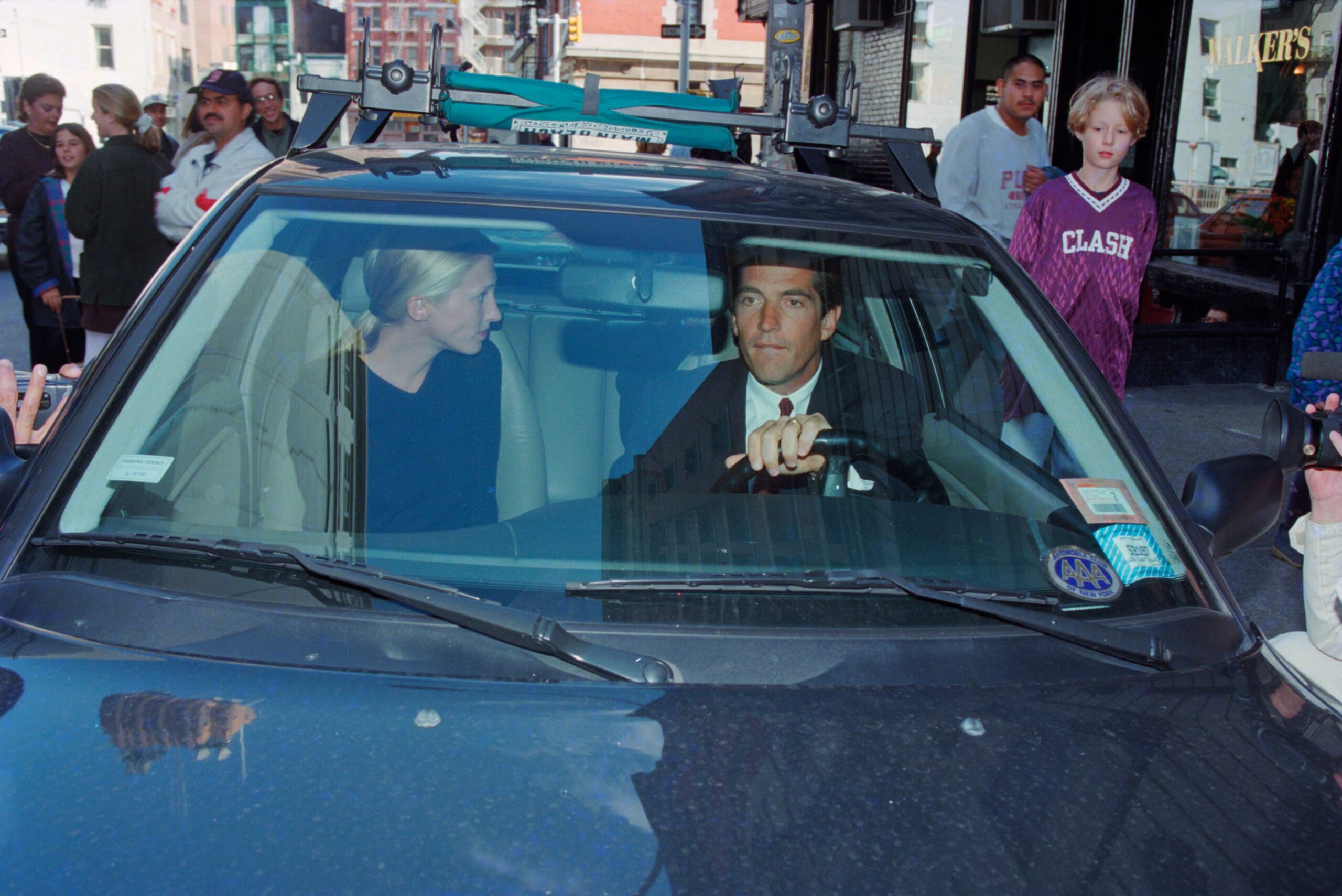
The couple leaving their Tribeca apartment for a gala in this undated photo.
Lawrence Schwartzwald/Sygma via Getty Images
Samotin points out that while they could have moved to a doorman building, it would assume privacy was still an option somewhere else in New York. And it wasn’t. “The paparazzi would have camped out wherever they landed. John also strikes me as someone who valued continuity and community—who genuinely loved where he lived. They didn’t stay because they were careless. They stayed because TriBeCa used to be a refuge and a genuinely cool part of New York City. Once he committed himself to Carolyn, I’d argue that anywhere they lived would have become just as unsafe.”
Of course, had that fateful flight in July 1999 not happened, it would have made sense to at least explore moving to a more private building, even if it ultimately wouldn’t have solved the intense scrutiny.
“What’s really unique about their marriage is that most times when a civilian marries a celebrity, the celebrity used to be a civilian, so they have a perspective of what it’s like to lose your anonymity,” Hines says. “But to marry somebody that only knows fame, that only knows being gawked at, being photographed, that’s somebody that actually can’t understand what it’s like to not be famous. I think that was a problem that’s so unique to the two of them versus other high-profile couples that lived anonymous lives at some point.”


President and Mrs. Kennedy and their two children, Caroline and John, Jr., watch from the balcony as the Black Watch Royal Highland Regiment performs on the White House lawn.
Bettmann via Getty Images
But the one thing everyone can agree on is that Carolyn deserved more help, even if John couldn’t be the one to give that to her. “I think it’s clear, at least in hindsight, that she needed more support,” Hallemann says.
For more on Love Story, you can read Glamour’s coverage here.