






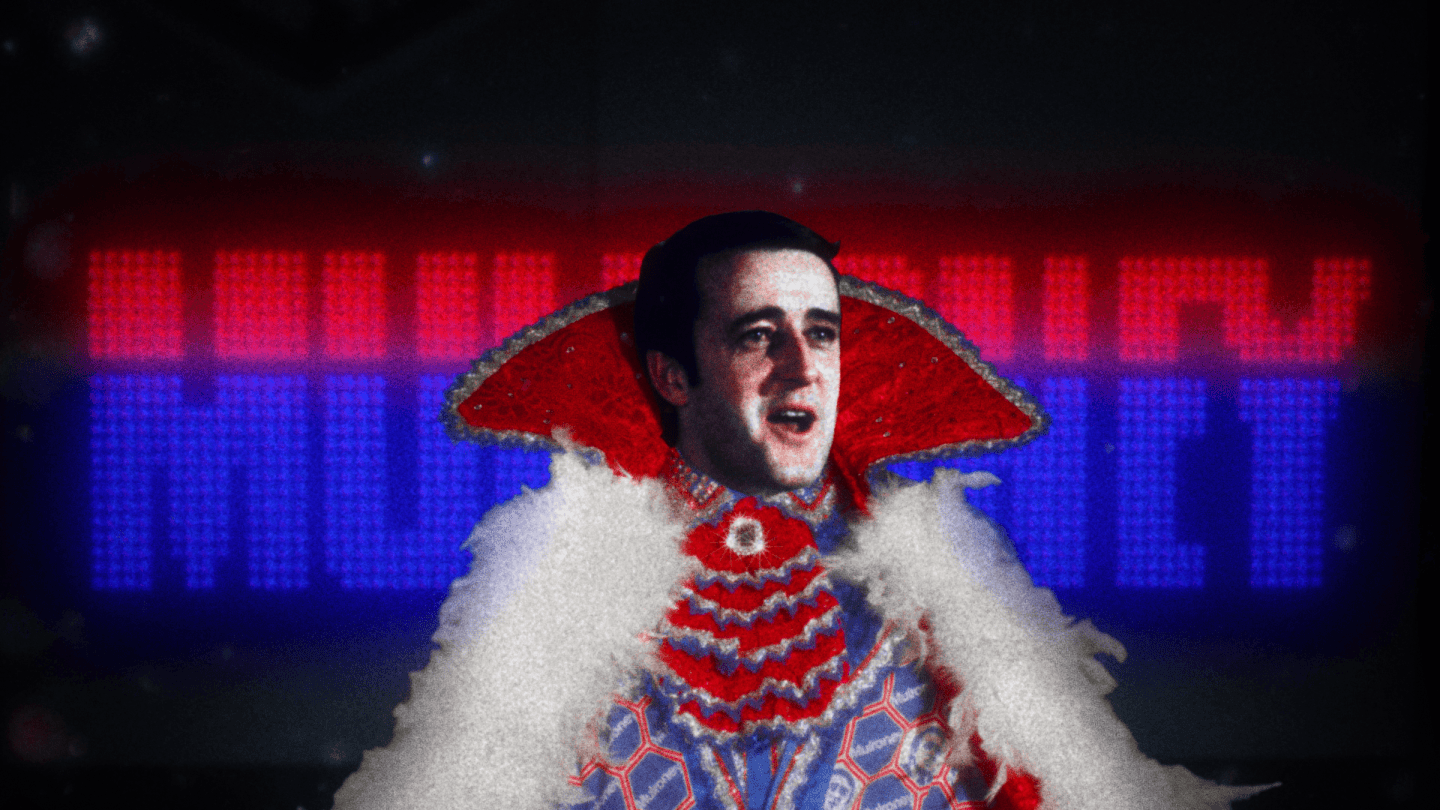
Matthew Rankin’s films about Canadiana tend to have theatrical audiences rubbing their eyes.
In his 2024 cinematic mashup Universal Language, marveling viewers could hardly believe a Canada onscreen where Persian and French are the two official languages and a local Tim Hortons becomes an Arabic tea lounge.
With Ladies and Gentlemen, Brian Mulroney — set for its world premiere on Sept. 15 as part of the Midnight Madness program at the Royal Alexandra Theatre in Toronto, Rankin’s genre-bending collage of archival footage, special effects and animation becomes a digital docufantasia of politics and pop culture, chronicling the journey to power for Canada’s 18th prime minister, Brian Mulroney.
Rankin tells The Hollywood Reporter that his English- and French-language film looks to combine the two things his producer, the National Film Board of Canada, does best: documentary and animation. The result is a kaleidoscopic manipulation of moving images, backed by abstract language about the generational machinations of the then-Progressive Conservative Party over which Mulroney ultimately triumphed to become Canadian PM in 1984.
“I don’t think of [the film] as a biopic. It’s the history of an image, how that image was created and how to mobilize his story to create a brand, to create a package that would ultimately become the brand of the Conservative Party,” Rankin explains.
His fever dream of political maneuvering north of the border portrays ambitious men campaigning for power less as a series of contests by candidates seeking public office and more like TV wrestlers seizing the championship belt by unseating rivals after brutal title matches and aggressive storylines.
“It’s like a blood sport,” the director says of the political environment that produced the joyfully combative Mulroney, who in one mixed-media collage wears a sequined and feathered robe like the ones boxers or professional wrestlers don to enter the competitive ring.


‘Ladies and Gentlemen, Brian Mulroney’
Toronto Film Festival
Behind the surface charm and inner furnace of ambition, Rankin portrays a Mulroney haunted by the early success of John Diefenbaker, Canada’s 13th prime minister, and the disembodied voice of Pierre Elliott Trudeau, another Canadian leader and father of the 23rd Canadian PM, Justin Trudeau. And as he won over Canadians, the director captures how Mulroney accomplished the Progressive Conservative dream: winning over Quebec, uniting a fragmented country and delivering economic gains coast to coast.
“The Conservative Party is a bizarre coalition,” adds Rankin. “Mulroney had to unite disparate factions like disappointed Quebec separatists, Alberta rednecks and elderly ladies in Atlantic Canada, in addition to business leaders in Toronto and environmentalists on the West Coast.”
The film also has a distinct parallel to today: the eventual fracturing of the Mulroney coalition led to the current Canadian political landscape, where Quebec and Alberta have separatist movements and the Conservative Party has moved further to the right than the former Progressive Conservatives.
“The whole idea of the political center is more and more problematic, more and more tense, and this film does set a compass to where the center was 40 years ago,” Rankin argues.
“Certainly, conservatism meant something very different in 1984 than it means in 2026. Donald Trump didn’t emerge out of the ether. There was a process at work, and it began then,” he adds.
Rankin portrays that triumph over Canada’s political center ground by combining found footage with music and cultural elements because the director, like most Canadians back then, came to know Mulroney as a creature of TV.
“He was the first to really create a sophisticated propaganda by seeing the potential in television and the packaging of his message in television. He really delivered,” Rankin insists. And to show Mulroney as the triumph of political performance over policy, the film blends archival footage, 16mm animation, pixilation and other experimental filmmaking techniques to play with vintage footage like analog-era TV commercials, political propaganda, as well as campaign buttons and brochures.
In all, Rankin remixed and reimagined around 80,000 pieces of archival material to arrive at a portrait of Mulroney that is more video art installation than sober political biopic.

‘Ladies and Gentlemen, Brian Mulroney’
Toronto Film Festival
In one scene, Rankin offers an animated train steaming ahead with the giant brain of Diefenbaker as cargo, in an echo of fellow surreal Winnipeg director Guy Maddin and his use of brain models and motifs in films like Brand Upon the Brain! and Rumors.
The director puts that satirical take on Canadian conservative politics down to his upbringing in Winnipeg. “The way I look at a thing, I always end up sort of seeing the thing and its opposite simultaneously,” Rankin explains. “Winnipeg is a very ironic place to live. It’s full of contradictions and hypocrisy and bizarre tensions, and when you live in a place like that, things become funny.”
The same double vision extends to the film’s subtle nods toward current U.S.-Canada tensions: In archival footage, Diefenbaker is seen meeting U.S. President John F. Kennedy, while Rankin scrolls at the bottom of the screen “51st State?” while Diefenbaker, in a thought bubble, thinks, “Yankee go home.”
Rankin’s visual layering and collage wastes little time in showing Diefenbaker and other Conservative Party politicians falling out of favor with Canadians, only for Irish Catholic Mulroney — famed for singing “When Irish Eyes Are Smiling” off-key — to emerge from the wings and win power in an eventual landslide, at a time when like-minded conservatives like Margaret Thatcher led Britain as prime minister and Ronald Reagan sat in the White House as the U.S. president.
In the end, Rankin’s Ladies and Gentlemen, Brian Mulroney chooses neither a hagiography or a curb-stomping critique, instead portraying an ambitious, risk-taking politician who managed to charm Canadians until he fell out of favor at the ballot box.
For Rankin, the moral murkiness is the point.
“I feel when we see Mulroney being kind of duplicitous or ruthless or superficial or whatever, these things that are typically lobbed at him honestly make me like him a little bit more.”


