

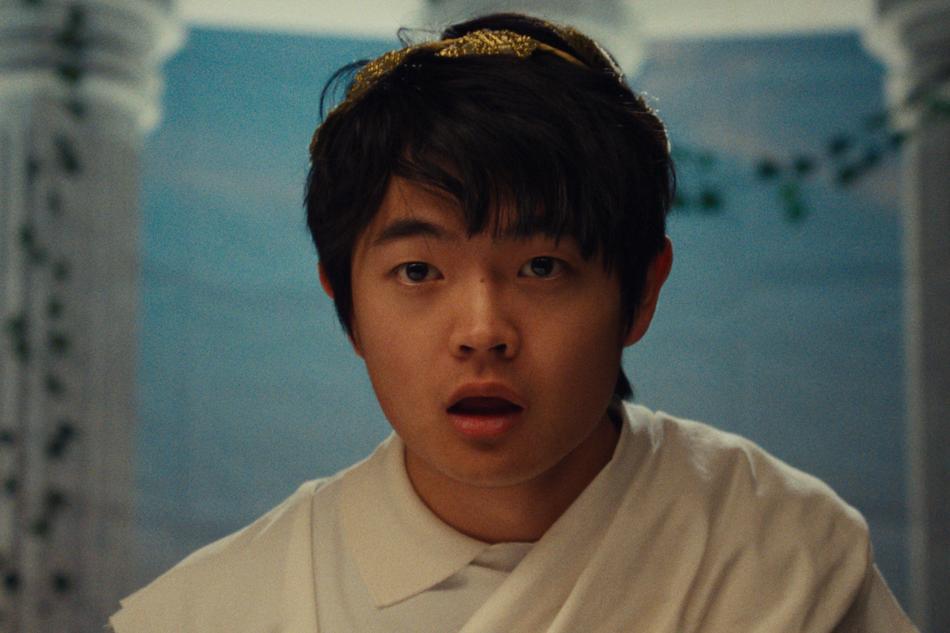
Whether for relatability, or digestibility, the American coming-of-age genre tends to focus on broadly awkward characters with mild social anxiety. Will Ropp’s feature debut “Brian” makes that idea more specific and turns it up to 11, with a teenage protagonist whose mental health issues cause not infrequent outbursts, and who maintains a keenly self-aware sense of self-loathing. That sounds like a recipe for gloomy melodrama, and the film does get serious on occasion, but “Brian” is also one of the most relentlessly, darkly funny films of its kind.
This is thanks in no small part to screenwriter Mike Scollins, whose monologues for Seth Meyers seem to have carried over in the form of rapid-fire punchlines — the comedy is brisk and to-the-point — and to lead actor Ben Wang, who creates a memorable, multi-dimensional loner you can’t help but love, hate, and cringe at all at once. The result is a movie that ought to be mentioned in the same breath as recent high school landmarks like “Eighth Grade” and “The Edge of Seventeen.” It follows a maladjusted 17-year-old, Brian (Wang), who messes up a drama club audition and counterintuitively runs for class president to be closer to his attractive teacher, Miss Brooke (Natalie Morales), a scheme that catalyzes the unraveling of his already unstable social life.
Popular on Variety
Brian’s troubles begin at home, with a popular older brother, Kyle (Sam Long Li), who bullies him playfully but relentlessly, taking advantage of his perturbed reactions. Anytime Brian is alone, he’s usually muttering under his breath, or flipping off invisible people; in his own words, there’s “a lot” wrong with him. Wang’s performance makes an immediate impact, with a high-pitched voice, twitchy gesticulations, and the avoidance of eye contact, all of which, in the hands of a lesser actor, could’ve come off as mockery of neurodivergence. Wang, however, projects each of these choice from deep within, crafting a character who’s both uncomfortable with his reactions to people, emotions and external stimuli, but is, at this point in his life, also unfortunately used to his discomforts, and begrudgingly accepts them.
Everyone around him seems to have their own protocol for his emotional episodes too. This allows Brian, his acerbic parents (Randall Park, Edi Patterson) and his kindly therapist (William H. Macy) to joke around and laugh with him about his litany of issues — as opposed to laughing at him — which grants an immediate sense of normalcy to even his prickliest moments. Most of his classmates, however, aren’t so kind, and they poke and prod at him about his obvious crush on Brooke, if only to watch him erupt in anger. However, a new student, the friendly, effortlessly charming, outwardly queer Justin (Joshua Colley) immediately befriends Brian, confusing him as to why anyone would want to actually spend time with him in the first place, given how the other kids tend to treat him.
A layman might assume Brian is on the autism spectrum (in addition to issues that cause frequent panic attacks), but film never gives a name to his diagnosis. However, its writing process involved putting the script in front of actual child therapists to ensure its verisimilitude, so rare are the moments (if any) when Wang’s performance doesn’t feel rooted in the familiar. What ends up being funny about Brian isn’t just that he keeps putting his foot in his mouth, but that each faux pas comes from a place of discernible anxiety. It’s a clear (if wobbly) mirror.
Films laden with this many jokes per minute can come across as try-hard if they aren’t well-modulated. However part of that modulation in a case like this is, paradoxically, recognizing Brian’s own try-hard nature, as someone who knows he struggles to fit in, but tries to join conversations before crashing and burning on a daily basis. It’s a difficult tight-rope to walk, but Ropp and Scollins never tip over into the mean-spirited.
There’s a tremendous sweetness to the film and its central relationships, but the banter ping-pongs swiftly between the intimate and the darkly absurd. You’ll seldom find a high school movie loaded with these many jokes about school shootings, but they’re situationally appropriate (as much as such a thing can be). If nothing else, they’re the natural endpoint of a culture that refuses to deal with the gun epidemic in any more useful a manner; it’s a surprise that gun massacres aren’t a more frequent topic of conversation in films like these.
Ropp’s tonal balance is greatly assisted by his steady, unobtrusive hand, and by some particularly seamless comedy editing by Anisha Acharya, who also edited one of this year’s most devastating dramas, the Sundance breakout “Josephine.” The underlying principles, however, appear to be the same: cutting for maximum impact without ever letting the cuts themselves intrude upon the actors’ natural rhythms (which, in this case, involves button after button of hilariously improvised punchlines, especially by Park).
Wang is the focus of practically every scene, but he meets this challenge with aplomb, creating a young character at the mercy of his own neuroses who also remains immediately empathetic, even if he isn’t always likable. Years of rejection have hardened Brian to other people, but letting them back in, and learning to be a good friend, are what ultimately define his delicate journey, far more than anything relating to his run for student government. That’s just a conduit for the more important and longer-lasting facets of the movie’s story, in which an isolated character is constantly around other people, for better or worse, and can seldom stand to be around himself. That such a hefty topic can be used to create such breathless, eye-watering comedy without tipping into self-indulgence — and without robbing the film of its most meaningful drama — is practically a miracle.
