






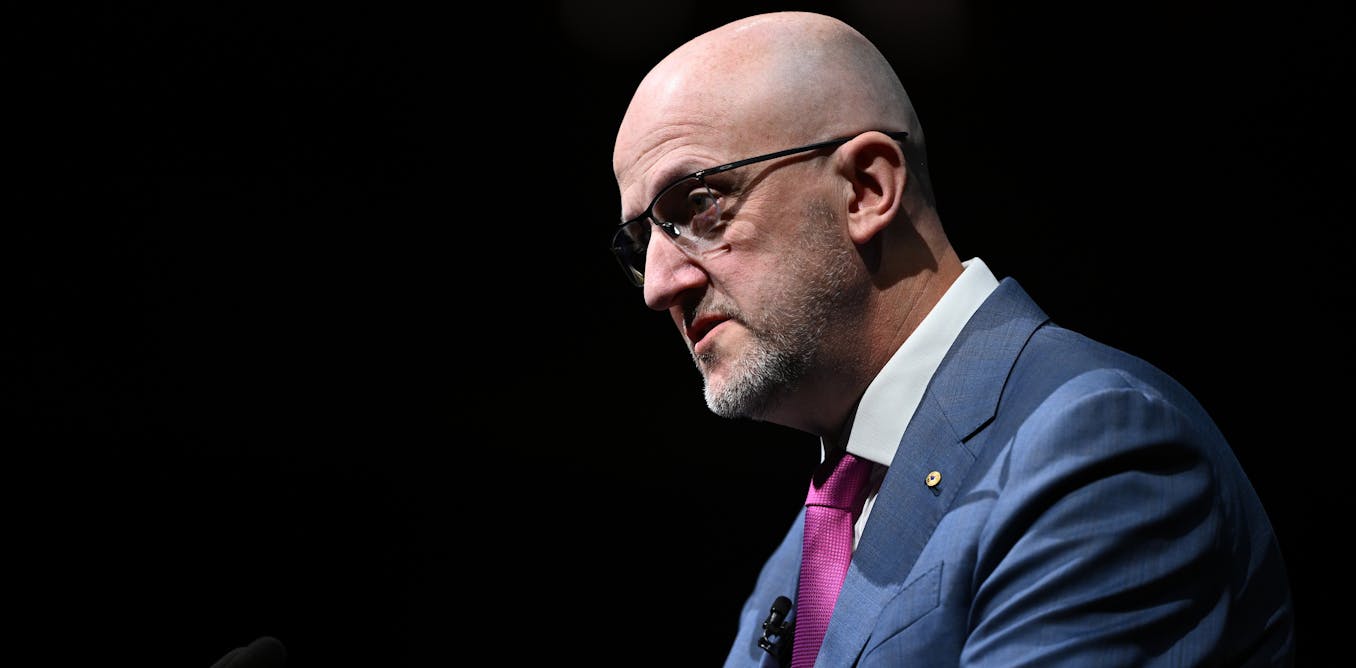
A former Australian resident living in Iraq directed the attack on Melbourne Adass Israel Synagogue in December 2024, the head of ASIO Mike Burgess has revealed.
Burgess said Iran, which was behind the attack, recruited the man through a “complex web of Iraqi-based militia groups”.
“Valuing his high wealth and criminal connections, the IRGC (The Islamic Revolutionary Guard Corps) protected him and supported his illegal enterprises.
“That changed dramatically after ASIO publicly named Iran’s involvement in the arsons.
“This person’s Iranian backers lost their enthusiasm, and after further pressure from Australian and local law enforcement, they threw him in prison.”
Burgess gave the details while delivering his Annual Threat Assessment speech on Wednesday evening. He also said an Iran-based Australian citizen orchestrated the firebombing of the Lewis Continental Kitchen in Bondi in October 2024, which was the “the first major attack in the summer of antisemitism”.
“This person is a senior agent of the IRGC Qods Force, running its networks around the world.
“We know more about him than he realises, including the name of his superior in Iran and the department he works for. Department eleven-thousand, a covert unit within the IRGC Qods Force, is responsible for coordinating operations in the West.”
Burgess said he couldn’t name the individuals because of the need to protect continuing investigations and related prosecutions.
“But I want them to understand this: we know who you are, we know what you’ve done and we know who you work for.”
On antisemitism generally, Burgess said it was often seen through a narrow lens. But it could come from “diverse sources simultaneously, challenging traditional definitions, assumptions, and approaches”.
Sadly, and illogically, hatred of Jews is one thing virtually all the violent extremist cohorts have in common. Neo-Nazis are antisemitic. Islamic extremism is antisemitic.
Issue-motivated extremists can be antisemitic, particularly when they subscribe to conspiracy theories and stereotypes about the Jewish community.
Nation states can be antisemitic, as we saw with the arson attacks against the Jewish communities in Melbourne and Sydney perpetrated by criminals directed by Iran’s Islamic Revolutionary Guard Corps.
Anarchists and revolutionary groups can be antisemitic.
He said Australian companies seen to have links to Israel were being targeted with “repeated acts of vandalism and arson by far-left activists”.
“My point is that violent antisemitism is not a single, or simple, intelligence problem.”
The firebombing of a synagogue “can simultaneously be criminal arson, foreign interference, the promotion of communal violence and politically motivated violence”.
“And when Iran directs the arson, it’s an act of state-sponsored terrorism.”
Burgess once again stressed the degrading of Australian’s security environment. “Great power competition is driving an insatiable appetite for strategic advantage. As a result, espionage and foreign interference are at extreme levels, while preparation for sabotage is growing in scale and sophistication.”
“At the same time, politically motivated violence – which incorporates terrorism – remains an acute concern.”
Burgess said the degrading security environment was marked by “concurrent, cascading, and compounding threats” which could be categorised as “threats to life” and “threats to our way of life”.
In a speech filled, as usual, with case studies, Burgess related the story of a person subjected to “an unrelenting campaign of intimidation” by a foreign regime that for a decade had demanded he return to his place of birth to address unspecified corruption investigations.
The harassment included detaining the man’s relatives living overseas, interrogating them and subjecting them to travel bans.
“After receiving a desperate plea from one of the detained relatives, a family member based in Australia tried to sort things out.The family member flew to the foreign country to meet the regime’s. They interrogated the traveller for hours, and bluntly stated the individual would only be allowed to return to Australia after agreeing to maintain phone contact with the regime and file reports on the target of the harassment.”
Burgess said ASIO knew of five regimes that targeted Australians with harassment, with one country particularly active.
“In 2023 alone, that country coerced at least eight individuals to leave Australia for the place of their birth. Five were Australian citizens or permanent residents. Three never returned.”
Burgess said Australia’s defence captivities, especially AUKUS, were priority targets for foreign intelligence services.
“A spy from a foreign intelligence service approached an Australian security clearance holder online, pretending to be from a consulting company.
“The spy paid the official to write two reports on Australia’s relationship with our Pacific neighbours, and then, thinking he’d been hooked, offered money for inside information on AUKUS. The foreign intelligence service wanted insights on the progress of Pillar 1, the technologies of Pillar 2, the amount of money being invested, Australia’s geo-strategic ambitions, relations between the three AUKUS governments and the likely trajectory of Australian public opinion.
“I’m pleased to report the clearance holder became suspicious and reported the contact.”
Burgess also said nation-state hackers had compromised the network of a critical Australian infrastructure provider. They were apparently preparing for sabotage, mapping out the network so it could be later crippled.
“Cyber sabotage is an evolving threat, and I have established dedicated teams to counter it. As ASIO’s understanding grows, so does our level of concern.
“The scale of this activity – led by one nation state in particular – is difficult to overstate. You’d be surprised how extensive our warrant coverage is. We struggle to find a single country in our region that has not been compromised by this state’s cyber apparatus.”
He said critical infrastructure in energy and communication as well as that supporting the military were “top targets”.
“In this case, a state-sponsored group didn’t just achieve access to the Australian critical infrastructure provider, it successfully acquired credentials – log in details and passwords – for active users of the networks, including the IT professionals guarding it.”
Burgess struck a defensive note when talking about ASIO’s counter terrorism activity in recent times, which can be read as a response to criticism that the organisation had not given counter terrorism sufficient priority.
“Even when surging espionage and foreign interference demanded more attention, countering terrorism remained a priority – as I stated publicly in ASIO’s 2022 Annual Threat Assessment.
“We increased CT resourcing when we raised the threat level in 2024 and it continued to grow in the months before Bondi. Resourcing followed the threat.
“The number of ASIO officers working on our counter-terrorism mission in 2025 was almost double the number from 2005.
“That reflects a bigger ASIO but also an on-going commitment to leave no known serious threat untreated.”
But he said in the new terrorism environment, even a “vast army” of ASIO officers might not be enough “to find an individual who’s been radicalised online and uses encrypted communications”.


